
Monkey Bars — a step-by-step lesson for grown-up and child
This lesson teaches the monkey bars — hand over hand across the sky — and its kindest secret: letting go and dropping safely is part of the skill, not a failure of it.
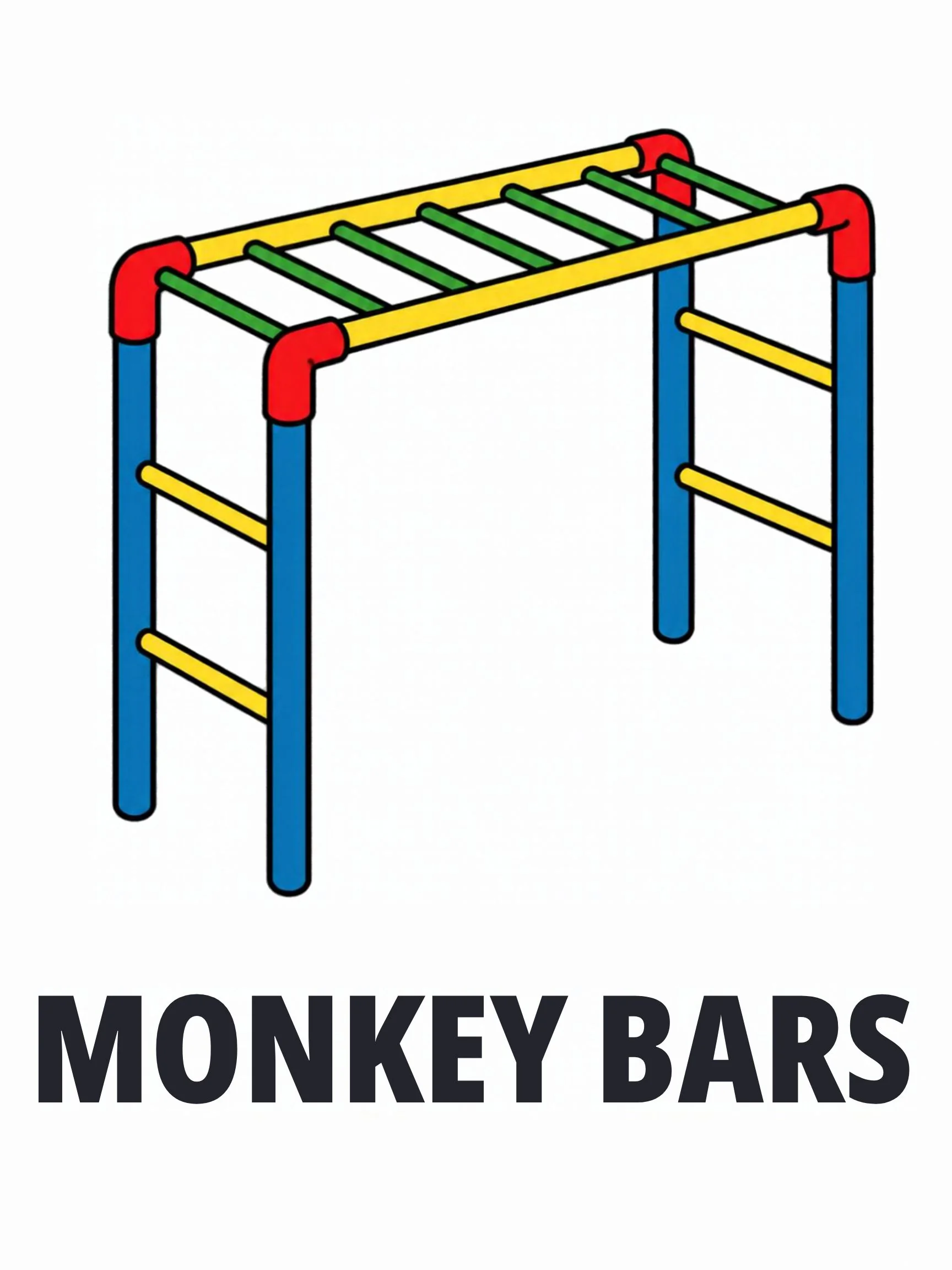
What is this?
Monkey bars are a row of overhead rungs: hands grip, the body hangs, and one hand at a time flies to the next rung — hand over hand, swing and reach, across the sky.
What does it mean?
The bars are the playground’s strength test and its courage test — and the honest rule is that grip gets tired: knowing the safe drop (bend knees, land on feet, roll the landing) is what makes a bar-crosser a bar-PLAYER.
What does the child need to know?
Your child needs three bar ideas: ONE hand flies at a time — the other always holds; the body swings to help reach — a little swing buys the next bar; and the safe drop is trained — bend the knees, let go, land on feet, bend on landing.
Why this matters
Grip strength plus courage plus honest limits — the bars build all three. And the trained drop means no one is ever stuck: the ground is always a safe choice.
What it teaches
Grip strength and endurance, alternating reach (one-hand-fly), body swing for momentum, and the safe drop — the skill that ends every bar session with a landing, not a fall.
Words to learn
monkey barsgriphanghand over handswingreachsafe drop
Say this to your child
“"The monkey bars are hand over hand across the sky! Both hands hang, then ONE hand flies to the next bar — the other always holds. A little swing helps the reach: swing… fly! And the honest secret: grip gets tired — when it says done, the safe drop is trained: bend the knees, let go, land on your feet, bend like a frog. Dropping safe is part of the game!"”
Step by step
- Show the card: "These are the monkey bars — hand over hand across the sky!"
- The hang: both hands on one bar, body hanging long, feet off the ground — feel the grip. Hang and count to five.
- One hand flies: reach ONE hand to the next bar — the other always stays. Hand over hand, the crossing begins.
- The swing helps: a small body-swing forward buys the reach — swing… and fly.
- Teach the safe drop, then play below: "one hand flies, grip decides, drop lands safe."
Look closer at the picture
On this card the words "Monkey Bars" stand in big navy capitals inside the rounded frame, with a friendly bars illustration below — exactly as the overhead rungs look.
Ask your child
"How many hands fly at a time? What helps the reach? What do we do when the grip says done?"
What your child can say or do
Your child might say: "One hand flies!" "Swing… and reach!" or the honest dropper: "My grip said done — safe drop, frog landing!"
Out in the real world
Monkey bars hang in every serious playground — and the trained drop transfers to every hang: climbing frames, tree branches, pool edges. Grip is honest everywhere; the safe drop honours it.
Try it together
Hang-and-Fly Ladder: hang-and-count (five, then seven, then ten) to build the grip. Then bar-crossings: one bar, then two, then as far as the grip honest says — always one hand flying. Finish every session with the SAFE DROP practice: from the first bar, bend knees, let go, land on feet, frog-bend. Three crossings, three clean drops. The bars respect the honest grip.
Understanding check
Ask: "How many hands fly? What helps the reach? What is the trained ending?" One, the swing, the safe drop — three answers and the sky is crossed.
Parent tips
Practise the drop from LOW first — the skill must exist before the height does. And never tease a drop: the child who drops safely today crosses tomorrow on stronger arms.
This lesson pairs with the Monkey Bars flashcard in the library — print it, show it, keep it on the fridge. Back to Playground.