
Seesaw — a step-by-step lesson for grown-up and child
This lesson teaches the seesaw — the playground’s two-person machine — and its one big truth: it only works when BOTH riders agree and play gentle.
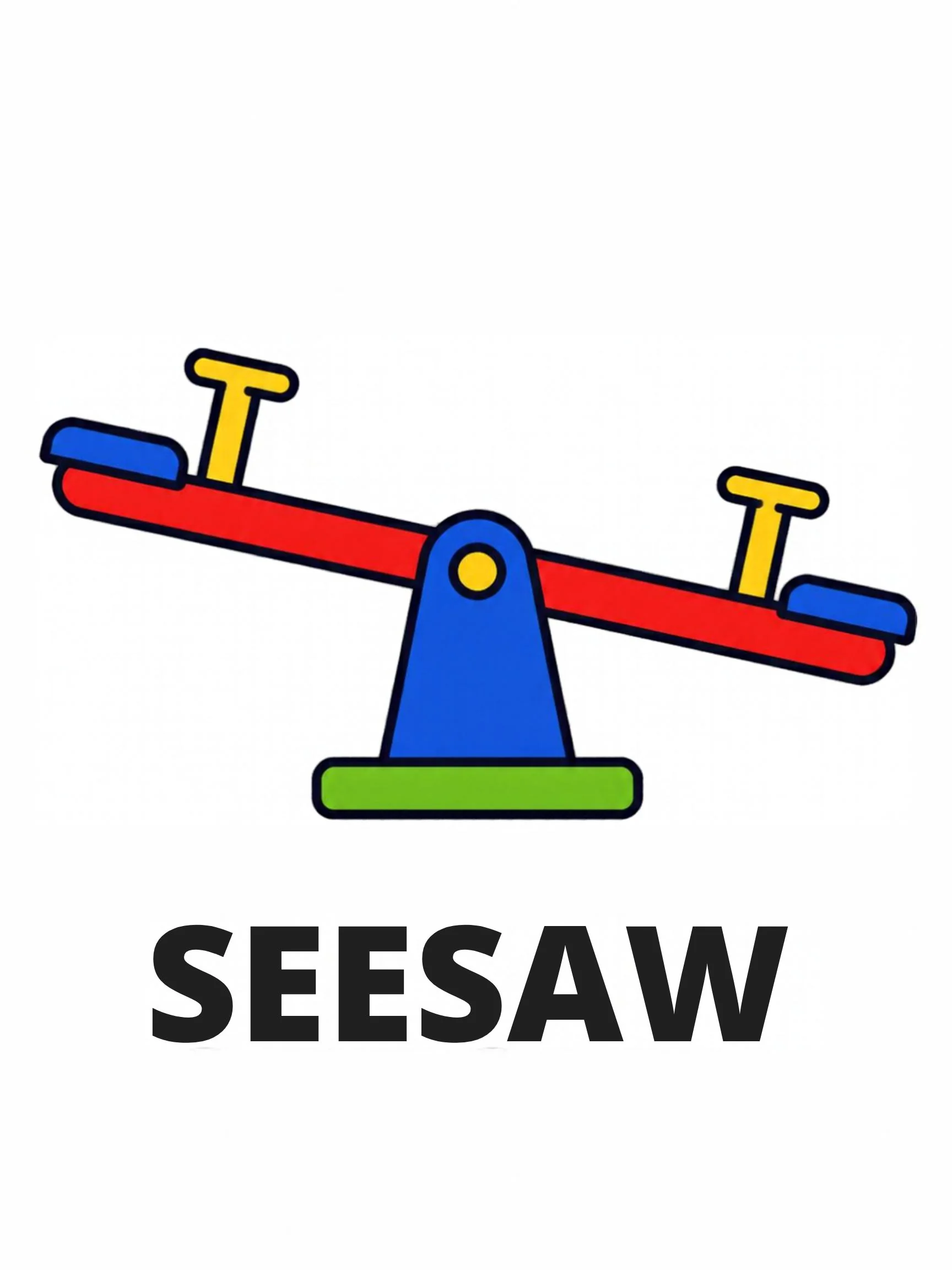
What is this?
A seesaw is a long board balanced on a middle point: one rider up, one rider down, pushing gently with the legs to tip it back and forth — up, down, up, down, together.
What does it mean?
The seesaw is physics teaching partnership: your lift is their descent — the ride literally cannot happen without the other person. And gentle pushing is the treaty: bounce hard and your partner gets a launch, not a ride.
What does the child need to know?
Your child needs three seesaw ideas: it takes TWO — the seesaw is the playground’s partnership machine; push GENTLE with the legs — soft bounces, not launches; and when up top, feet ready and hands holding — the ground is close, land soft.
Why this matters
Partner play needs negotiation (ready? set?), empathy (how high is MY partner happy with?) and trust — the seesaw trains all three with a board and a fulcrum.
What it teaches
Partner coordination, force moderation (gentle for the other’s comfort), the ready-set-go ritual, and landing readiness at the top.
Words to learn
seesawpartnergentlebounceupdowntogether
Say this to your child
“"The seesaw is the two-person machine — it needs BOTH of us! You go up when I go down, I go up when you go down. And the treaty is GENTLE: legs push softly, bounces not launches — ‘ready, set, gentle!’ Hands hold at the top, feet ready, land soft. The seesaw only works when both riders play kind."”
Step by step
- Show the card: "This is the seesaw — the two-person machine!"
- The partnership: one rider each end — the seesaw needs BOTH to work. Your up is their down!
- The gentle treaty: push with the legs, softly — "ready? set? gentle!" Bounces, not launches.
- The top position: when you are up — hands hold the handles, feet ready near the ground, land soft when your turn comes down.
- Play the partner games below and close: "two riders, gentle bounces, soft landings."
Look closer at the picture
On this card the word "Seesaw" stands in big navy capitals inside the rounded frame, with a friendly seesaw illustration below — exactly as the two riders look.
Ask your child
"How many riders does it need? What is the push treaty? What do hands do at the top?"
What your child can say or do
Your child might say: "Two riders — your up is my down!" "Ready, set, gentle!" or the kind bouncer: "Soft bounces — my partner is smiling!"
Out in the real world
Seesaws tip in every playground — and the partnership lesson travels to every two-person game: swings pushed for friends, tug-of-war agreed, teeter-totters everywhere. Ready-set-gentle is the universal treaty.
Try it together
Ready-Set-Seesaw: two riders mount, agree the treaty out loud — "ready, set, GENTLE!" — and see-saw with soft leg bounces, partner smiling the whole ride. Then the trade round: bigger rider bounces softer, smaller rider gets the lift — fairness felt in the body. End together: both riders slow it to a stop, dismount, bow to each other. The machine that teaches kindness with a board.
Understanding check
Ask: "How many riders? What is the treaty? What do we do at the top?" Two, gentle, hold and land soft — three answers and the seesaw sings.
Parent tips
The spoken "ready, set, gentle!" is the whole safety system — never start without it. And match riders thoughtfully: a kind big-partner makes the little one’s whole day.
This lesson pairs with the Seesaw flashcard in the library — print it, show it, keep it on the fridge. Back to Playground.