
Circle — a step-by-step lesson for grown-up and child
The circle starts the class because it is the shape a child meets first and names soonest — wheels before breakfast, plates at every meal. This lesson gives the roundness a rule (no corners anywhere), a movement (rolling), and a house-wide hunt that turns every room into practice.
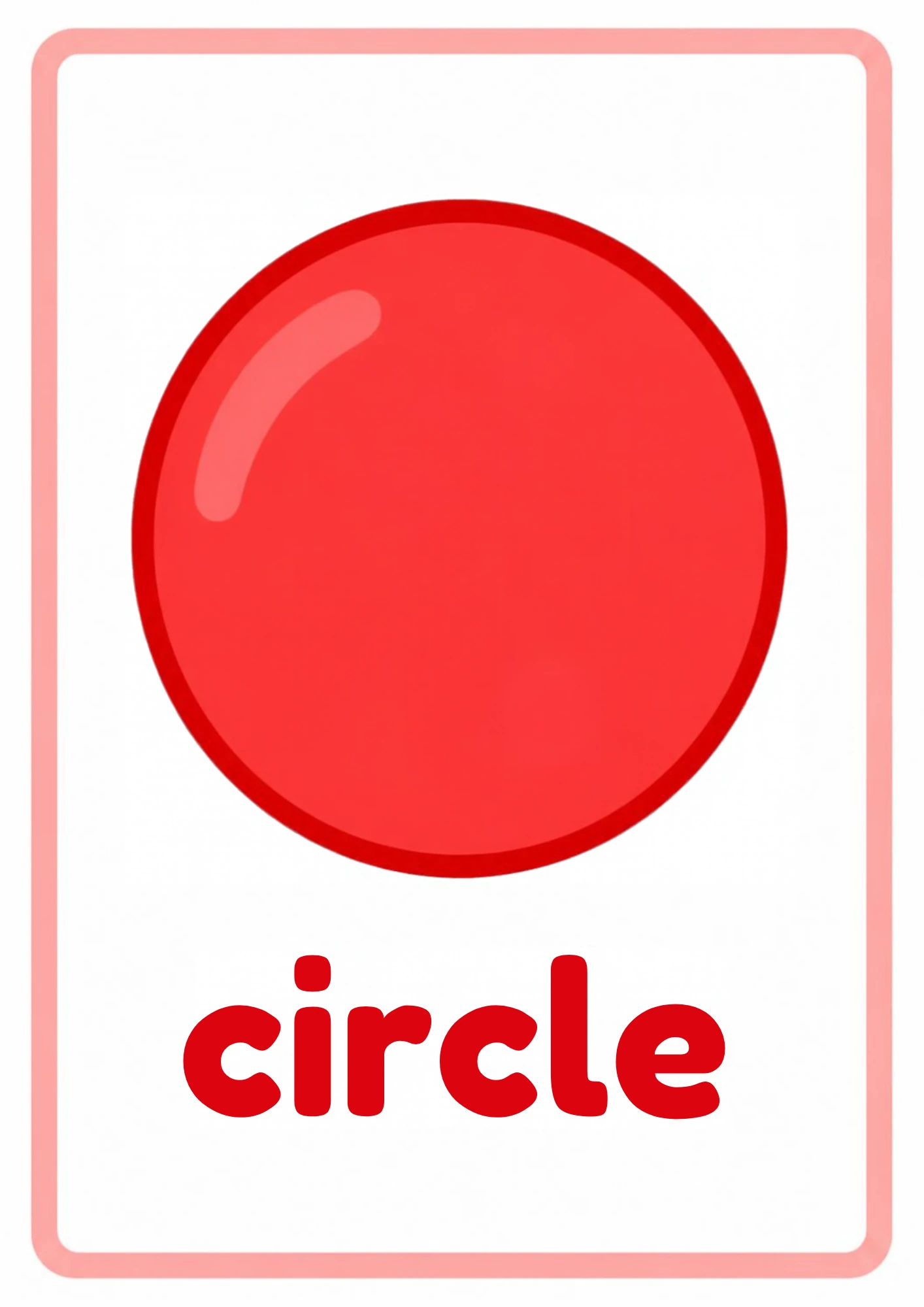
What is this?
A circle is a flat shape whose edge curves the whole way round — no corners, no straight sides, no beginning and no end. Walk your finger along it and you arrive back where you started. On the card it is one big red circle with a shiny highlight, and it is the shape of things that roll: balls, wheels and coins.
What does it mean?
Corner-free is the meaning children feel first: nothing sticks out, nothing pokes, nothing stops the finger. That smoothness is also the physics — round things roll because nothing catches. A child who traces the edge once and then rolls a ball has met both halves of the idea: the look of a circle and the reason wheels work.
What does the child need to know?
Three ideas carry the lesson: a circle is round all the way round with no corners at all, round things roll because nothing sticks out, and circles are everywhere once the word is awake. Keep a ball nearby — the card shows the shape, the ball proves the rule.
Why this matters
Shape names are sorting tools: a child who can pull all the round things out of a mixed pile is classifying, the same thinking that later sorts letters from numbers and animals from vehicles. The circle is the kindest place to start, because the household supplies endless examples and the rule is only one word long: round.
What it teaches
Shape vocabulary, smooth edge-tracing for fine motor control, rolling and catching for gross motor work, visual matching (card circle to plate, clock face, wheel), and the first idea that shapes are rules a thing either follows or does not.
Words to learn
circleroundrollcorneredgeball
Say this to your child
““Circle! Round and round and round — no corners anywhere, not even one. Run your finger all the way around the edge... feel how it never stops turning? That is what a circle is. Now roll the ball — see, nothing catches! Circles roll. Let us find three more circles in this room!””
Step by step
- Show the card and say circle, then walk one finger all the way around the edge — round and round, never lifting, never turning a corner.
- Ask what is missing: how many corners can your child find? Zero is the answer, and zero is a fun number to shout.
- Roll a ball across the floor and watch why: nothing sticks out, so nothing catches. Say the rule — circles roll.
- Hunt the house for circles: plates, clock faces, buttons, toy wheels. Tap each one and say the word together.
- Finish with the air-trace: one big circle drawn with a whole arm in the air, while saying the word once, slowly.
Look closer at the picture
Look at the card together: one big red circle with a shiny highlight, and the word circle underneath. Where does the shine sit — near the top or off to the side? Does the red edge ever turn a corner, or does it curve the whole way round? Which circle at home matches it best?
Ask your child
“How many corners does a circle have?” “Which things in the kitchen are circles?” “Why do wheels work — what shape are they?” “Can you draw a circle in the air?”
What your child can say or do
Your child might announce circle at every plate, coin and wheel in sight, demand a rolling race down the hallway, or air-trace the shape in mid-air while telling a story — a shape owned by the body gets drawn on everything, including the air.
Out in the real world
Circles repeat all day: the round kitchen table, the clock, the buttons on a cardigan, the wheels of the pram, the plate at every meal. Name them as you pass — a household full of circles is a household full of free rehearsals, and the word costs nothing at the till.
Try it together
The rolling race: sit facing your child and roll a ball back and forth, announcing circle every time it leaves your hands. Then graduate to the floor hunt — three round things brought to the rug and lined up beside the card. Rolling is the physics; the naming is the lesson.
Understanding check
Ask: “How many corners does a circle have? What does a circle do that a square cannot? Show me round with your finger.” Zero, roll and a smooth air-trace — that is the lesson landed.
Parent tips
If everything remotely round gets called circle, enjoy the enthusiasm — precision arrives with repetition, not correction. If an oval gets claimed as a circle, answer honestly and lightly: “almost — a circle is round the whole way, that one got stretched,” and let the oval card finish the thought later.
This lesson pairs with the Circle flashcard in the library — print it, show it, keep it on the fridge. Back to Shapes & Patterns (Preschool).