
Fish — a step-by-step lesson for grown-up and child
This lesson opens the ocean — the biggest habitat on the planet — with its most numerous resident. The fish teaches the swap nobody can make: we breathe air, fish breathe water, and gills are the reason.
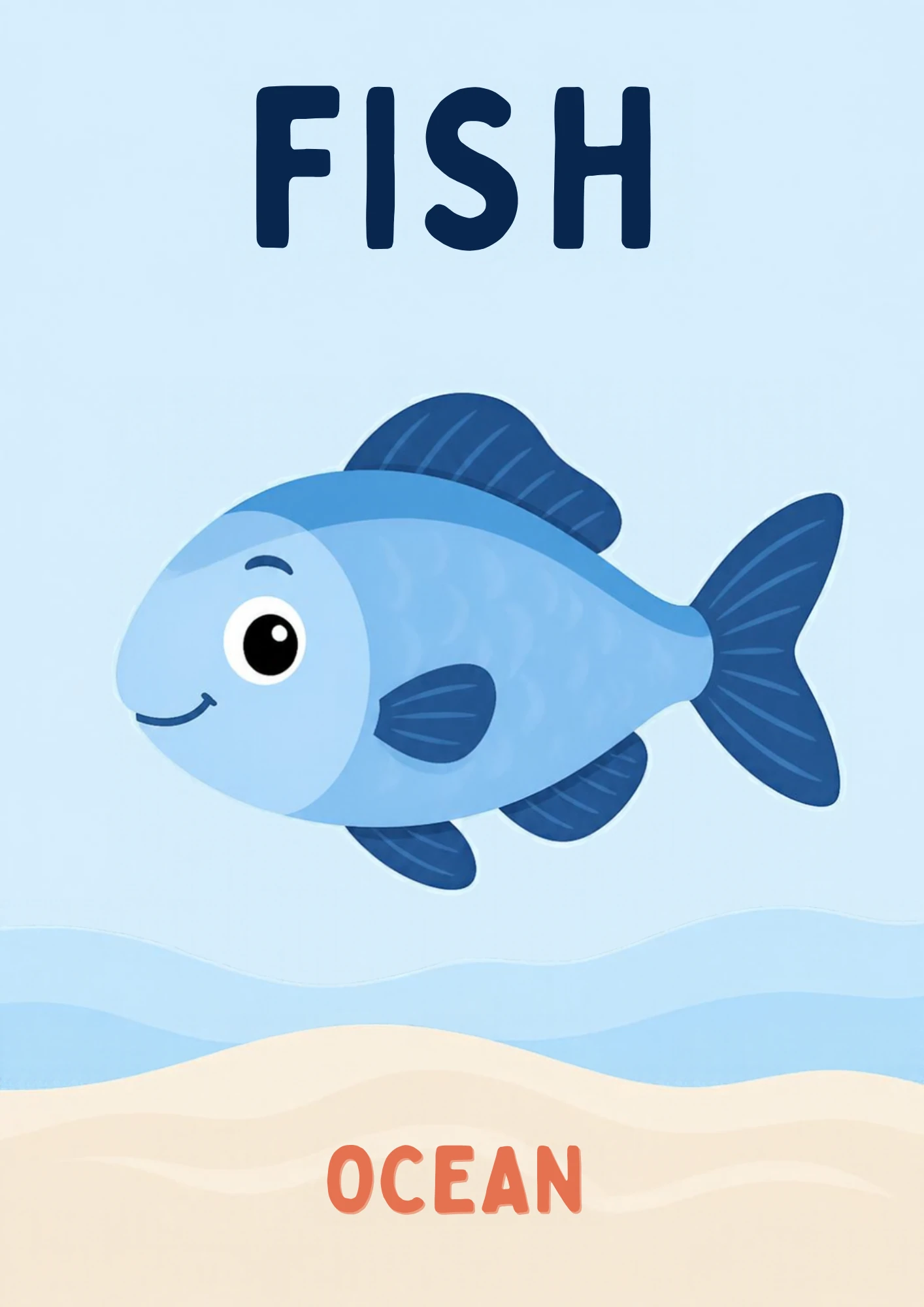
What is this?
The ocean is one enormous connected sea covering most of the Earth — deeper than mountains are tall, from sunlit shallows to the sandy floors. All of it is one address: every drop touches every other drop.
What does it mean?
Land animals carry their air around inside them; fish skip the carrying. Water pours in the mouth, washes over the gills on each side of the head — feather-red filters that grab the oxygen — and out it flows. Fins steer, the tail drives, and the whole body is shaped to slide through a home that has no floor you could trip on and no ceiling you could bump.
What does the child need to know?
Your child needs three ocean ideas: the ocean is the biggest habitat on Earth, bigger than all the land homes together; fish breathe the water itself through their gills — they would suffocate in our air; and fins and tails are their steering and engine.
Why this matters
Gills are the cleanest possible contrast lesson: same need, opposite solution. Once a child can say "we could never swap — I breathe air, the fish breathes water," they hold the deepest fact about habitats: the home and the breather must match.
What it teaches
Respiration basics in child words, scale thinking (biggest home on the planet), body-part function (gills, fins, tail), and humble awe — the ocean is too big to visit all of, and that bigness is the lesson.
Words to learn
fishoceangillsfintailwaterscale
Say this to your child
“"The fish lives in the ocean, the biggest home on the whole Earth. It does not breathe air like us — it breathes the water! The water runs in its mouth, through its red gills and out again. Its tail pushes and its fins steer. We could never swap homes."”
Step by step
- Show the card: "This is a fish, and this is its home — the ocean."
- Size it honestly: the ocean covers most of the globe — spin a globe or map and let the blue win. Biggest home, no contest.
- Do the gill story: behind each fish cheek sits a red, feathery filter. Water in the mouth, past the gills — out the sides. The fish is breathing the water itself.
- Try the swap-proof: pinch your nose and mouth gently for one second — we cannot breathe water; the fish cannot breathe air. Never swap. That is why the ocean is its home and ours is ours.
- Finish with the fins: steering wheels and engine. Then play gill-breathing (below).
Look closer at the picture
On this card a rounded blue fish with a pale belly, dark fins and a big friendly eye swims above a sandy seabed with a soft wave of water behind it. The word "ocean" sits below — one fish, gliding through the biggest room in the world.
Ask your child
"What does a fish breathe — air or water?" "Where are the gills?" "What do the tail and fins do?" "Which is bigger, the ocean or all the land?"
What your child can say or do
Your child might say: "It breathes water through its gills," "The ocean is the biggest home on Earth!" or the swap line: "We couldn’t live there and it couldn’t live here — we breathe different things!"
Out in the real world
Aquarium walls and fish counters are gill theatres: watch the mouth open-shut rhythm and name it — "that is breathing, water edition". A globe’s blue share is the size lesson, repeatable every time the world map comes out.
Try it together
Gill pantomime: cheeks puffed, mouth open-shut in slow fish-breath, glide across the room with palms pressed together as the tail. Mid-game call the swap: "SWAP!" — everyone must gasp one big human breath and shout what they breathe. Air and water, two breaths, one game.
Understanding check
Ask: "What is the biggest habitat on Earth? What do fish breathe, and with what?" Ocean, water-through-gills — two giant answers and the lesson is deep enough.
Parent tips
Keep gills concrete: finger-draw the two cheek lines on your own face and your child’s — "gills here, filters here". If asked whether the ocean ever ends, give the honest size: from space the Earth is called the blue planet because the fish’s home is bigger than all of ours together.
This lesson pairs with the Fish flashcard in the library — print it, show it, keep it on the fridge. Back to Animals & Their Habitats (Class 36).