
Owl — a step-by-step lesson for grown-up and child
This lesson teaches the owl’s version of forest life: perched high above the floor, watching with the biggest eyes in the bird world and gliding down through the dark without a whisper of wing.
What is this?
A forest is deeper and darker than woodland — tall trunks close together, layered from floor to canopy. Owls claim the middle-height branches, and older trees offer hollows: ready-made dark rooms for sleeping the day away.
What does it mean?
The forest stacks life in floors: roots below, moss and mice on the ground, branches in the middle, leaves on top. The owl rents the middle floor and hunts the bottom one — from a branch with a clear view, its giant eyes gather light so well that night looks like late evening up there. When it hears a move below, it drops silently and the forest floor never hears it coming.
What does the child need to know?
Your child needs three owl ideas: owls perch on branches and rest in tree hollows by day; their huge eyes see in near-dark, and they turn their whole heads to look around; and their wing feathers are fringed so soft that flight makes no sound at all.
Why this matters
The owl reframes "night is scary" into "night has its own experts". Children meet the dark through an animal that is not just unafraid but spectacularly good at it — the forest at night becomes a workplace with the owl on shift, and bedtime stops being when the world ends.
What it teaches
Vertical thinking (habitat layers: floor, branch, canopy), light-and-dark science, head-turn body awareness, listening precision, and comfort with darkness built through the night-shift framing.
Words to learn
owlbranchhollowglidesilenttwilighthoot
Say this to your child
“"The owl lives high in the forest. By day it rests in a hollow tree; by night its great golden eyes watch the ground below. Its wings make no sound at all — the mouse on the forest floor never hears a thing until the owl is there."”
Step by step
- Show the card: "This is an owl, and this is its home — high in the forest trees."
- Point at the eyes: those two big golden circles catch even the tiny light of the moon and stars. To the owl, night is never fully dark.
- Try the owl neck: eyes fixed forward, turn only your head slowly left and right. That is how owls look around — their eyes cannot swivel, so the head does the travelling.
- Do the silent-wing test with a scarf or tea towel: flap it fast (whoosh!) then slow and wide. Owls fly slow and wide — soft, silent, unbeatable for sneaking.
- Finish with the listen-and-swoop game (below) and one line: "the owl sleeps by day in a hollow and rules the forest at night."
Look closer at the picture
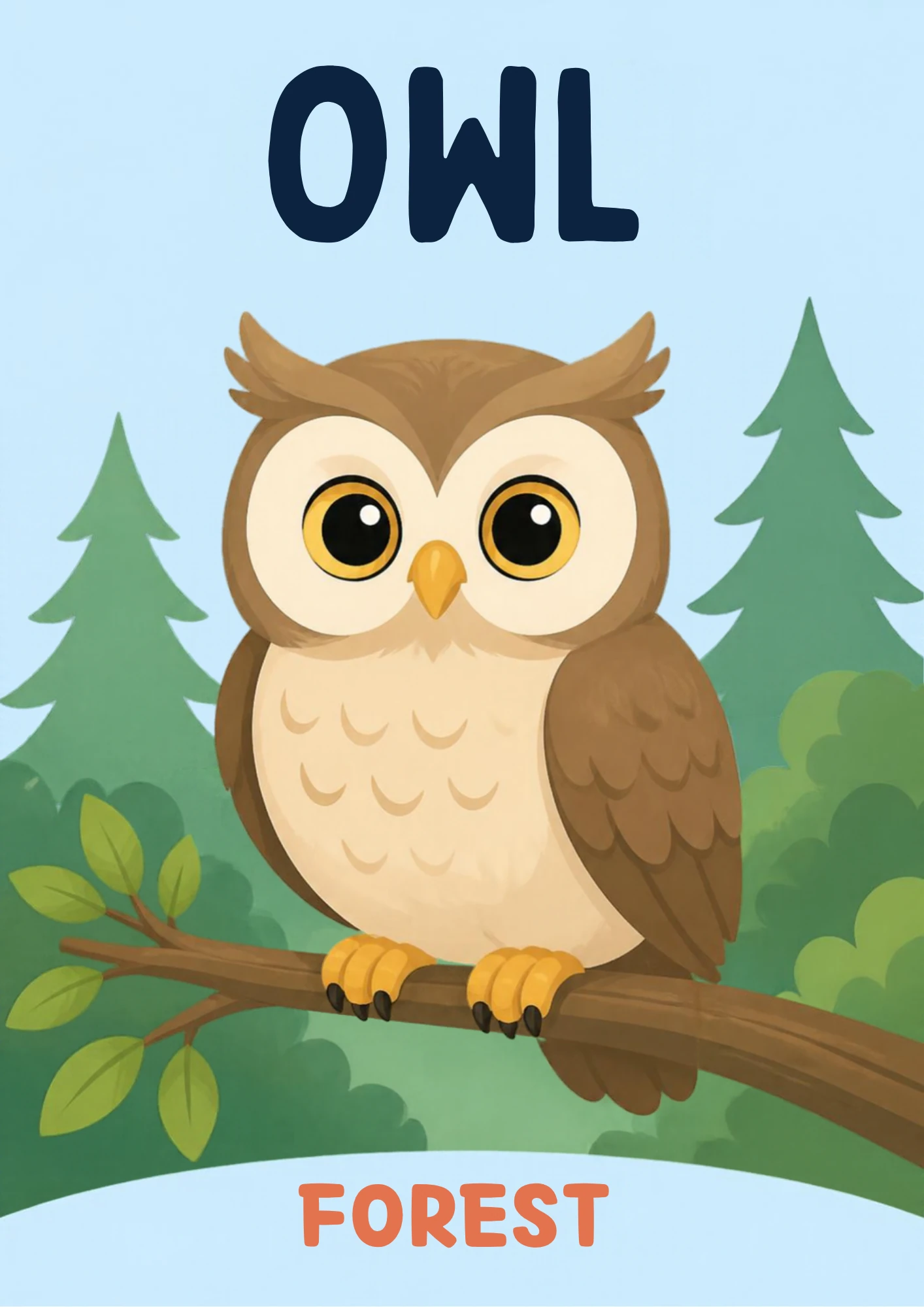
On this card a brown owl with a cream, speckled chest and two enormous golden eyes grips a leafy branch with its talons, dark pine trees standing behind it. The word "forest" sits below — perched, patient and facing us, the owl is exactly where a forest puts its night watch.
Ask your child
"Why are the owl’s eyes so big?" "What sound do its wings make?" "Where does it sleep during the day?" "Can you turn your head like an owl?"
What your child can say or do
Your child might say: "Its eyes see in the dark," "Its wings are silent — whoosh, no sound!" or the head-turn boast: "I can look behind me like an owl!"
Out in the real world
At twilight, stand under tall trees and hoot-listen for one minute — many parks have owls that call right after sunset. By day, look for owl pellets and pale droppings on trunks below hollows: the quiet evidence of the night shift.
Try it together
Listen-and-swoop: the "mouse" rustles a paper under a blanket while the owl sits blindfolded (or eyes-closed) on a chair-branch. One rustle, then stillness — the owl points to where the sound came from, then swoops (arms wide, silent, no whooshing — owls never whoosh) to catch it. Score a point for silence on the swoop.
Understanding check
Ask: "Where does the owl perch? What do its big eyes do? How do its wings fly?" On a branch, see in the dark, silently — three answers and the forest sleeps safe.
Parent tips
Own the head-turn yourself first — children copy the owl neck for days once it is taught, and every repetition rehearses the lesson. If the dark still feels big, end with this: somewhere out there, an owl is flying right now and it thinks the dark is easy.
This lesson pairs with the Owl flashcard in the library — print it, show it, keep it on the fridge. Back to Animals & Their Habitats (Class 36).