
Penguin — a step-by-step lesson for grown-up and child
This lesson travels to the white end of the Earth: the polar region, where the ground itself is ice. The penguin shows how a bird with no fur, no den and no trees still keeps warm — feathers, blubber, and each other.
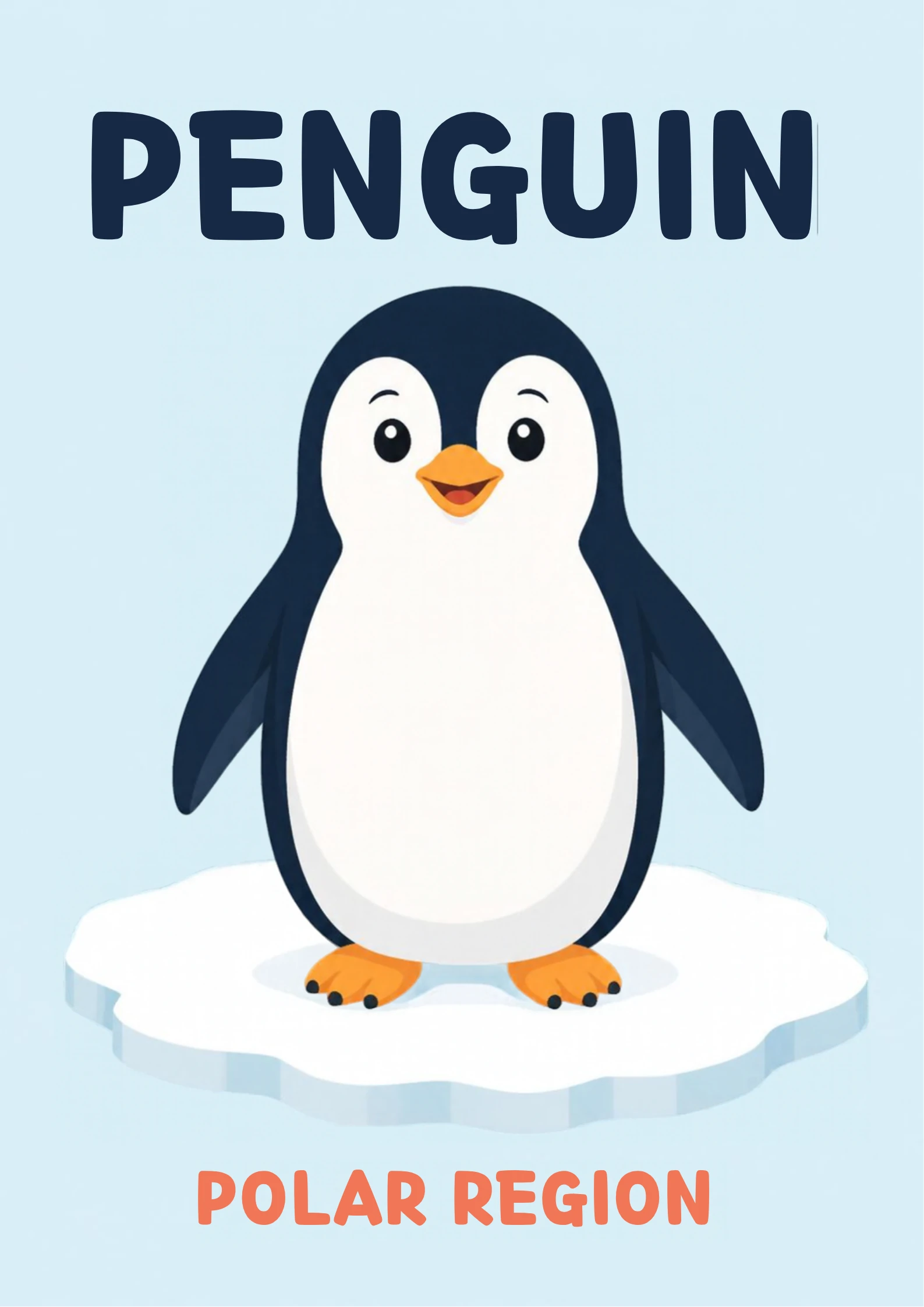
What is this?
The polar regions are the freezing ends of the Earth — sea ice, ice shelves and water that would numb a finger in seconds. No trees grow, few land plants — the "ground" is white and the sea below is full of fish.
What does it mean?
The penguin’s warmth is layered. Outside: dense feathers, oiled and overlapping — a windproof coat. Under the skin: a thick blanket of fat called blubber. And when the wind really bites, penguins do the trick no single bird can: they huddle, hundreds deep, shoulders tucked, and slowly rotate so everyone takes a turn in the warm middle and nobody stays cold at the edge.
What does the child need to know?
Your child needs three polar ideas: the polar region is the icy end of the Earth, where the sea itself freezes; penguins are birds that swim with their wings instead of flying; and they keep warm with feather coats, blubber — and the famous huddle.
Why this matters
The penguin teaches warmth as cooperation: the huddle only works because everyone shares the cold edge. It also corrects the bird story — wings are not only for flying — and it hands families the fairest warmth game ever invented.
What it teaches
Insulation science at coat level (feathers, blubber, huddling), turn-taking ethics built into the rotation, swimming-versus-flying body reasoning, and cold-weather empathy — the outside-of-the-huddle seat is real.
Words to learn
penguinpolaricehuddlefeathersblubberwaddle
Say this to your child
“"The penguin lives in the polar region, where the ground is ice and the sea is freezing. Its feather coat and fat blanket keep it warm — and when the wind blows hard, the penguins huddle up tight and take turns in the warm middle. Nobody stays cold alone."”
Step by step
- Show the card: "This is a penguin, and this is its home — the polar region, where even the sea turns to ice."
- Meet the coat: thousands of tiny feathers, overlapping like roof tiles, plus a fat blanket underneath. The cold cannot get through either easily.
- Flip the wings: these are birds that gave up flying in the AIR to fly in the WATER — wings as flippers, faster than they look.
- Tell the huddle: when the wind howls, penguins pack together tight and take turns — cold penguins on the outside shuffle slowly to the warm middle, and warm ones take their turn at the edge. Sharing, in feather coats.
- Play waddle-slide-huddle (below) and close with the address: ice above, fish below, friends all around.
Look closer at the picture
On this card a black-backed, white-bellied penguin with an orange beak and feet stands squarely on a low white ice floe, calm and front-facing, pale sky and sea around it. The words "polar region" sit below — one bird, dressed for the coldest address there is.
Ask your child
"Why doesn’t the penguin freeze?" "What are its wings for?" "What do penguins do when the wind gets too cold?" "Who stands at the edge of the huddle — and what happens next?"
What your child can say or do
Your child might say: "It has a feather coat and a fat blanket," "Its wings swim — it flies in the water!" or the huddle line: "They take turns — the cold ones go to the middle and warm ones go to the edge."
Out in the real world
Winter dressing becomes feather logic: coat = feather layer, jumper = blubber layer, hugging a grown-up = huddle. Ice in a drink shows the floe from below. And any bath-time raft of toys floating on the water is an ice floe waiting for a penguin passenger.
Try it together
Waddle-slide-huddle: waddle across the room, feet out, arms tucked — then belly-slide the final stretch onto a cushion floe. Call "WIND!" and everyone packs into one tight back-huddle, arms wrapped, shoulders touching. Rotate the huddle one slow turn so the edge players move toward the middle — fair shares, warm hearts, zero frostbite.
Understanding check
Ask: "Where does the penguin live? What keeps it warm — three things?" Polar region, feathers-blubber-huddle — one big answer in three parts and the lesson is warm through.
Parent tips
Honour the turn-taking explicitly: "at the edge, then the middle — everyone gets both." If your child asks whether penguins miss flying, give the swim answer proudly: they traded one sky for another, and theirs is full of fish.
Staying safe
Ice is for penguins: real frozen water is never for walking on, however thick it looks. Cold-weather dressing follows the penguin plan — layers first, hat always — and snowy play ends with dry clothes and warm hands.
This lesson pairs with the Penguin flashcard in the library — print it, show it, keep it on the fridge. Back to Animals & Their Habitats (Class 36).