
Ocean Animals and Their Habitat — solve it right on the sheet.
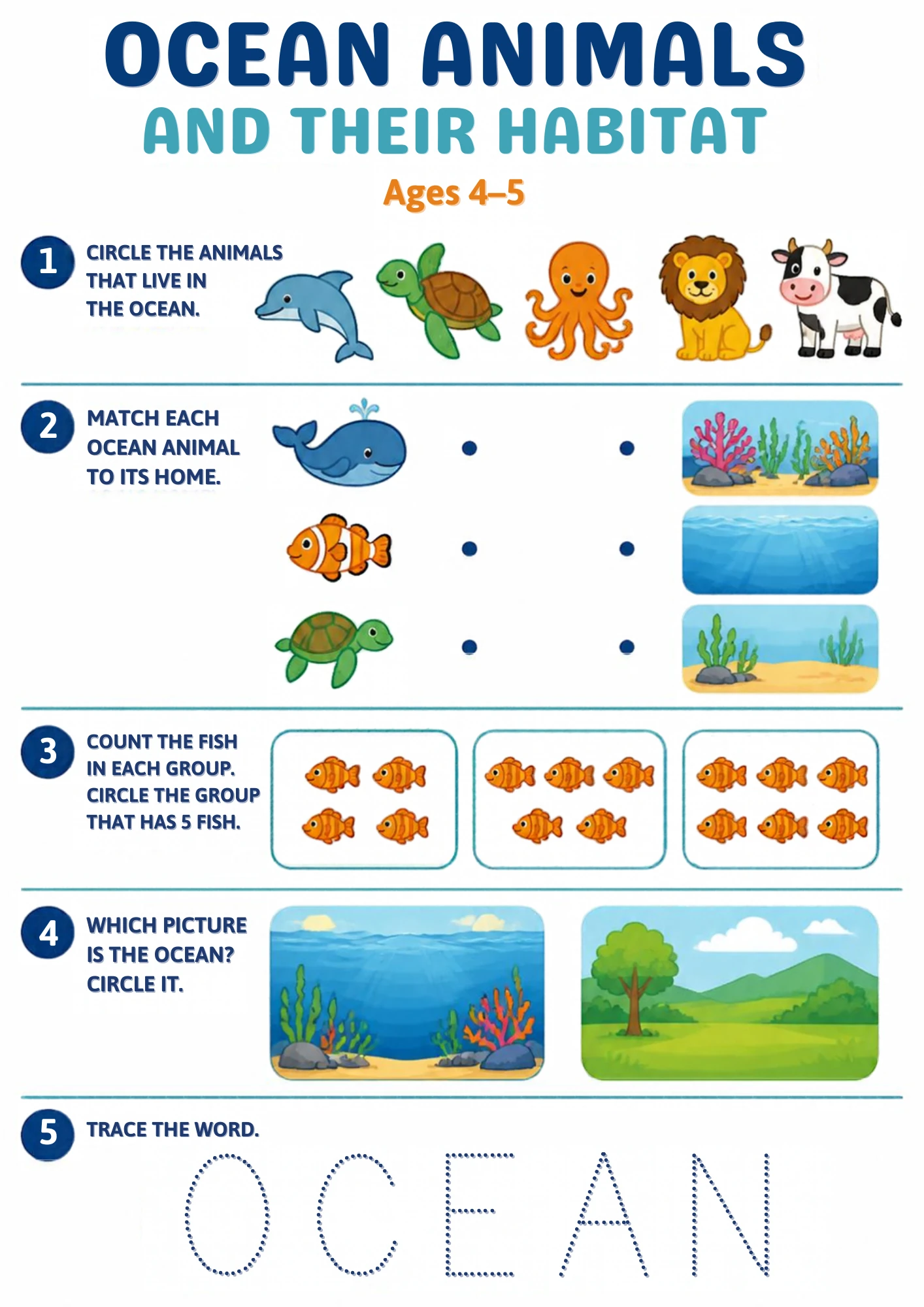
Circle who lives under the waves, match whale, clownfish and turtle to their ocean homes, count fish and trace OCEAN.
Your sheet is ready.
Pick a color or the eraser, then circle, match, count, choose and trace straight on the sheet with your finger, a stylus or the mouse. Press Save my work when you are proud — that is what marks this activity cleared for your child.
What this worksheet teaches.
What the child is learning: The ocean is the biggest habitat on Earth — and even inside it, animals split it up: the reef, the open water, the sandy floor.
Knowledge to have ready: The word ocean, and three ocean residents on the sheet: whale, clownfish and sea turtle.
Why this activity matters: Splitting one huge habitat into addresses — reef, open sea, seabed — is the first step from "fish live in water" to real ecology.
- Habitat vocabulary
- Matching animals to ocean homes
- Sorting belong and not belong
- Counting to 6
- Word tracing
What to say before you start: The ocean is one home so big it has rooms inside it — let us find who lives where.
What to look for on the sheet: For the cow standing quietly in the circle row — dry land is her whole world, and that is the point.
Questions to ask along the way: Who breathes air but lives in the sea? (The whale — a real surprise.) Who paints the reef orange?
Helpful hints without giving it away: The seabed scene has seaweed on the sand — that clue separates it from the open blue water.
Parent tips: A bathtub becomes the open sea, a sponge the reef — retell the matching row with bath toys.
Understanding check: Name two animals from the sheet that could never live in the ocean — and one that could.
Real-life practice: At bath time or a aquarium visit, use the three ocean words: reef, open sea, seabed.
This activity belongs to Class 36 — Animals & Their Habitats on the Learning Path. Progress is saved on this device for the child chosen in My Classroom — and only a real save of finished work marks it cleared, never just opening the page.
How did it go?
One tap, no writing, no name. Pick the face that matches how it went — reactions are counted instantly and stay anonymous.
Parent reviews.
A different thing from the quick faces above: a star rating for the grown-ups, plus an optional line about how it went. Every review is read by the school office before it appears.
No parent reviews yet — yours could be the first.
Parent comments.
How did you use this page Share the game, the moment or the trick that worked in your house. Comments are read by the school office before they appear, and they are about your ideas — never about your child.
No parent comments yet — yours could be the first.