
Crossing Guard — a step-by-step lesson for grown-up and child
This lesson teaches the crossing guard’s job and drills the road-crossing routine your child will use every single day of childhood.
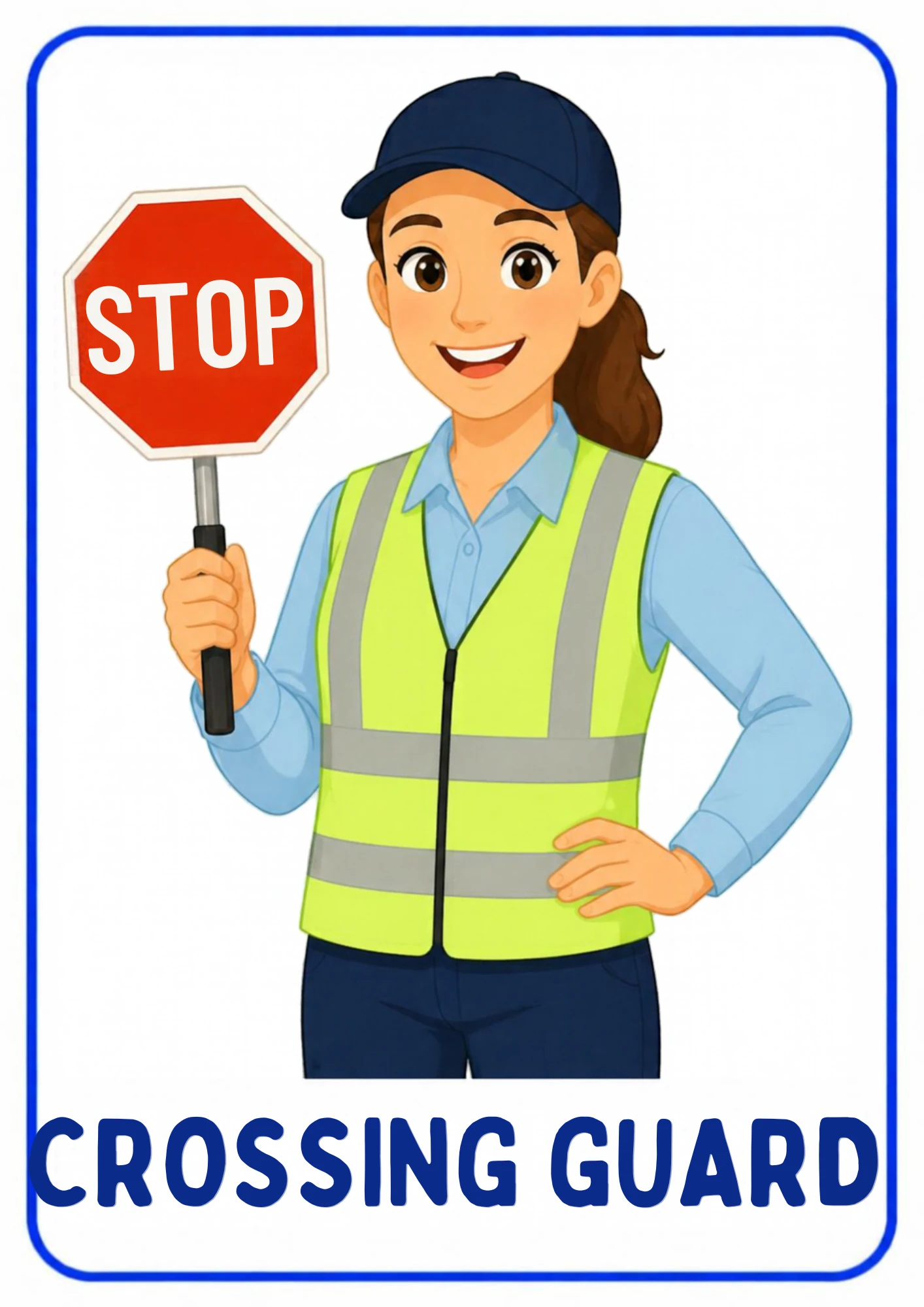
What is this?
A crossing guard is a road helper who stops traffic so children and families can cross the street safely.
What does it mean?
Crossing guards wear bright vests and carry a stop sign. They stand at busy crossings at school times, watch the cars, step out, hold up the sign, and wave people across when the way is clear.
What does the child need to know?
The routine: wait at the kerb, listen for the guard, cross only on the guard’s or your grown-up’s signal, and hold hands the whole way. Streets are for crossing, never for playing.
Why this matters
Roads are the most dangerous place in a child’s daily life. A drill with a rhythm — stop, look, listen, hold — is remembered by the body, not just the head.
What it teaches
Self-control at kerbs (the hardest skill!), left-right scanning, listening for engines, hand-holding cooperation, and traffic vocabulary.
Words to learn
crossing guardkerbtrafficstop signsafecross
Say this to your child
“"At the kerb we stop. We look left, look right, look left again. We listen for cars. Then we hold my hand and cross together — and we never run."”
Step by step
- Show the card: "This is a crossing guard. They stop the cars so we can cross safely."
- Find the stop sign and the bright vest. "Cars can see the bright colours from far away."
- Teach the four beats with hand motions: STOP (hand flat), LOOK (hand over eyes), LISTEN (hand to ear), HOLD (squeeze hands).
- Practise the beats at a pretend kerb — a rug edge — with teddies as traffic.
- Then do it for real on your next walk, narrating quietly: "Stop… look… listen… now we hold hands and cross."
Look closer at the picture
Ask: what is the guard holding up? What colours can you find on the vest? Which way is the guard looking? Where are the children standing — on the road or at the kerb?
Ask your child
"What does the stop sign tell the cars?" "What do we do first at the kerb?" "Why do we hold hands?" "Can we play on the road?"
What your child can say or do
The four beats, chanted: "Stop, look, listen, hold!" And the rule, in their own words: "We cross with a grown-up, never alone."
Out in the real world
Greet your real crossing guard by role — "there is the crossing guard keeping us safe" — and let your child wave. The routine becomes a relationship, and relationships stick.
Try it together
Cushion kerb: line up cushions as the road, teddies drive toy cars, your child is the guard with a paper stop sign. They must hold the sign, count "one, two, three, safe!", then wave the teddies across. Swap roles.
Understanding check
Ask: "What do we do first at the kerb? Who stops the cars? Do we run or walk?" Stop + guard + walking = pass.
Parent tips
Never step into the road with a moving car "to show what happens" — the drill is always done safe. Reward the wait: patience at the kerb is the win, not speed.
Staying safe
Never cross alone, never run across, never play near roads — even quiet ones. Cars need a long time to stop; small children are hard for drivers to see.
This lesson pairs with the Crossing Guard flashcard in the library — print it, show it, keep it on the fridge. Back to Community Helpers & Our Neighborhood (Class 33).