
Mail Carrier — solve it right on the sheet.
Trace MAIL CARRIER, match the mail carrier to the envelope, the stamp and the mailbox, circle the items that belong in the mail, count the letters and draw a letter you would like to send.
Your sheet is ready.
Pick a color or the eraser, then trace, match, circle, count and draw straight on the sheet with your finger, a stylus or the mouse. Press Save my work when you are proud — that is what marks this activity cleared for your child.
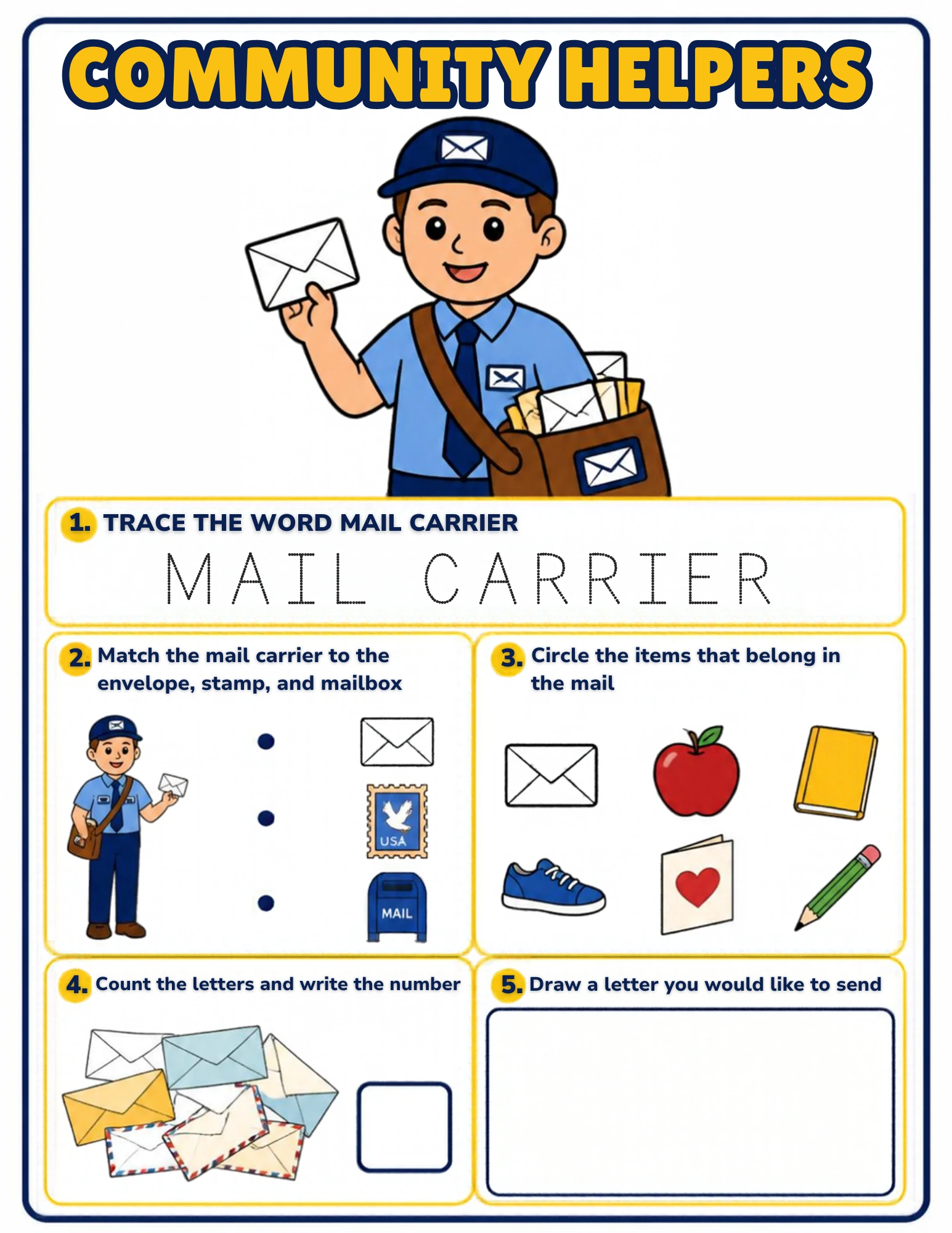
What this worksheet teaches.
What the child is learning: How a letter travels from a hand to a mailbox across town, what the mail carrier carries, and which things really travel through the mail — plus how to write the words MAIL CARRIER.
Knowledge to have ready: A mail carrier brings letters and packages to every door: the envelope holds the words, the stamp is the ticket that pays for the trip, and the mailbox is where the journey starts and ends. Flat things ride in envelopes; bigger things ride in boxes.
Why this activity matters: Sending real mail is a disappearing joy, and this sheet hands it back. Naming the mail’s journey builds the idea that messages travel — the seed of understanding addresses, maps and how people stay in touch across any distance.
- Community helper vocabulary
- Tool matching
- Mail sorting
- Word tracing
- Counting practice
- Letter drawing
What to say before you start: "This is a mail carrier — the helper who brings letters to every door. Trace the two words, then connect the envelope, the stamp and the mailbox. Now the six pictures: which ones travel through the mail? Count the letters in the pile, and then draw a letter YOU would like to send."
What to look for on the sheet: Find the stamp and ask what happens if a letter has none — it cannot take the trip! In the grid, ask of each tile: would this go in an envelope, ride in a package, or not be posted at all? In the count row, letters overlap a little; touch each one so none is missed.
Questions to ask along the way: "What does the stamp do?" "Where does a letter start its journey and where does it end?" "Which grid things would you post, and which would you keep?" "Who would YOU send a letter to first?"
Helpful hints without giving it away: Ask of each tile: envelope, package, or no mail at all? The greeting card is a sure friend of the mailbox; the snack and the shoe need more thought. For the count, count from one end of the pile to the other, one touch each.
Parent tips: Make the sheet real: help your child draw the letter from the last box, fold it into an envelope, add a stamp and post it today. A real reply, days later, is the most magical follow-up lesson there is.
Understanding check: Ask: "Who brings the letters? Name two things that travel in the mail. What does the stamp pay for?" The carrier, two posts, the trip = the sheet landed.
Real-life practice: Write and post one real letter this week — a thank-you, a drawing, three words to grandma. Then walk past your own mailbox together and wait. Real mail beats any worksheet every single time.
This activity belongs to Class 33 — Community Helpers & Our Neighborhood on the Learning Path. Progress is saved on this device for the child chosen in My Classroom — and only a real save of finished work marks it cleared, never just opening the page.
How did it go?
One tap, no writing, no name. Pick the face that matches how it went — reactions are counted instantly and stay anonymous.
Parent reviews.
A different thing from the quick faces above: a star rating for the grown-ups, plus an optional line about how it went. Every review is read by the school office before it appears.
No parent reviews yet — yours could be the first.
Parent comments.
How did you use this page Share the game, the moment or the trick that worked in your house. Comments are read by the school office before they appear, and they are about your ideas — never about your child.
No parent comments yet — yours could be the first.