
Teacher — solve it right on the sheet.
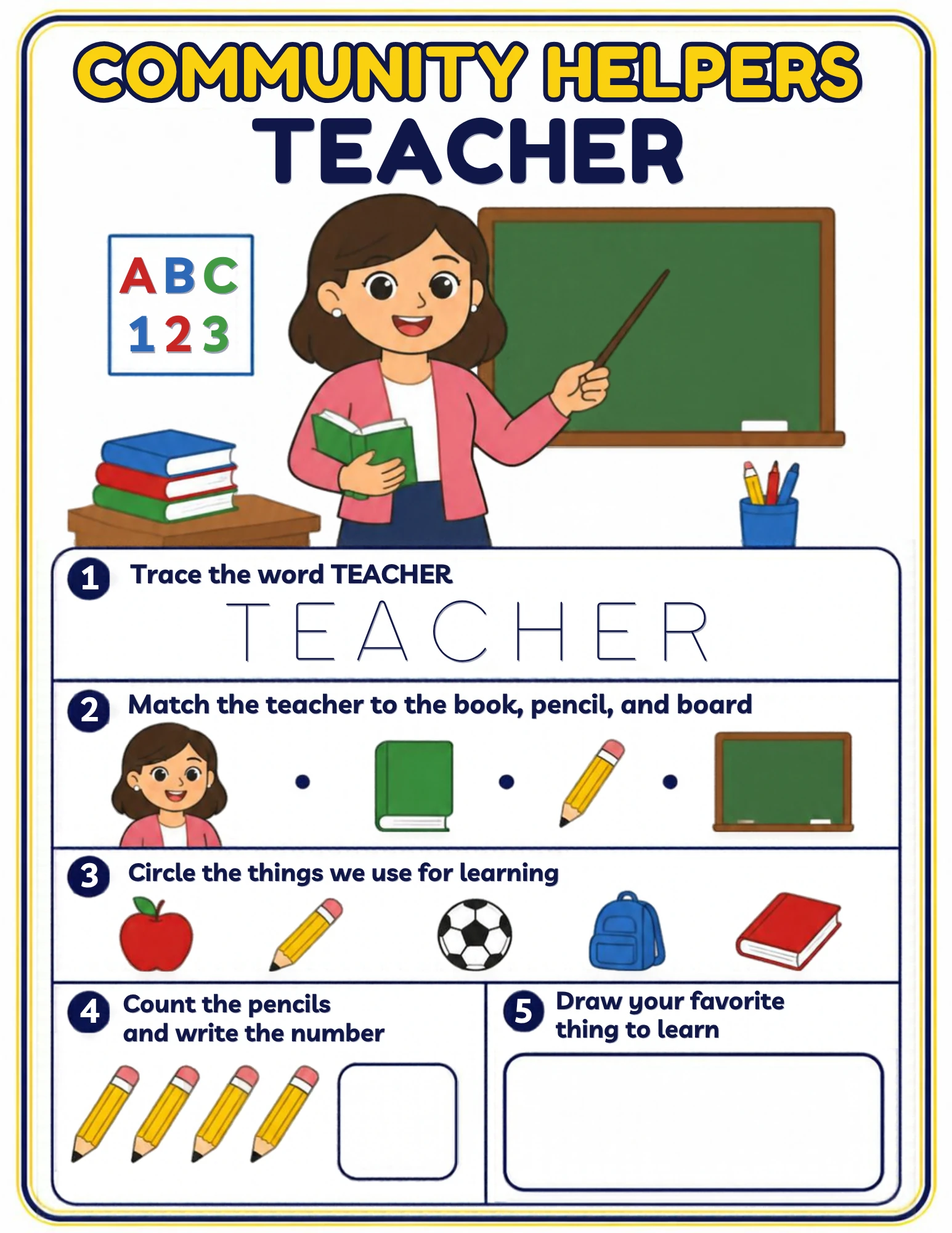
Trace TEACHER, match the teacher to the book, pencil and board, circle the things we use for learning, count the pencils and draw your favorite thing to learn.
Your sheet is ready.
Pick a color or the eraser, then trace, match, circle, count and draw straight on the sheet with your finger, a stylus or the mouse. Press Save my work when you are proud — that is what marks this activity cleared for your child.
What this worksheet teaches.
What the child is learning: What a teacher’s day is full of — books, pencils, a board and questions — plus which objects help learning happen and how to write the word TEACHER.
Knowledge to have ready: Teachers help children learn letters, numbers, stories and how to be good friends. The board shows the lesson, the book holds the story, the pencil writes the practice. Your child already knows this world — the sheet names it.
Why this activity matters: A child who can name the teacher’s tools walks into any classroom feeling at home. The favorite-thing draw box turns the sheet into a small show-and-tell, and the pencil count is real counting with a real object.
- School vocabulary
- Tool matching
- Learning-object awareness
- Counting to 4
- Word tracing
- Self-expression drawing
What to say before you start: "This is a teacher — she helps children learn new things every day. Trace her name, then connect the book, the pencil and the board. Look at the five pictures: which help us learn? Count the pencils with your finger, and then draw the thing YOU love learning most."
What to look for on the sheet: Find the ABC-123 poster, the chalkboard and the pointer stick in the big picture. In the row, ask what each circled object does for learning. The apple sits with the school things for a reason — ask your child who traditionally gets an apple!
Questions to ask along the way: "What does the teacher write on the board?" "Which pictures help us learn — and what does each one do?" "How many pencils?" "What is YOUR favorite thing to learn, and who teaches it to you?"
Helpful hints without giving it away: The soccer ball is the playground guest — learning happens outside too, but the sheet asks for learning TOOLS. In the count, pencils lie at a slant; touch each tip so the count stays true.
Parent tips: Ask your child to teach the sheet back to you — playing teacher with the worksheet is the deepest rehearsal there is. Name real teachers your child knows and what each one is teaching them this year.
Understanding check: Ask: "What does a teacher do all day? Name three learning tools. How many pencils?" Helps-us-learn, three objects, four = the sheet landed.
Real-life practice: Tonight, your child plays teacher with teddies as the class: board, book, pencil — the whole lesson. Ten minutes of teaching-back beats an hour of being taught.
This activity belongs to Class 33 — Community Helpers & Our Neighborhood on the Learning Path. Progress is saved on this device for the child chosen in My Classroom — and only a real save of finished work marks it cleared, never just opening the page.
How did it go?
One tap, no writing, no name. Pick the face that matches how it went — reactions are counted instantly and stay anonymous.
Parent reviews.
A different thing from the quick faces above: a star rating for the grown-ups, plus an optional line about how it went. Every review is read by the school office before it appears.
No parent reviews yet — yours could be the first.
Parent comments.
How did you use this page Share the game, the moment or the trick that worked in your house. Comments are read by the school office before they appear, and they are about your ideas — never about your child.
No parent comments yet — yours could be the first.