
Put Clothes Away — a step-by-step lesson for grown-up and child
This lesson gives clean clothes a finishing routine: your child stacks the folded pile, carries it, and puts every garment where it lives — with a drawer system that makes the whole job winnable.
What is this?
Putting clothes away means taking the stack of clean clothes to where they live — the drawer, the shelf, the box — and placing each one where it belongs, ready to be found again.
What does it mean?
Clothes have homes like toys do. A garment that lands in its home is findable; a garment dumped anywhere is lost in practice. Two categories are enough at four — shirts here, trousers there — the rest is grown-up sorting.
What does the child need to know?
The moves: take the stack, walk it to the drawer, place the shirts, place the trousers, close the drawer. If the pile is big, two trips beat one wobbly tower. Lumpy folds are a win — they mean the child did it.
Why this matters
Children who know where their clothes live can dress without an adult — the dressing independence from earlier lessons depends on THIS lesson. Contribution at home is also quietly identity-forming: "I am someone this house needs."
What it teaches
Sorting into categories, spatial stacking (a tower that survives the walk), sequencing a multi-move job, ownership of a personal space, and the quiet pride of a drawer that opens to find exactly what was put there.
Words to learn
foldstackdrawershelfput awaytidy
Say this to your child
“"Clean clothes have homes, just like toys. You stack them like a sandwich, carry them with two hands — walking, not running — and each piece goes where it lives. The fold can be lumpy; the putting-away is the real work, and lumpy is proud work."”
Step by step
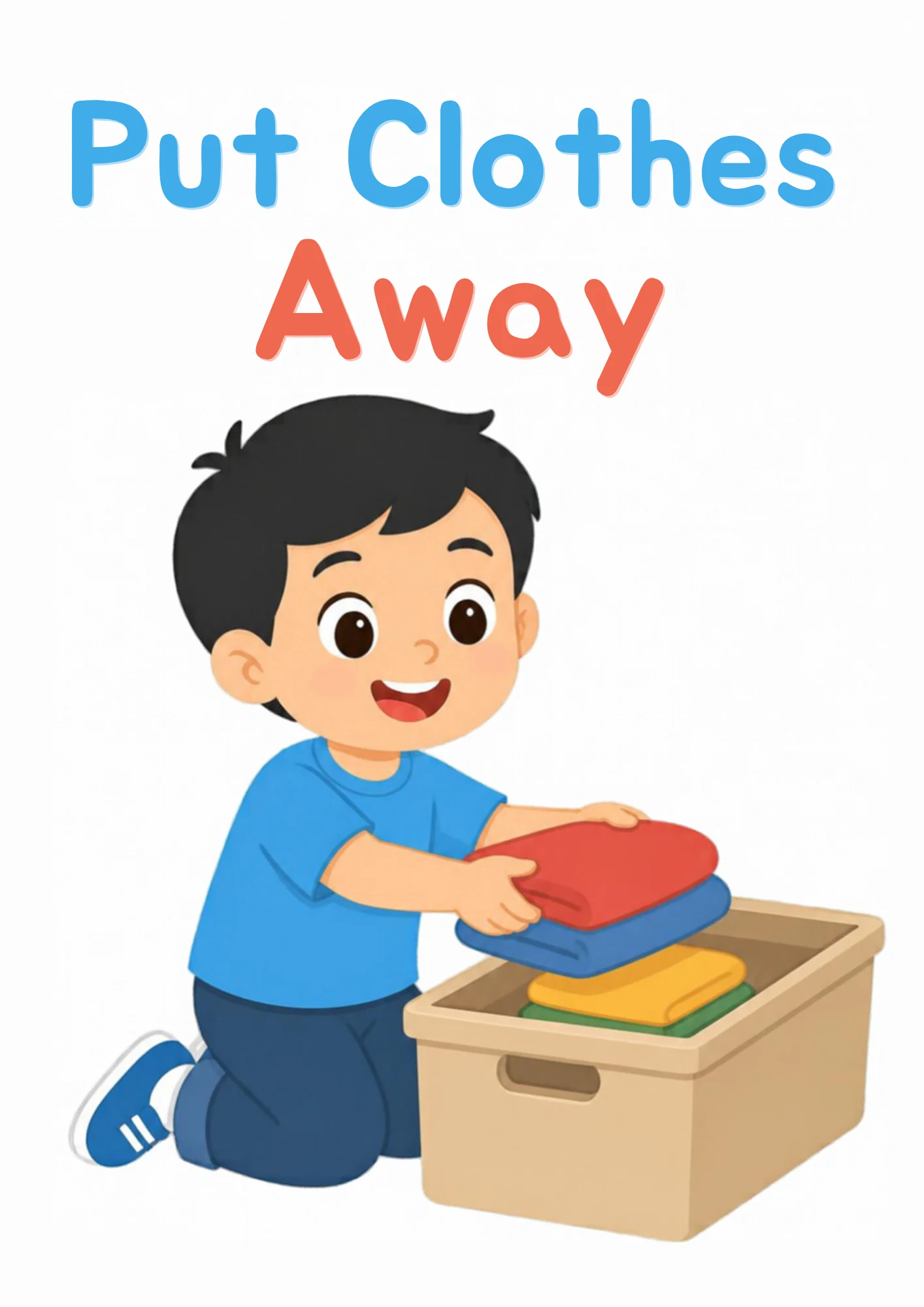
- Show the card: the boy is stacking folded clothes — red on blue on yellow on green — into a big box. Name the colors and the order; stacking is half the job.
- Open the real drawer or basket your child will use. It must be reachable without asking — that is the design rule.
- Walk the job once together: stack, carry with two hands, shirts home, trousers home, close.
- Agree the two categories for your house: shirts and trousers is the classic start; anything else is yours.
- Hand the job over: from the next laundry day, the stack is theirs to deliver — you fold, they file.
Look closer at the picture
Ask your child: what is the boy holding — how many folded clothes? Which colors can you see? Where are they going, the box or the floor? Is he kneeling or standing? What is he wearing on his feet?
Ask your child
"Where do your shirts live? And your trousers?" "How do we carry a tall stack?" "What do we do if the tower wobbles?" "Why does the drawer need to be low?"
What your child can say or do
"Shirt home, trousers home, all done!" Your child may invent a stacking order by color every laundry day, or forbid anyone else from touching "their" drawer — which is exactly the ownership working.
Out in the real world
Laundry day is the practice day: the pile comes off the line or out of the dryer, and your child files their own share. Hotels, holidays and grandma’s house all have drawers too — the homes just have different names.
Try it together
Laundry basket relay: two baskets at one end, empty drawer at the other. Your child stacks, carries, files, returns for the next load — against a song, not a clock. The stack that survives the walk wins the quiet cheer.
Understanding check
Ask: "Where do clean clothes go? How many trips is a big pile? Whose drawer is it?" Their home, two trips, THEIRS = landed.
Parent tips
Do not refold in front of them — smooth the shirt later if you must, quietly. One low drawer or basket is all the infrastructure a four-year-old needs; ownership needs the right height, not more storage. Praise the delivery, not the folding.
Staying safe
Drawers and boxes stay closed when not in use — open drawers are climbing invitations and tripping hazards. Heavy items live in low drawers, never stacked above a child’s head, and the wardrobe door is a pinch-point to respect.
This lesson pairs with the Put Clothes Away flashcard in the library — print it, show it, keep it on the fridge. Back to Life Skills & Good Habits (Class 32).