
Use an Inside Voice — a step-by-step lesson for grown-up and child
This lesson teaches volume as a choice, not a scolding: three voice levels your child can name and switch between, the rooms that ask for each, and the game that makes quiet modes fun instead of forced.
What is this?
Using an inside voice means matching your loudness to the place — whisper-voice or talk-voice inside, big voice saved for outside and for emergencies.
What does it mean?
Sound travels and touches people: in a shop, a bus or a library, big voices land on everyone. It is not that loud is bad — it is that places have needs. Outside, big voice belongs; inside, soft voice keeps everyone comfortable.
What does the child need to know?
Three levels to name: whisper (libraries, shops, baby-sleeping hours), talk (home conversation), big (the park, the garden, calling across the yard). The dial between them is your hand turning an imaginary knob.
Why this matters
A child who can control volume keeps the places they love open to them — cafés, cinemas, waiting rooms. Voice control is also the first self-regulation skill outsiders notice, and it is practised entirely through play.
What it teaches
Auditory awareness (hearing their own loudness), self-regulation (turning the dial on purpose), social empathy (how my sound lands on others) and the vocabulary of situations — each room has its rules and its reasons.
Words to learn
whispervoiceloudquietinsideoutside
Say this to your child
“"We have three voices: whisper, talk and big. Inside places like shops and libraries, we travel on whisper or talk. The big voice is not banned — it lives outside, at the park, where it can stretch its legs. Show me your whisper. Now your big voice. Now back to whisper."”
Step by step
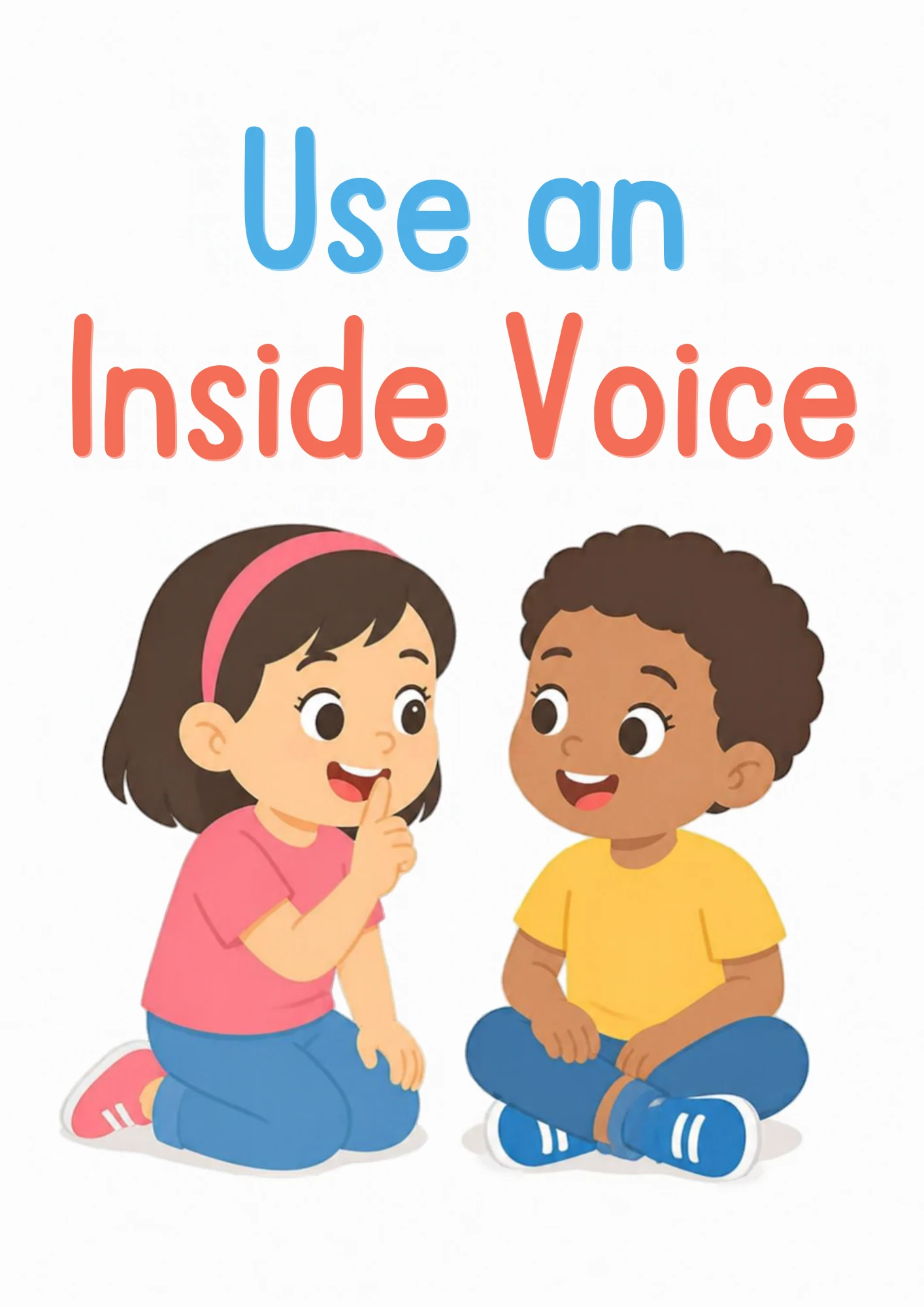
- Show the card: the girl has a finger at her lips and the boy is leaning in to hear her whisper — name both jobs: the whisperer AND the listener.
- Demonstrate all three voices yourself, dramatically: whisper, talk, big. Let your child label each.
- Play the voice dial: your hand turns an invisible knob, your child matches the level — whisper, talk, big, back down.
- Name the rooms in your real week that ask for each voice: the shop, the library, the baby’s nap hour, the park.
- Catch the transfers: "that was shop-voice at the shop — you read the room all by yourself."
Look closer at the picture
Ask your child: what is the girl doing with her finger? Who is she talking to? Is the boy’s face calm or cross? Why do you think he is leaning closer? What do our ears do when a sound is too big?
Ask your child
"Which voice fits the library? The park? The baby’s nap?" "How does the dial work?" "Why do big voices bother people inside?" "What voice are you using right now?"
What your child can say or do
"Whisper mode!" Your child may announce their own voice level before entering a shop, turn the imaginary dial on YOU mid-shout, or invent a baby-sleeping whisper for the hallway.
Out in the real world
Voice levels are everywhere once named: the library story-time whisper, the restaurant talk, the cinema hush, the playground roar. Each place is a level your child can now predict — and predictability is what makes outings calm.
Try it together
Sound detective: in a quiet place, whisper a sentence and let your child repeat it back; across the garden, use big voice for a call-and-answer. The gap between the two modes IS the lesson, played.
Understanding check
Ask: "Name the three voices. Which fits the shop? Where does big voice live?" Three levels, whisper-or-talk, outside = landed.
Parent tips
Inside voice lands as a game, never as a shush — children move toward what you name positively ("shop voice now") and away from what you hiss ("quiet!"). Model the switch yourself: your visible dial-turn teaches more than any reminder.
Staying safe
There is one place a big voice is a tool inside: calling for help when something is wrong. Teach the difference plainly — big voice for real trouble and outside play, never for getting your own way.
This lesson pairs with the Use an Inside Voice flashcard in the library — print it, show it, keep it on the fridge. Back to Life Skills & Good Habits (Class 32).