
Seventeen Apples — a step-by-step lesson for grown-up and child
This lesson builds counting stamina: seventeen, deep in the teens. Your child counts seventeen apples as ten and seven, learns where long counts usually wobble and picks up the restart-from-ten rescue trick.
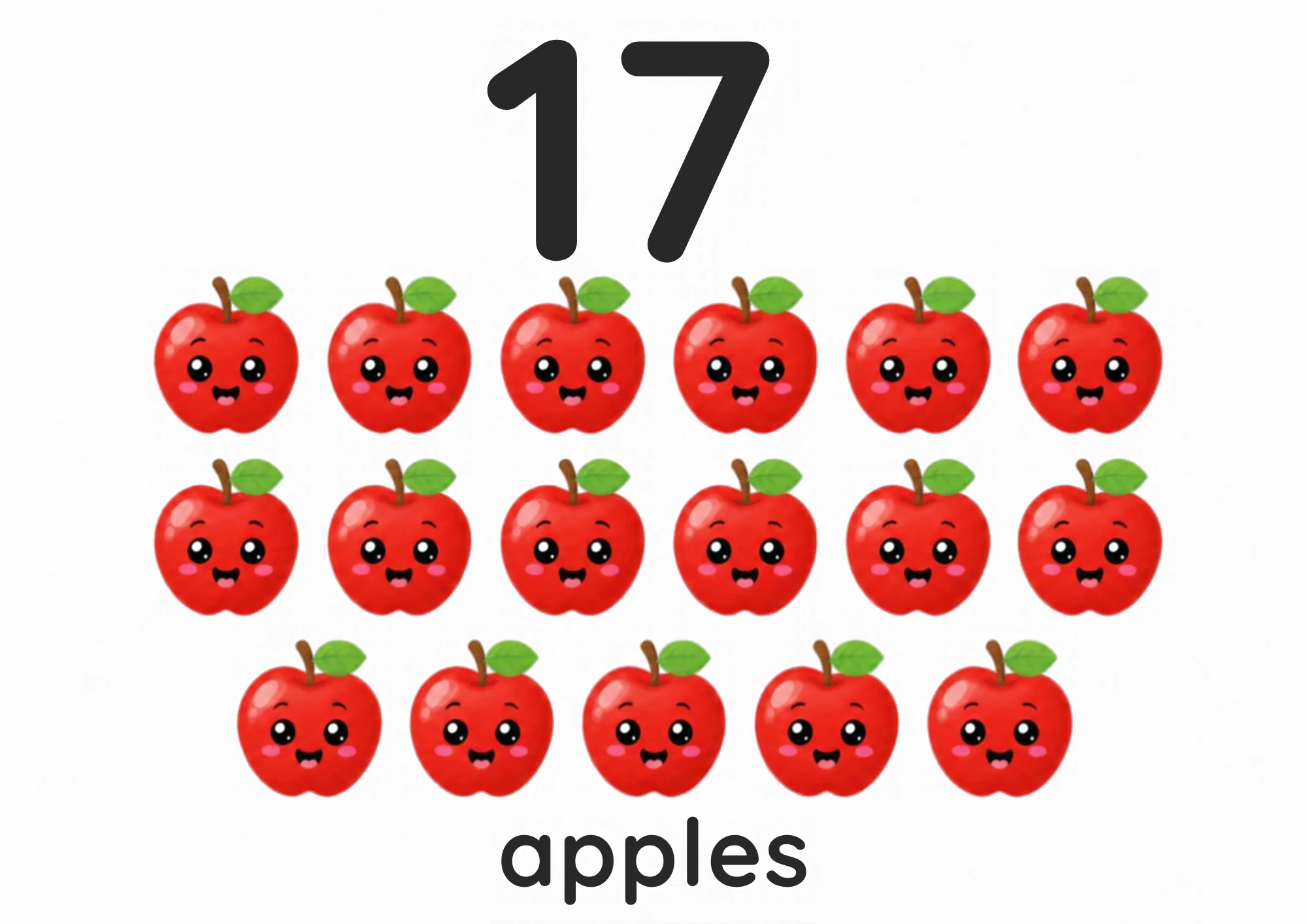
What is this?
Seventeen is ten and seven more — seventeen apples grouped six, six and five on the card. Seventeen is far enough along that long counts get tired: most counting wobbles happen between fifteen and eighteen.
What does it mean?
Long counts need a rescue plan. When a seventeen-count tangles, restarting from one wastes all that work — restarting from ten saves it. That little trick, counting on from a known landmark, is a genuine math strategy hiding in a snack.
What does the child need to know?
Your child needs three seventeens: the ten-and-seven recipe; the wobble map — most stumbles land between fifteen and eighteen; and the rescue — when lost, go back to ten and count on.
Why this matters
Endurance counting is a real skill: the discipline to keep one-touch-one-word going for seventeen steps. The restart-from-ten trick teaches that landmarks are safe harbors — the same habit that will one day become adding on a number line.
Words to learn
seventeensteadywobblerestartlandmarkten and seven
Say this to your child
“"Seventeen apples — ten and seven. Long counts wobble near the end sometimes, and that is fine: when we get lost, we jump back to ten and count on. Ten is a safe harbor."”
Step by step
- Show the card: "Seventeen apples — ten and seven more. This is a long count, so we count like professionals: steady and slow."
- Recipe count: a full ten apples, then seven more, tapping each one. Ten and seven: seventeen.
- Read the groups: six, six, five. Count each pack, then the whole seventeen — big numbers in little packs.
- Practice the rescue: count and "accidentally" lose your place near sixteen. Laugh, and show the trick — "back to ten! Ten... eleven, twelve..." Counting on from ten, not from one.
- Clap-count to seventeen with a metronome voice — steady as a clock. If it tangles, restart from ten together.
Look closer at the picture
On this card a big black numeral 17 stands over seventeen smiling red apples, grouped six in the top row, six in the middle and five below, and the word "apples" is printed below.
Ask your child
"How many apples? What is ten and seven more?" "Where do long counts usually get tangled?" "What is the rescue trick when we lose count?"
What your child can say or do
Your child might say: "Ten and seven — seventeen!" "Back to ten and count on!" or the steady-counter's badge: "I counted all seventeen with no wobble."
Out in the real world
Seventeens turn up on big number lines: bus routes, house numbers on a long street, calendar dates — walk past date seventeen every month. Number the steps of a staircase with sticky notes and let seventeen be the summit of the morning climb.
Try it together
Steady-hand count: seventeen coins into a jar, one per second, metronome-steady — wobble means back to ten, not back to one. Then apple pack relay: sort seventeen toys into packs of six, six and five like the card, count each pack, then the whole lot.
Understanding check
Ask: "How many apples? Say the recipe. What do we do when the count tangles?" Seventeen, ten and seven, restart from ten — the steady count is trained.
Parent tips
Do the fake-wobble rescue yourself first — children adore catching a grown-up losing count, and the trick teaches itself while they laugh. Never demand perfection at seventeen; demand the restart habit, and perfection arrives on its own later.
This lesson pairs with the Seventeen Apples flashcard in the library — print it, show it, keep it on the fridge. Back to Numbers, Counting & Early Math (Class 35).