
Two Bananas — a step-by-step lesson for grown-up and child
This lesson teaches two as the number of pairs — shoes, ears, bananas leaning together. Your child counts one-and-then-one-more, matches twins around the house and discovers that two is the friendliest number there is.
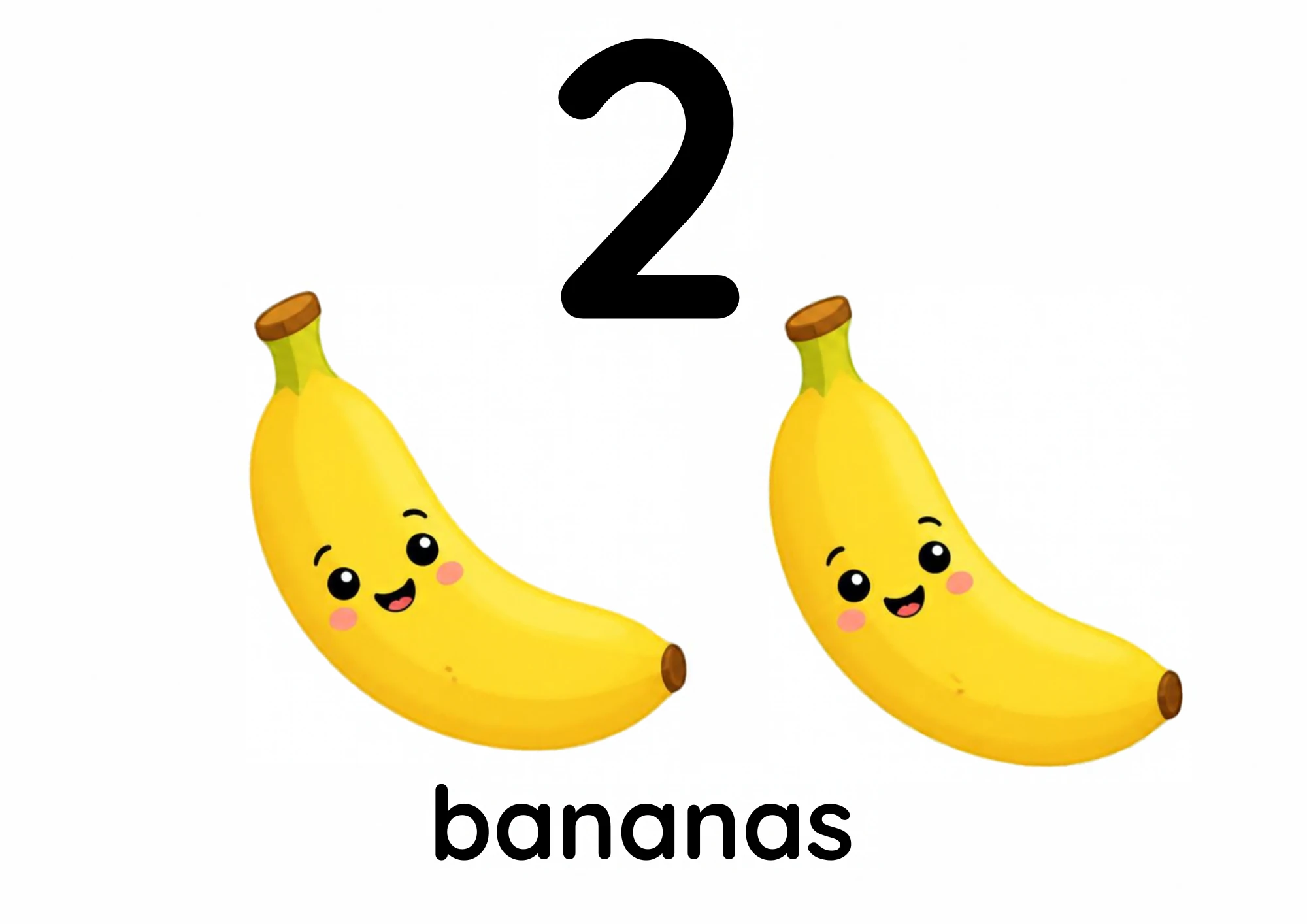
What is this?
Two is one and one more. Two bananas lean side by side; two shoes wait by the door; two ears listen for bedtime. Anything that comes as a matched pair is hiding a two.
What does it mean?
Two is where counting becomes a story: one, then another one. It is also the number of matching — pairs belong together, and spotting "the other one" is real mathematical thinking about sameness.
What does the child need to know?
Your child needs three twos: the word "two" counted slowly across two things; the numeral 2 recognized on its card and in the wild; and the pair idea — two things that match, one for each hand, one for each foot.
Why this matters
Pairs are a child's first number pattern. Matching two identical things builds same-and-different thinking, and the one-more step from one to two is the engine that will later drive all counting.
What it teaches
Counting with one-to-one touches across two objects, matching and pairing, the plus-one idea (one and one more), body awareness through paired body parts, and early comparison: same or different.
Words to learn
twopairbothmatchtwinside by side
Say this to your child
“"Two bananas — one and one more. Lots of things come in twos: two shoes, two hands, two ears. Let us find the pairs hiding in our house."”
Step by step
- Show the card: "Two bananas, leaning together like friends. Let us count them: one... two."
- Touch each banana once — left, right — and say one number per touch. Two touches, two words, two bananas.
- Hunt for pairs: two shoes, two socks, two sleeves, two eyes. Touch each part of the pair as you count it.
- Build a two: set out one cracker, then add one more. "One and one more is two!" Eat one and watch two fall back to one.
- End with the body count: clap two times, stomp two times, blink two eyes. Two lives in the body, not just on the card.
Look closer at the picture
On this card a big black numeral 2 stands over two smiling yellow bananas leaning side by side, and the word "bananas" is printed below — the pair drawn exactly the way pairs look in real life.
Ask your child
"How many bananas? What else comes in twos?" "Can you match these two socks?" "If we eat one banana, how many are left?"
What your child can say or do
Your child might say: "One, two — two bananas!" "Shoes come in twos!" or the matcher's cry: "Here is the other one!"
Out in the real world
Pairs run through the whole day: two sleeves to put on, two handles on the drawer, two wheels on each side of the car, two wings on every bird outside the window.
Try it together
Pairs snap: scatter a few socks or cards face-up and race to find the matching two. Then the two-steps game — everyone in the house takes exactly two steps and freezes; two is surprisingly hard to obey, and that is the fun.
Understanding check
Ask: "How many bananas on the card? Show me two fingers. What did we add to one to make two?" Two bananas, two fingers, one more — the pair is learned.
Parent tips
Let one banana get eaten mid-count and treat it as the best question of the day: "Now how many?" Numbers that shrink and grow on demand stop being pictures on cards. Keep matching games to a handful of pairs — victory first, difficulty later.
This lesson pairs with the Two Bananas flashcard in the library — print it, show it, keep it on the fridge. Back to Numbers, Counting & Early Math (Class 35).