
Turtle — a step-by-step lesson for grown-up and child
This lesson teaches Tt and its quick tap with the turtle card: your child traces the letter, punches imaginary train tickets one t-word at a time, and feels the whisper-tap that never buzzes.
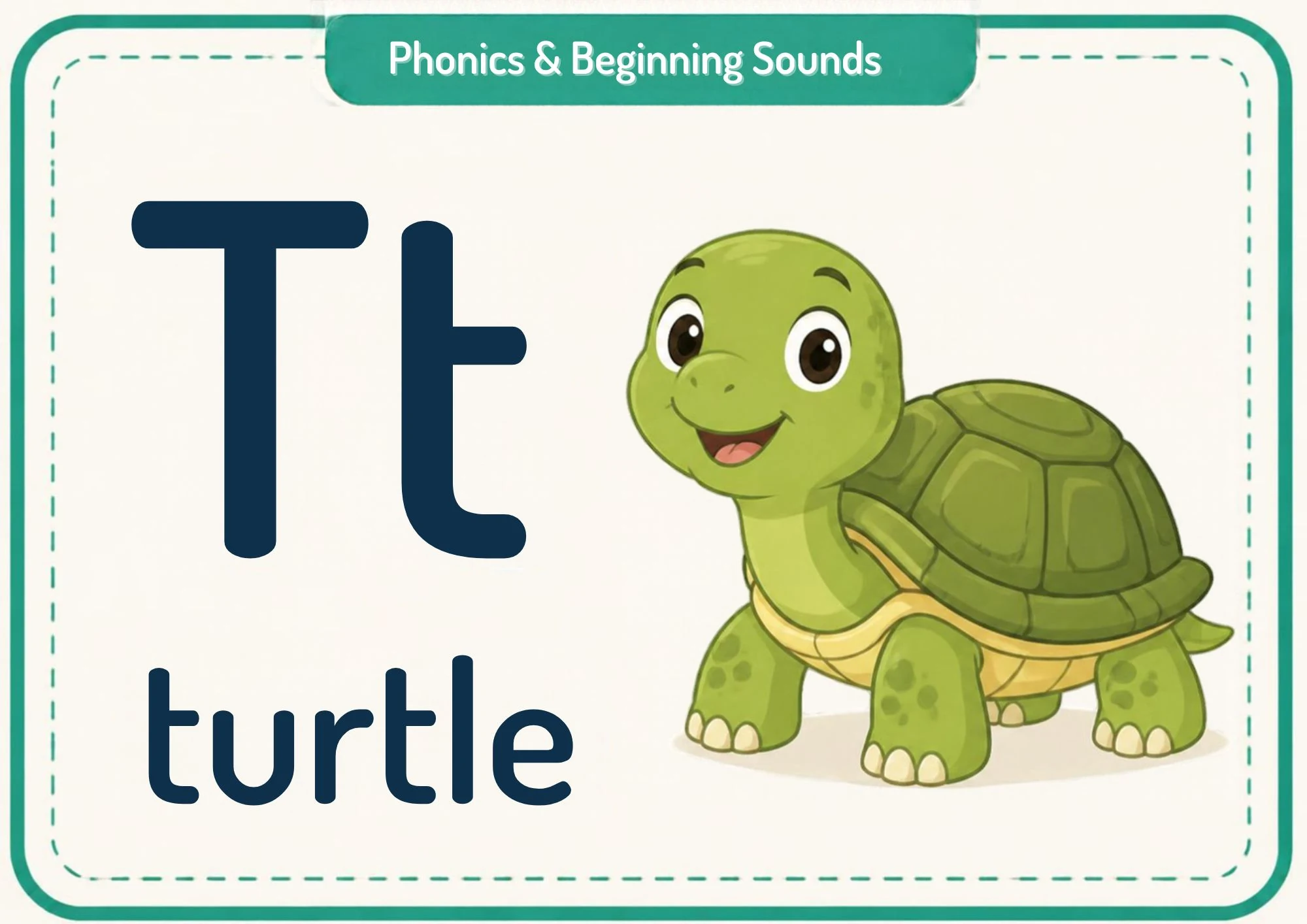
What is this?
Tt is the letter that stands for the first sound in turtle — a quick tongue tap just behind the top teeth with no voice: light, dry, over in a blink.
What does it mean?
T is d’s whisper twin: the same tap, the same spot, minus the buzz. Learning the pair by feel — tap with voice, tap without — is mouth-machinery knowledge for life.
What does the child need to know?
Your child needs the quick dry tap, the silent throat, and a turtle-pace list of t-words: turtle, toe, tree, ten.
Why this matters
/t/ carries toe, tea, train and tick-tock — sounds a child hears from morning to night. It is also the most common ending tap in English (cat, sit, hot), so the tap learned here works at BOTH ends of words.
What it teaches
Tongue-tip speed, voice-off control (the d/t switch), and word-ending awareness — noticing that sounds can finish words too.
Words to learn
tturtletoetreetentick-tock
Say this to your child
“"Tap your tongue just behind your teeth — t! Quick and quiet, like a clock. T says t, like turtle. Tick-tock the sound: t, t, turtle."”
Step by step
- Show the card: "Tt. Tap behind your teeth — quick and quiet: t! The turtle sound."
- Finger-trace the Tt on the canvas: one tall post and one roof, one tap per stroke.
- Play the train-ticket game below; every punch is a tap.
- Tap three t-things: turtle, toe, tea. Quick taps, slow words.
- Finish with the tick-tock finale: alternate t-t-t with d-d-d and feel the voice switch.
How to say it
Tongue tip taps the ridge behind the top teeth and releases, voice off: "t". One dry tap — no buzz, no puff-drag. The throat stays silent the whole time.
Look closer at the picture
On this card the big navy pair Tt sits beside a smiling green turtle, and the word "turtle" is printed below — the slowest animal in the set, perfect for the tap that is over fastest.
Ask your child
"Does your throat buzz for t?" "Where does your tongue tap?" "What t-word ticks?"
What your child can say or do
Your child might say: "t-t-t-turtle!" like a careful little clock, or report the great discovery: "t and d are the same tap — one just whispers!"
Out in the real world
Tick-tock clocks, taps at the door, toast and tea; turtles at the pond, toes in the bath. The tap hides at the END of words too: cat, hot, sit — say them slowly and catch it.
Try it together
Train-ticket game: build a train from chairs. The conductor punches each passenger’s ticket — "t-t!" — and every ticket names a t-stop: Turtle Town, Tree Station, Ten Street. Choo-choo between stops, tap the tickets, announce the destinations. Late passengers must pay in t-words.
Understanding check
Ask for the sound and watch the throat: a dry tap with no buzz is the pass. Then alternate with d — same tap, buzzing. If your child can feel the switch, the twins are clocked and sorted.
Parent tips
If turtle comes out "durdle", the voice crept in — hand on the throat restarts the whisper. And try t at the END of words too: cat, hot, sit — the tap works both shifts.
This lesson pairs with the Turtle flashcard in the library — print it, show it, keep it on the fridge. Back to Phonics & Beginning Sounds (Class 28).