
Spring — a step-by-step lesson for grown-up and child
This lesson teaches spring as a story your child can watch weekly: what the season wakes up, how to adopt a tree and track its changes, how to plant the first seeds, which birds come back to sing — and why the rain jacket never quite goes away.
What is this?
Spring is the season of waking up: days stretch longer and warmer, buds burst into leaves, bulbs push up shoots, blossom covers the trees, and the birds that left for winter return singing and busy with nests.
What does it mean?
Spring is change you can watch at child speed — one week buds, the next week leaves, the week after blossom. It is also a moody season: sunshine, shower, sunshine can share a single hour, which is why spring outings keep a rain jacket folded in the bag.
What does the child need to know?
Your child needs three spring ideas: spring is when plants wake and grow and birds come home; growth is fast and watchable — track one tree and see the story; and spring weather swings between sun and shower, so the light rain jacket travels with us.
Why this matters
Spring is the season of patient observation: the child who visits the same tree every week learns that big changes are made of small weekly changes — the deepest idea in science, taught by a bud. Add planting a seed and the season teaches cause, patience and care in one pot.
What it teaches
Weekly observation and recording, growth sequencing, plant-care responsibility, bird recognition and listening, weather flexibility (sun-shower-sun in one outing), and the vocabulary of new life: bud, shoot, blossom, nest, shoot, seedling.
Words to learn
springbudblossomseedshootnestshowergrow
Say this to your child
“"Spring is the waking-up season. The trees grow new leaves, the flowers push up, the birds come back to sing and build nests, and we plant our seeds in the soft ground. We keep our rain jackets close, because spring skies love a quick shower between the sunshine."”
Step by step
- Show the card: "Spring is when the world wakes up — the trees, the flowers, the birds."
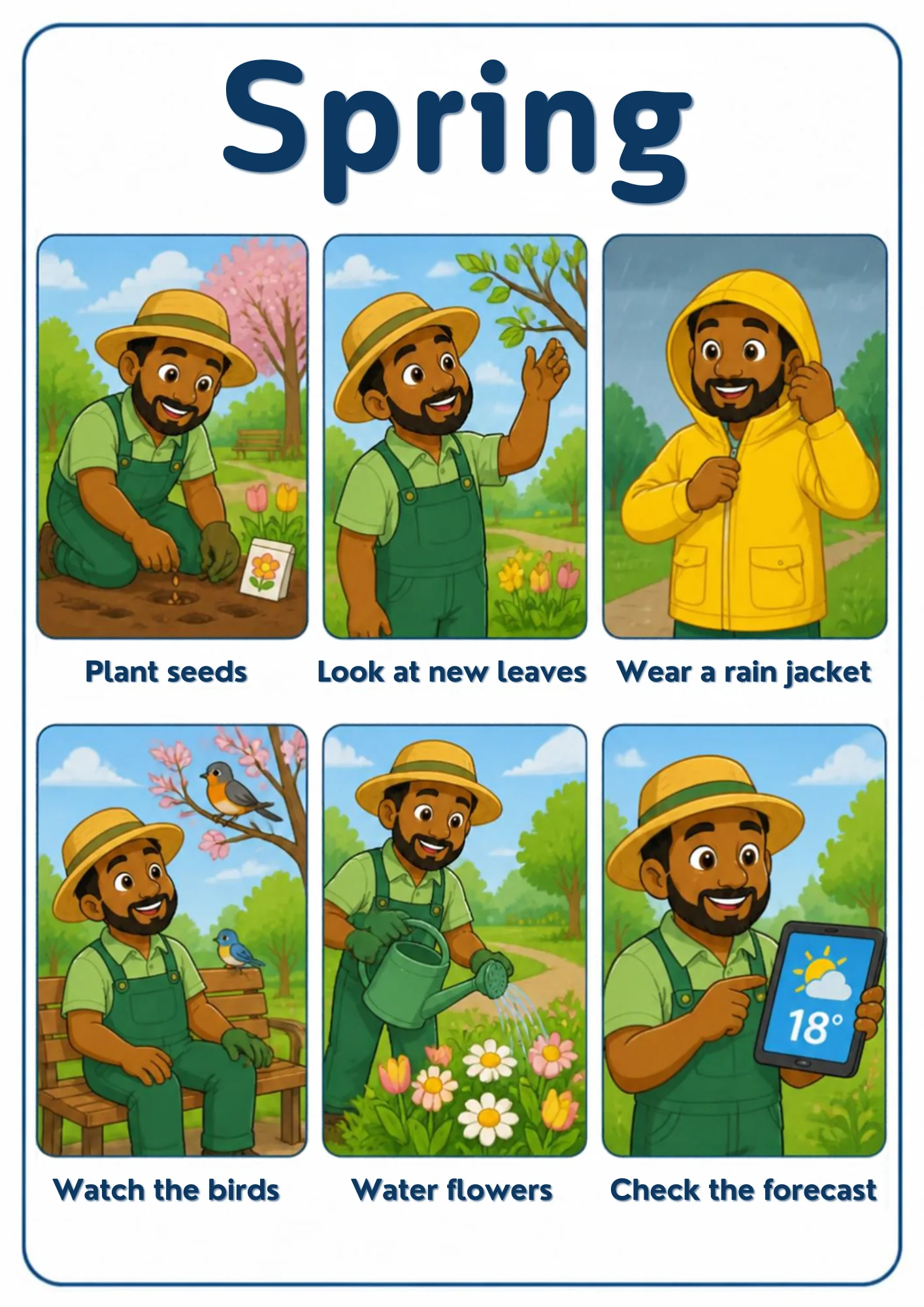
- Read the picture: the gardener in a straw hat plants seeds in the soft soil, touches the new green leaves on a branch, wears a yellow rain jacket under a grey shower, watches a robin and a blue bird on a blossom branch, waters the tulips with a green can and points at a partly-sunny forecast reading 18 degrees.
- Adopt a tree today: your tree for the whole spring. Visit weekly, draw what changed — bud, leaf, blossom — and keep the drawings in order like a comic strip.
- Plant the first seeds: beans in a clear cup by the window. Watch the root wiggle down, the shoot push up. Measure it with your finger every Monday.
- Pack the spring bag: sun hat AND folded rain jacket. Say the spring rule out loud: in spring we carry both, because the sky changes its mind.
Look closer at the picture
On this card a gardener in a straw hat with a green band, a light-green shirt and green overalls: kneels to plant seeds beside a seed packet with tulips blooming nearby, reaches up to touch fresh new leaves on a branch, wears a yellow rain jacket under a grey shower cloud, sits on a bench watching a robin and a small blue bird on a blossom branch, waters pink tulips and white daisies with a green watering can, and points at a tablet showing a partly-sunny icon and 18 degrees.
Ask your child
"What is waking up in spring?" "What did OUR tree change this week?" "What does a seed need to start growing?" "Why do we carry a rain jacket in spring?"
What your child can say or do
Your child might report like a scientist: "Two new leaves on our tree — three last week plus one!" or the planting log: "My bean grew a shoot as tall as my finger."
Out in the real world
Walk the neighbourhood as a bud-census: which trees woke first? Count the returning birds and learn one song by heart — the one that sings outside your window. Find the first bees back at work on the blossom and watch them a respectful moment: spring has staff, and they are busy.
Try it together
Tree-diary comic strip: one square per week, taped in a row — the tree’s whole spring as a story. Seed race: bean versus sunflower in neighbouring cups — who sprouts first, who grows tallest? Nest-watch from a distance with binoculars: busy birds, never touched, always marvellous.
Understanding check
Ask: "What happens in spring? What are we tracking on our tree? Why carry a rain jacket?" Waking-up, the weekly changes, and moody skies — your child is now fluent in spring.
Parent tips
Keep the tree visits short and sacred — five minutes, same tree, same question: "What changed?" The discipline is the magic. And when the shower ambushes your picnic, laugh and shelter: getting caught by a spring shower once teaches the jacket rule better than a hundred reminders.
Staying safe
Spring rules: hats return with the blossom — spring sunshine still burns; wash hands after soil and watering cans before snacks; watch nests and baby birds from a distance, never touch; and on blossom-branch climbs, remember wet spring grass is slippery grass.
This lesson pairs with the Spring flashcard in the library — print it, show it, keep it on the fridge. Back to Weather, Seasons & What We Wear (Class 34).