
Sun — a step-by-step lesson for grown-up and child
This lesson teaches what the sun actually does for us — light, warmth, growth and shadows — and builds the sun-respect habits that keep eyes and skin happy all summer.
What is this?
The sun is the star that lights our daytime and warms our world. It rises, crosses the sky and sets, and everything on Earth — plants, animals, people — arranges its day around its light.
What does it mean?
Sunlight does three big jobs at child height: it lets us see, it warms the ground and the air, and it feeds the plants that become our food. Where sunlight falls, shadows form on the other side — the sun is always the reason for a shadow.
What does the child need to know?
Your child needs three suns: the friendly sun that warms and lights; the bright sun that must never be stared at because its light is too strong for our eyes; and the summer sun whose heat asks for a hat, water and shade.
Why this matters
The sun is a child’s first astronomy and first safety lesson in one object. Pointing at the sun, tracking its shadows and feeling its warmth build real scientific reasoning — and respecting its brightness is a habit that protects eyesight for life.
What it teaches
Cause-and-effect thinking (sun out, shadows sharp), temperature vocabulary, time concepts through the sun’s daily journey, observation skills, and early self-care: hat, water and shade become the child’s own decisions.
Words to learn
sunsunshineshadowwarmbrightsunrisesunsetshade
Say this to your child
“"The sun gives us light so our eyes can see and warmth so we are cosy. It helps the flowers grow tall. We love the sun from far away — we never stare at it, and on hot sunny days we wear our hats and drink water."”
Step by step
- Show the card: "This is the sun. It gives us light to see and warmth to feel."
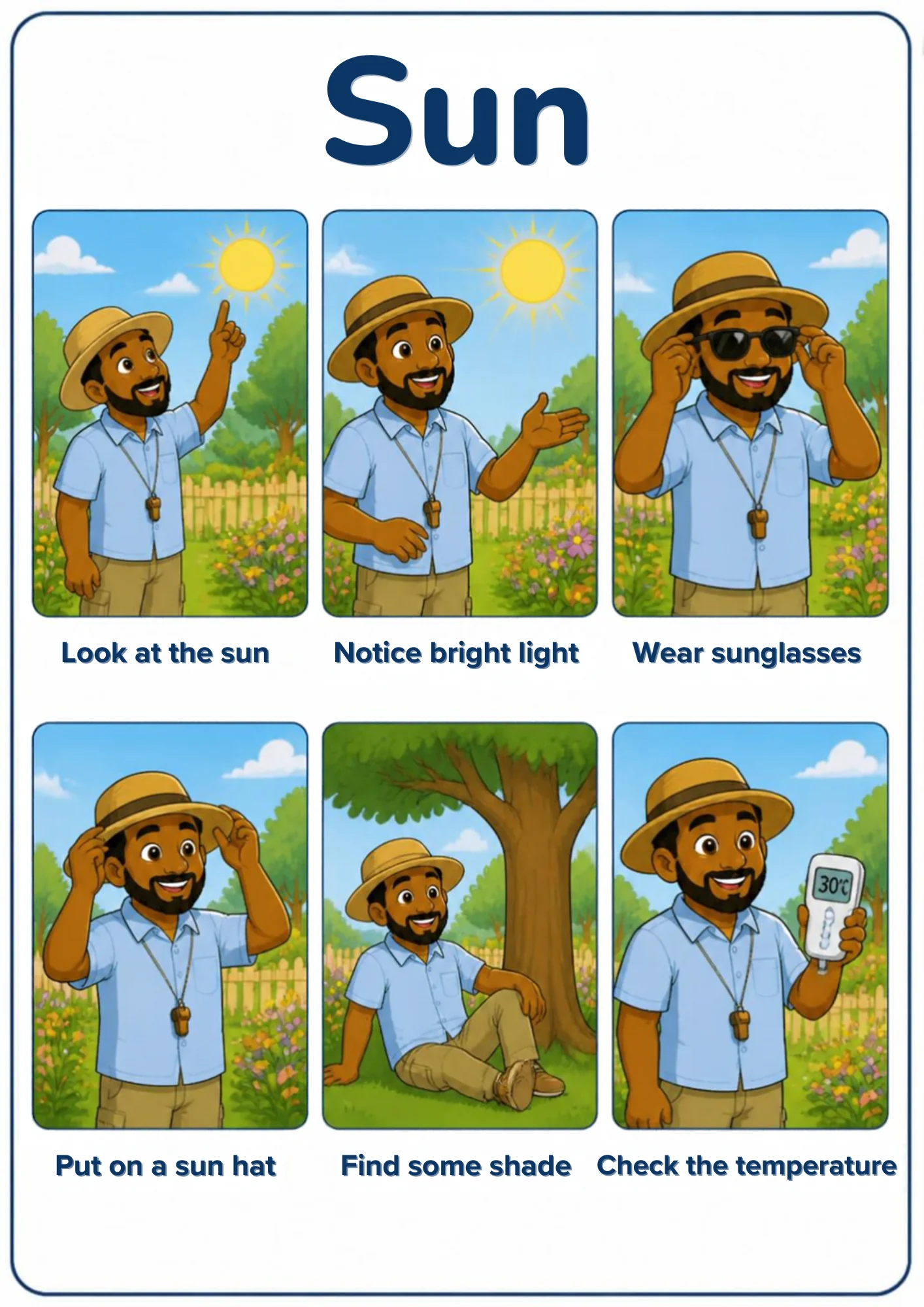
- Read the picture together: the guide points up at the sun in the sky, wears sunglasses, puts on a sun hat, rests under a tree and holds a thermometer that reads 30 degrees.
- Do the two-spot test: stand one moment in sunshine, one in shade. Which feels warmer? That warm feeling IS the sun.
- Teach the eye rule with respect, not fright: the sun is too bright to look at straight on — we admire it the way we admire a lamp, from the side, never staring.
- Finish with the sunny-day plan: hat on, water bottle filled, play in the shade when the sun is strongest. Act all three out right now.
Look closer at the picture
On this card a guide in a straw hat stands in a sunny park: he points toward the sun high in the blue sky, holds his hand out to notice the bright light, puts on dark sunglasses, places his hat on his head, sits resting in the shade of a big tree, and holds a white thermometer that reads 30°C. Every panel is a real sunny-day action your child can copy.
Ask your child
"What does the sun give us?" "Where does a shadow come from?" "Which spot feels warmer — the sunshine or the shade?" "What do we never do with our eyes at the sun?"
What your child can say or do
Your child might say: "The sun warms my face," "My shadow follows me because the sun is up," or the safety line: "I never look right at the sun — it is too bright."
Out in the real world
Chase shadows on the walk to preschool — long in the morning, stubby at midday, long again in the evening. Notice sun-warmed surfaces: the bench that bakes, the car door that glows, the sand at the park that heats through your shoes.
Try it together
Shadow tag in the garden: step on each other’s shadows instead of bodies. Then shadow freeze — when the sun "hides" behind a cloud, everyone freezes; when it peeks out, shadows dance again. Finish with a chalk line around a shadow and re-check it after lunch: it moved!
Understanding check
Ask: "What does the sun give us? Where must we never look? What do we wear on a hot sunny day?" Light-plus-warmth, never-stare, hat-and-water — three hits and the lesson has landed.
Parent tips
Model the eye rule yourself — if you squint and turn away from the sun, narrate it: "Too bright for my eyes, I will look down here." Children copy what you do with your face far faster than what you say. And keep hats by the door so grabbing one is automatic.
Staying safe
Never look directly at the sun — not with eyes alone, not through sunglasses as a "test". On hot days: hat, water breaks and shade rests, sunscreen applied by a grown-up, and never wait inside a parked car, not even for a minute.
This lesson pairs with the Sun flashcard in the library — print it, show it, keep it on the fridge. Back to Weather, Seasons & What We Wear (Class 34).