
Loved — a step-by-step lesson for grown-up and child
This lesson gives the deepest feeling its name: loved. The card pairs the word with the warmth, and the week makes sure the word arrives on ordinary days, not just special ones.
What is this?
Loved is the warm, safe, held feeling — cuddles, tucked blankets, being found in a crowd. Your toddler has lived it since day one; the card simply hands the feeling its word.
What does it mean?
Love named becomes love owned: a toddler who hears loved attached to cuddles and ordinary Tuesdays learns the feeling is permanent, not earned. That security is the platform every other feeling stands on.
What does the child need to know?
Expect a hug, a grin, or loved said as a happy mumble into your shoulder. There is nothing to test here — the lesson is the saying, and the saying is the lesson.
Why this matters
The word costs nothing and pays forever. Said at bedtime, after a storm, in the middle of nothing at all, it builds the constant your toddler will stand on for years.
What it teaches
Attachment language, security, and emotional vocabulary for the feeling under all feelings — the word that makes the rest of the deck safe to explore.
Words to learn
lovedlovehugcuddlekisswarm
Say this to your child
“"Loved. This face is feeling loved — warm and safe and snug. That is my heart about you! I love you at cuddle time, I love you after storms, I love you all day long. Come here — cuddle time."”
Step by step
- Show the card at cuddle time with your toddler already in your arms: loved — this face is feeling loved. Let the word land inside the hug.
- Connect word and warmth: this face shows loved — it is exactly how I feel about you. Say it slowly, once, and let the cuddle finish.
- Ask where the loved face is; a point from inside the hug is the perfect answer.
- Say loved at ordinary moments all week: after breakfast, after a storm, halfway through shoes. The word should feel like furniture, not a fireworks display.
- Let your toddler give it back: a hug offered to you or to teddy is loved spoken in their own language — receive it like the news it is.
Look closer at the picture
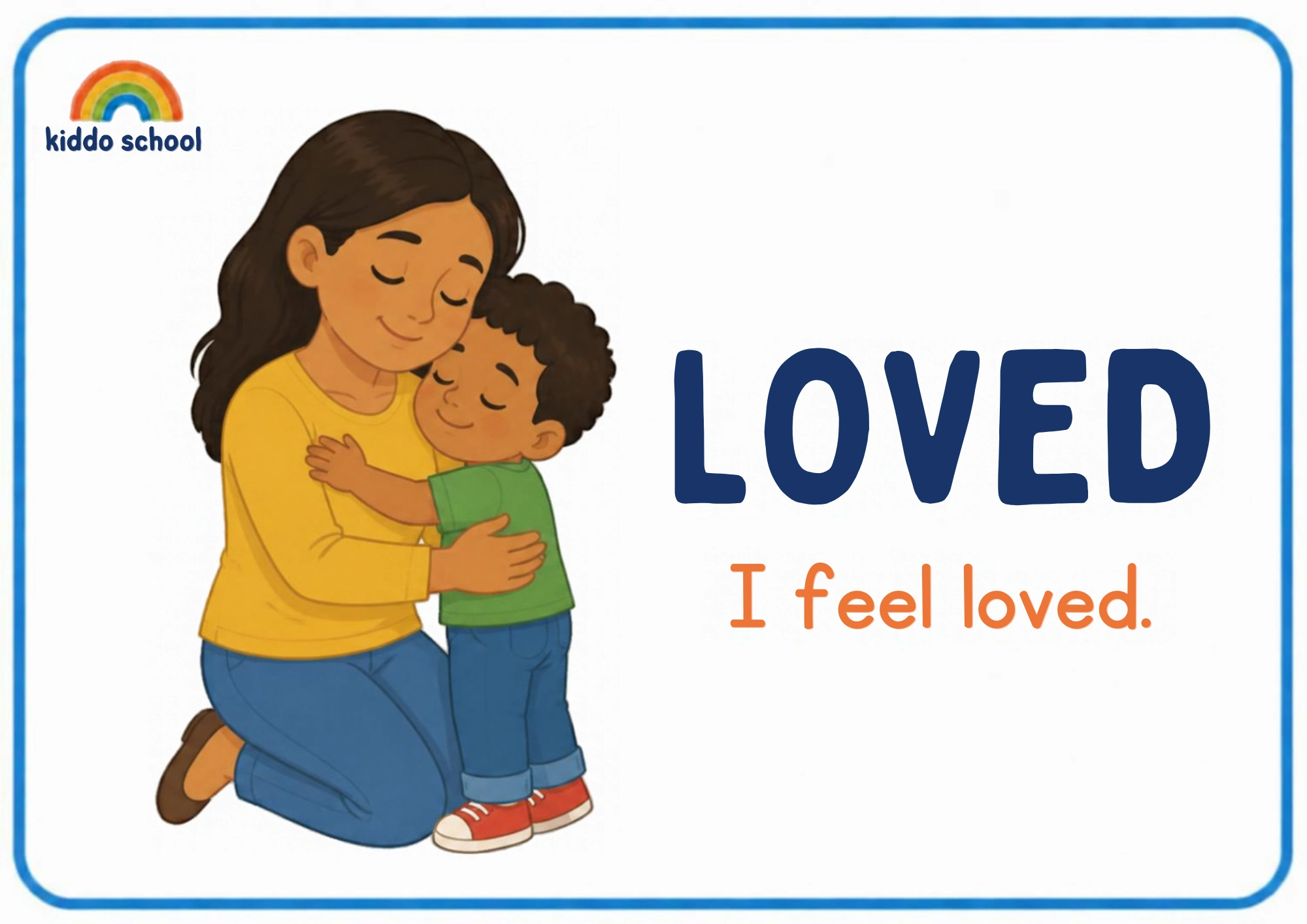
The card shows an illustrated child feeling loved — one warm, cosy face. Ask your toddler to find the loved face, then to give someone nearby a hug to match it.
Ask your child
"Where is the loved face?" "How does a cuddle feel?" "Who loves you?" "Who do you love?"
What your child can say or do
A hug that arrives as the answer, a loved said with milk still on the top lip, or a kiss blown at the card — the feeling barely needs the word. Expect to be hugged mid-sentence; accept it as fluency.
Out in the real world
Loved moments are everywhere already: the towel at bath time, the reunion at the gate, the last story. Attach the word to two a day and the feeling gets its name on the regular.
Try it together
Love-round game: at bedtime, name three people who love your toddler — one, two, three, each with a squeeze. The roll call turns love from a feeling into a list your toddler can hold.
Understanding check
There is no test for being loved — the pass mark is the cuddle itself. Watch instead for the word arriving in your toddler’s play: a teddy told it is loved means the vocabulary is moving in for good.
Parent tips
Say it on flat days as much as golden ones — loved needs to feel like a steady constant, never a reward for behaviour. The word after a meltdown teaches the deepest version: love that does not depend on the weather.
Staying safe
No safety angle here — this is the safest word in the deck. The honest note: keep it unconditional. Loved said at tantrums and triumphs alike is what makes the word load-bearing.
This lesson pairs with the Loved flashcard in the library — print it, show it, keep it on the fridge. Back to Emotions & Feelings (Toddler 7).