
Butterfly — a step-by-step lesson for grown-up and child
This lesson makes the prettiest card a whole-body game: your toddler becomes a butterfly, flapping slow and gentle, then learns the watching rule — a butterfly’s wings belong to the air, not to our hands.
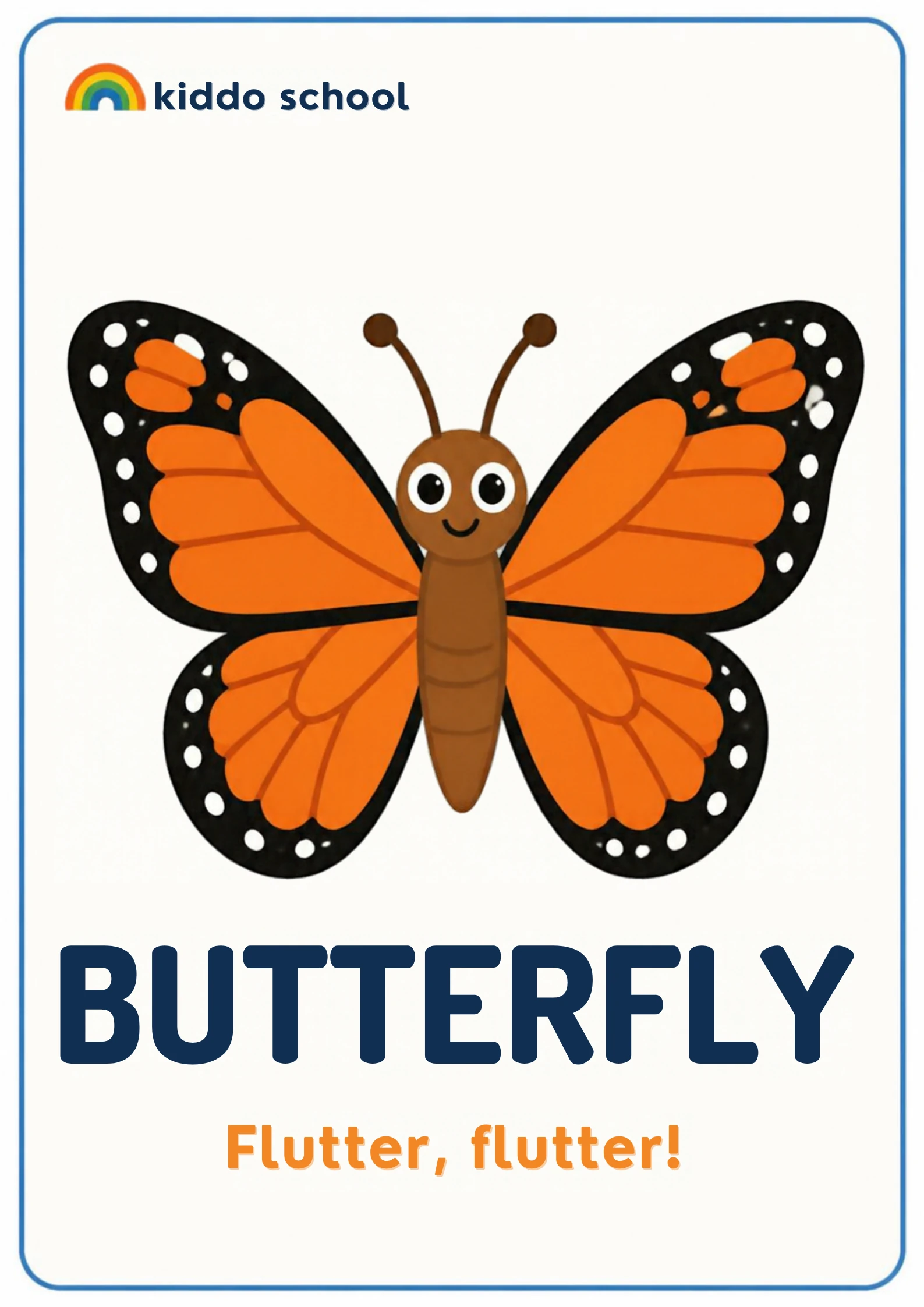
What is this?
A butterfly is an insect with two pairs of big painted wings that flap slowly from flower to flower. It lands to sip nectar, rests with its wings open, and flies off the moment anything moves too fast.
What does it mean?
Butterflies hand a two-year-old the perfect movement word: flutter. The flap is slow, the mood is calm, and the animal is far too quick and delicate to hold — which is exactly why the lesson works on gentleness.
What does the child need to know?
Butterflies flap slowly and love flowers, and they are look-at friends: chasing only sends them away. Hands stay down; the wings are prettiest in the air where they belong.
Why this matters
A creature that leaves when chased teaches cause and effect more kindly than any lecture: quick hands mean a gone butterfly, still hands mean it stays. The lesson teaches self-control with a living, flying reward.
What it teaches
Slow-and-gentle body control (the crossed-wing flap is surprisingly tricky), vocabulary for wings and flowers, watching practice at garden speed, and the earliest what-happens-if reasoning.
Words to learn
butterflyflutterwingsflowerssoftslow
Say this to your child
“"A butterfly! Big painted wings — flap, flap, slowly, slowly. Butterflies love flowers and take their time. When we see one, we walk soft and watch with our eyes. Our hands stay down, and the butterfly stays with us a little longer."”
Step by step
- Show the card and say butterfly — a big, beautiful mouthful, so say it slowly and let your toddler try the syllables.
- Lift both arms overhead, cross them at the wrists, and flap slowly — a butterfly’s own unhurried flutter — and let your toddler copy.
- Flutter around one cushion together: slow wings find flowers, fast wings scare them away. The speed is the lesson.
- Whisper the story: butterflies sip from flowers, rest a while, then fly off — so we tiptoe past and let them get on with it.
- Finish with the rule, warm and short: butterflies are look-at friends. We flap like them, we watch them, and our hands stay empty.
Look closer at the picture
Say butterfly together, then make slow crossed-arm wings. The butterfly on this card has orange and black wings — ask your toddler which colour shows the most, and flap once for each colour they can find.
Ask your child
"What do the butterfly’s wings look like?" "Can you flutter slowly?" "Where does the butterfly like to rest?" "Do we catch the butterfly, or watch it?" — answered with a flap, a whisper and a proud head-shake.
What your child can say or do
"Fly!" with crossed-arm flaps at the window, butterflies discovered in every second picture book, and the first real sighting met with a hush instead of a dash — the gentleness training already showing.
Out in the real world
Butterflies drift through gardens, parks and balconies on sunny days, resting on petals and fences. Each one is a rerun: name it, flap once, watch it sip, and let it drift off without a single grabbed handful.
Try it together
Flower to flower: scatter a few paper flowers on the floor and flutter from one to the next, resting at each with wings open — slow, calm, and the finest quiet-time game in the set.
Understanding check
Ask for the butterfly move tomorrow: crossed arms and a slow flap means the word has grown wings. If your toddler whispers instead of shouting at a real one, the gentleness has landed too.
Parent tips
Flap slowly yourself — your pace sets your toddler’s. If a real butterfly startles and darts away, narrate the happy ending: it flew home. Chasing is not a failure; it is simply the next chance to practise still hands.
Staying safe
Butterfly wings are covered in tiny dust-fine scales that fingers rub off, so catching squeezes the colour right off them — and garden flowers may host other bugs too. Watching from a small distance keeps both the butterfly and the toddler clean.
This lesson pairs with the Butterfly flashcard in the library — print it, show it, keep it on the fridge. Back to Garden Bugs & Friends (Toddler 8).