
Fence — a step-by-step lesson for grown-up and child
This lesson walks the edge: your toddler traces the boundary post by post, counts what passes, peeks through a gap to the world beyond, and learns the two fence rules.
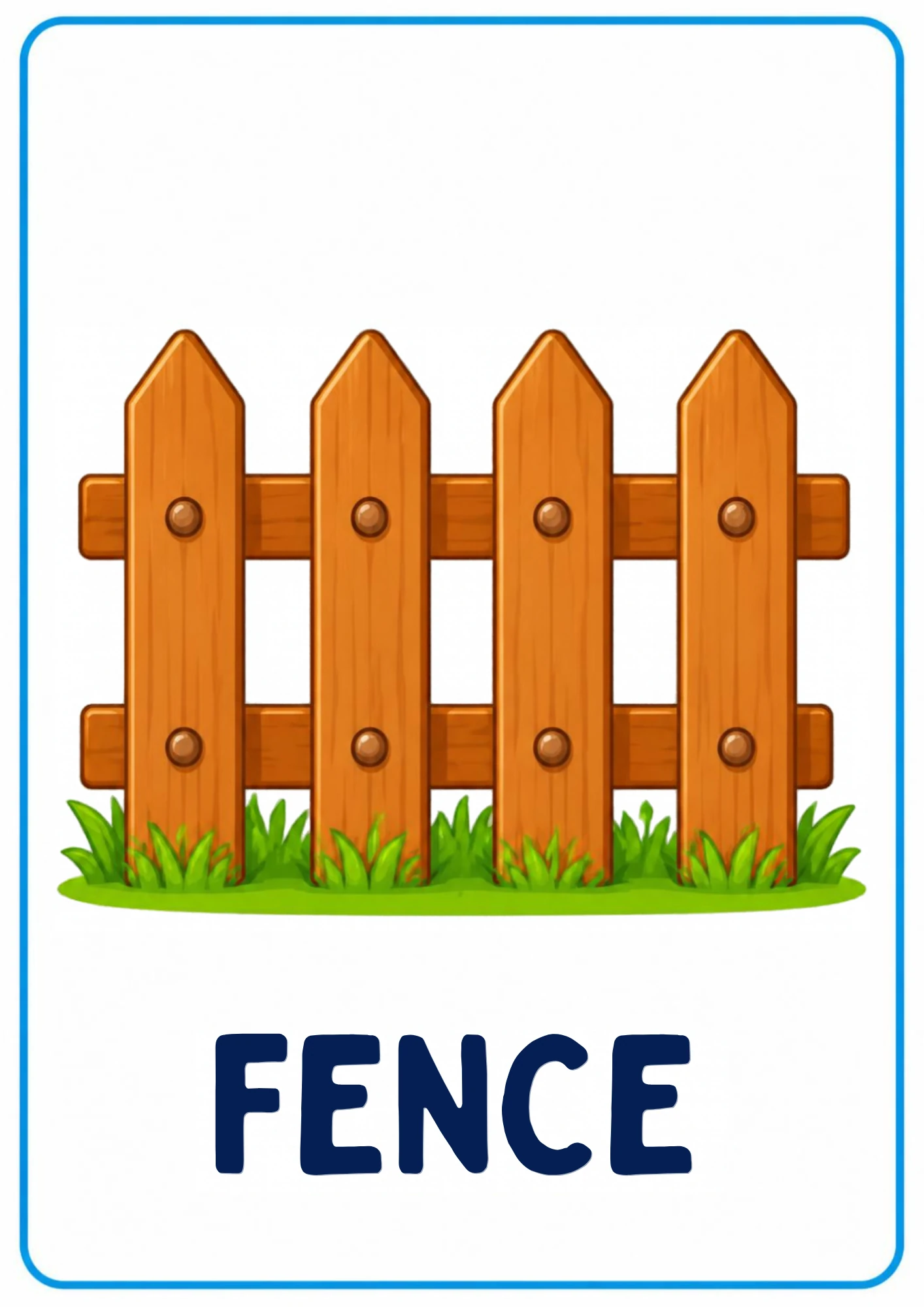
What is this?
A fence is the line that goes all the way around a garden, made of posts and panels or wire. It marks where the garden ends, keeps balls in and shows everyone exactly where the boundary runs.
What does it mean?
The fence is the set’s boundary card — the first map your toddler can walk with their feet. Following it round teaches where home ends and the world begins, one post at a time.
What does the child need to know?
The fence runs the whole way round, and every post holds a piece of it. The rules: fingers stay out of gaps (they pinch), and gates open with a grown-up’s help — the fence guards the garden, and the grown-up guards the gate.
Why this matters
Boundary-walking is orientation, counting and safety in one loop. And the peek-through turns a barrier into a window — the world next door becomes a curiosity rather than a mystery, from a perfectly safe side.
What it teaches
Boundary awareness (where does our garden stop?), early counting on posts, gap-and-pinch safety logic, spatial words (around, through, over), and neighbourly hello-practice.
Words to learn
fencepostsaroundgapgateboundary
Say this to your child
“"A fence! It wraps right around the garden, edge to edge — post, panel, post, panel. Let us walk it and tally the posts as we pass: one, then two, then more... Look through this gap — what can you see next door? And our fence rules: fingers stay out of the gaps, and gates only open with me."”
Step by step
- Show the card, say fence, and trace a big rectangle in the air with one finger — around and around, the garden’s outline.
- Ask what the fence does — it goes all the way around! — then count the posts you can see on the card: one, two, three...
- Walk the real boundary at home or the park: follow the fence line the whole way round, counting posts as you pass them.
- Stop at a gap or a knot-hole and peek through together — what is on the other side? Trees? A dog? The world next door?
- Close with the two rules, hands demonstrated: fingers never in gaps, and gates open only when a grown-up does the opening.
Look closer at the picture
Draw a big fence line in the air and say fence. Ask your toddler to find the posts on the card, count the ones you can see together, then walk your own boundary at the first chance — post by post.
Ask your child
"What goes all the way around the garden?" "How many posts can you count?" "What is on the other side of the fence?" "Do our fingers go in the gaps, or stay out?" — answered with a count, a peek and fingers held up safe and sound.
What your child can say or do
"One two three!" Expect boundary walks demanded at every garden, posts counted on every railing, and hellos called over fences to dogs, cats and startled neighbours. Gate-opening will be reported to you for approval — take the promotion.
Out in the real world
Fences edge every garden, park, school and pitch; railings count too. Each boundary is a walkable map — follow it round, count, peek, and finish with a wave over the top to whoever is next door.
Try it together
Post count: walk any railing or fence and count posts aloud together — restart whenever you like, the counting matters more than the total. Finish with a proper over-the-fence hello to something: tree, dog, cloud.
Understanding check
At the next gate, watch the hands: they wait for yours means the gate rule is home. A fence line walked all the way round without shortcutting is the diploma.
Parent tips
Count posts loosely — "one, two, lots" is a fine total at two. If your fence has a favourite gap, make the peek a daily weather report: what can we see through the hole today?
Staying safe
Gaps between boards and wire can pinch or trap small fingers — hands stay flat on posts, not inside holes, and that includes railings. Gates open with a grown-up only, driveways and pools behind fences stay strictly supervised, and nobody squeezes through, ever.
This lesson pairs with the Fence flashcard in the library — print it, show it, keep it on the fridge. Back to Garden Things (School Garden).