
Weigh-In — a step-by-step lesson for grown-up and child
This lesson teaches the weigh-in as the growth report: stand on the scale, hold still, and hear how much bigger you are than last time.
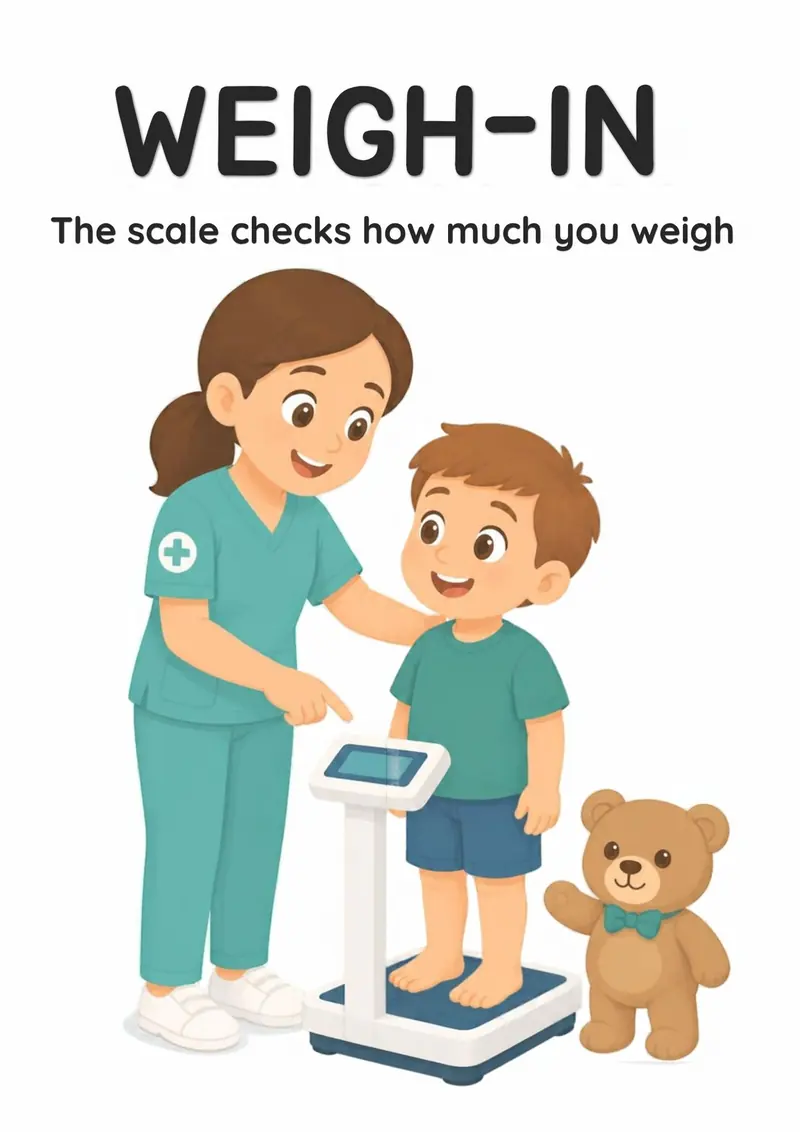
What is this?
A weigh-in is standing on the clinic scale so it can measure how much your body weighs — one of the numbers that shows the doctor you are growing.
What does it mean?
Numbers about bodies are just facts — unless nobody explains them. "You grew!" is the only interpretation a three-year-old needs, and it makes the scale a scoreboard.
What does the child need to know?
You need the card and any bathroom scale. Practice stepping on, standing still (the hard part!), stepping off. Weigh teddy. Weigh everyone. Numbers become a party trick.
Why this matters
The weigh-in is the first "hands-on" moment of most visits and it is completely gentle — a guaranteed early win that carries courage into the stethoscope part.
What it teaches
Measuring as describing (not judging), body-awareness vocabulary (heavier, taller, growing), and standing-still control — a real motor skill.
Words to learn
weigh-inscalestand stillgrowheavynumber
Say this to your child
“"Weigh-in! Stand on the scale — click! Hold still like a statue… and there it is: you GREW. That is the best news the doctor could hear."”
Step by step
- Show the card: "the scale checks how much you weigh."
- Home practice: step on, statue-still, three seconds, step off.
- Weigh the whole family — and teddy. Laugh at the numbers.
- The magic sentence: "you grew! Last time you were smaller."
- At the real visit: "statue time!" — and the nurse gets a perfect weigh-in.
Look closer at the picture
On this card the words "weigh-in — the scale checks how much you weigh" sit over a nurse guiding a child onto a clinic scale, teddy bear waiting on the floor.
Ask your child
"What does the scale tell us?" (how much you weigh) "What does it mean when the number is bigger?" (you grew!) "How do we stand on it?" (still, like a statue)
What your child can say or do
Your child might weigh everything with batteries (no) or without (also no), demand weekly weigh-ins, or announce "I GREW" to the dinner table.
Out in the real world
The market scales fruit and the bathroom scales the whole family — scales are everywhere, and every one is just a measuring machine with a job.
Try it together
The Statue Scale: painter’s tape square on the floor; whoever stands still longest "gets weighed" (a paper number held up). Best statue wins the biggest number. Silly, and it drills the exact skill.
Understanding check
Ask: "What do we do on the scale?" (stand still) "What does the scale measure?" (how much you weigh) "What did the number show?" (that you grew!)
Staying safe
Keep it light and skip comments about weight in any direction other than growing. The scale measures, the doctor reads, the child hears only "you grew."
This lesson pairs with the Weigh-In flashcard in the library — print it, show it, keep it on the fridge. Back to Doctor Visit.