
Harmonica — a step-by-step lesson for grown-up and child
This lesson teaches the harmonica’s two-way secret: blow OUT for one note, breathe IN for another — the only instrument on the shelf that plays on the inhale, and small enough to live in a pocket.
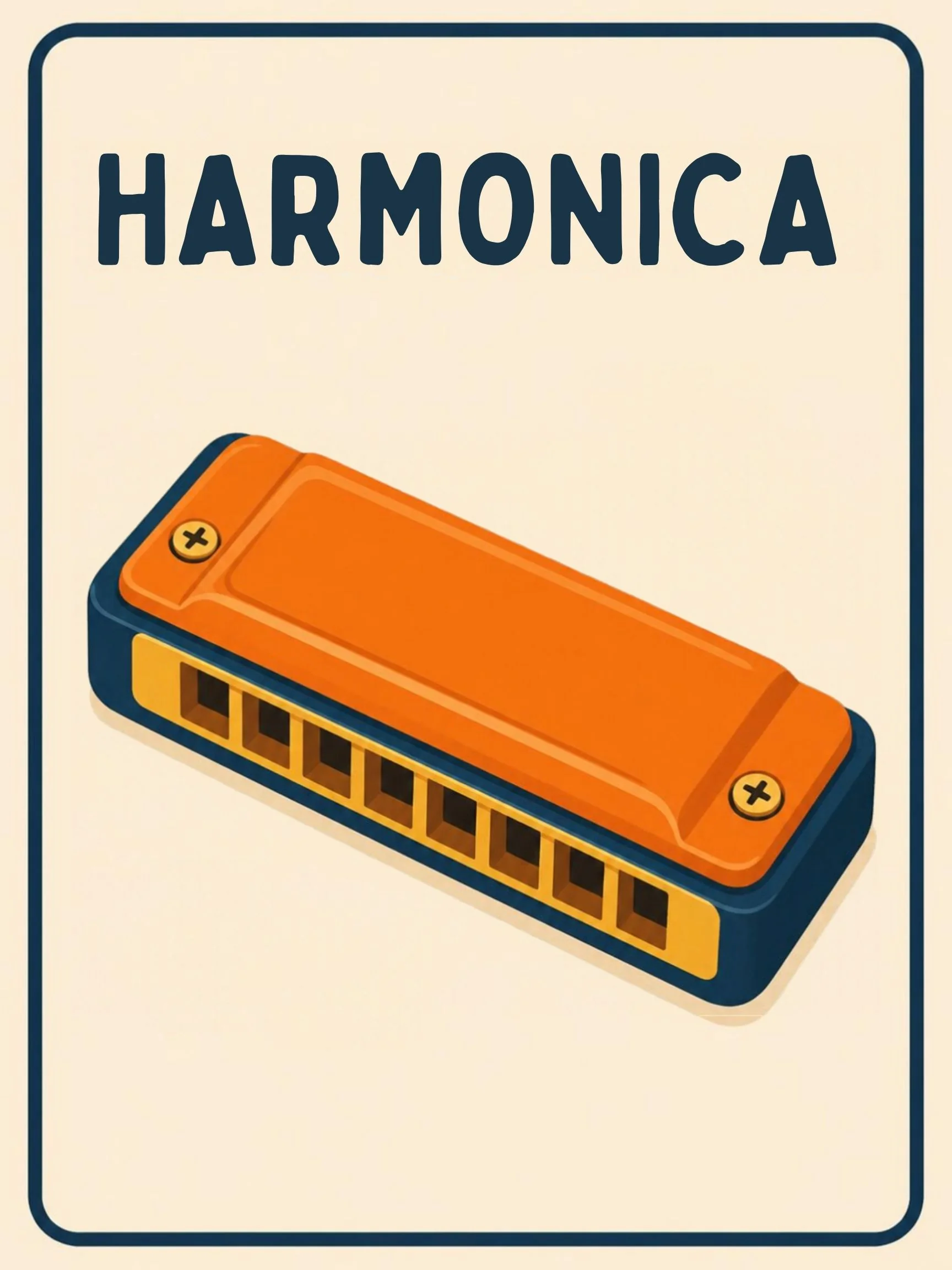
What is this?
A harmonica is a tiny bar of metal combs and reeds: blow through a hole and one reed sings; breathe IN through the same hole and a different reed answers. Ten holes, twenty notes, whole songs — and it fits in a sock drawer.
What does it mean?
The blow-draw pair is a breathing revelation: music on the EXHALE and the INHALE. Children discover their own breath has two directions of song — and the harmonica’s size makes it the first instrument that goes everywhere they do.
What does the child need to know?
Your child needs three harmonica ideas: blow = one note, draw (breathe in) = a different note — the two are neighbours on every hole; it moves ACROSS the lips — tilt and slide to find holes; and the train sound — two notes chuffing in and out — is the famous first song.
Why this matters
The blow-draw game trains breath direction awareness that swimming, woodwinds and singing all borrow later — and the harmonica hands it over in a toy-sized, pocket-sized, giggle-sized package.
What it teaches
Bidirectional breath control, small-muscle slide-and-tilt, pattern pairs (blow-draw-blow), and the confidence of carrying an instrument in a pocket.
Words to learn
harmonicablowdrawbreathe inholesslidechuff
Say this to your child
“"The harmonica plays on BOTH breaths! Blow OUT — one note. Breathe IN — a different note! It tilts against your lips, and sliding along finds new holes: wee-oo-wee-oo. And the famous first song is a train: chuffa-chuffa, out and in, out and in — a whole railway in your pocket!"”
Step by step
- Show the card: "This is a harmonica — a whole band in your pocket."
- The two ways: blow OUT through a hole — one note. Breathe IN through the same hole — a different note! The harmonica plays both ways; no other shelf instrument does.
- The slide: it rests against the lips and TILTS — moving mouth finds moving holes. Slide gently along: wee-oo-wee-oo.
- The train: blow-draw-blow-draw on two neighbouring holes — chuffa-chuffa — the famous harmonica train.
- Play the train game below and close: "out and in, both directions sing."
Look closer at the picture
On this card the word "Harmonica" stands in big navy capitals inside the rounded frame, with a friendly illustration of the small harmonica below — exactly as the pocket band looks.
Ask your child
"What do we call breathing IN on the harmonica? What happens on the same hole when we draw? What is the famous first song?"
What your child can say or do
Your child might say: "Blow and draw — two notes, one hole!" "Wee-oo — I’m sliding!" or the chuff: "Chuffa-chuffa — my train!"
Out in the real world
Harmonicas ride in pockets everywhere — folk, blues, campfires — and the blow-draw trick lives in every blade of grass held between thumbs and every bottle-top whistle. Breath both ways is an old, old human toy.
Try it together
Pocket Train: harmonica (or paper-tube stand-in). Find one blow note, one draw note — neighbours. Chuff them in a slow rhythm: out-in, out-in — the train leaves the station! Speed up gently… round the mountain… slow to a stop at the platform. Then the echo game: two notes blown, two drawn — answered. Twenty notes, one pocket, whole journeys.
Understanding check
Ask: "What note plays when we breathe IN? How does the mouth find new holes? What is the first song?" A draw note, by sliding, the train — three answers and the pocket sings.
Parent tips
Tilting works better than pushing — the harmonica rests on the lips like a feather. And keep it personal: harmonicas are one-mouth instruments; every player deserves their own (even if the paper tube gets the encore).
This lesson pairs with the Harmonica flashcard in the library — print it, show it, keep it on the fridge. Back to Music Room (Class 23).