
Harp — a step-by-step lesson for grown-up and child
This lesson teaches the harp — the tall instrument where the strings stand in a ladder: long strings at your tummy ring low, short strings above ring high, and one sweep makes the famous angel-run.
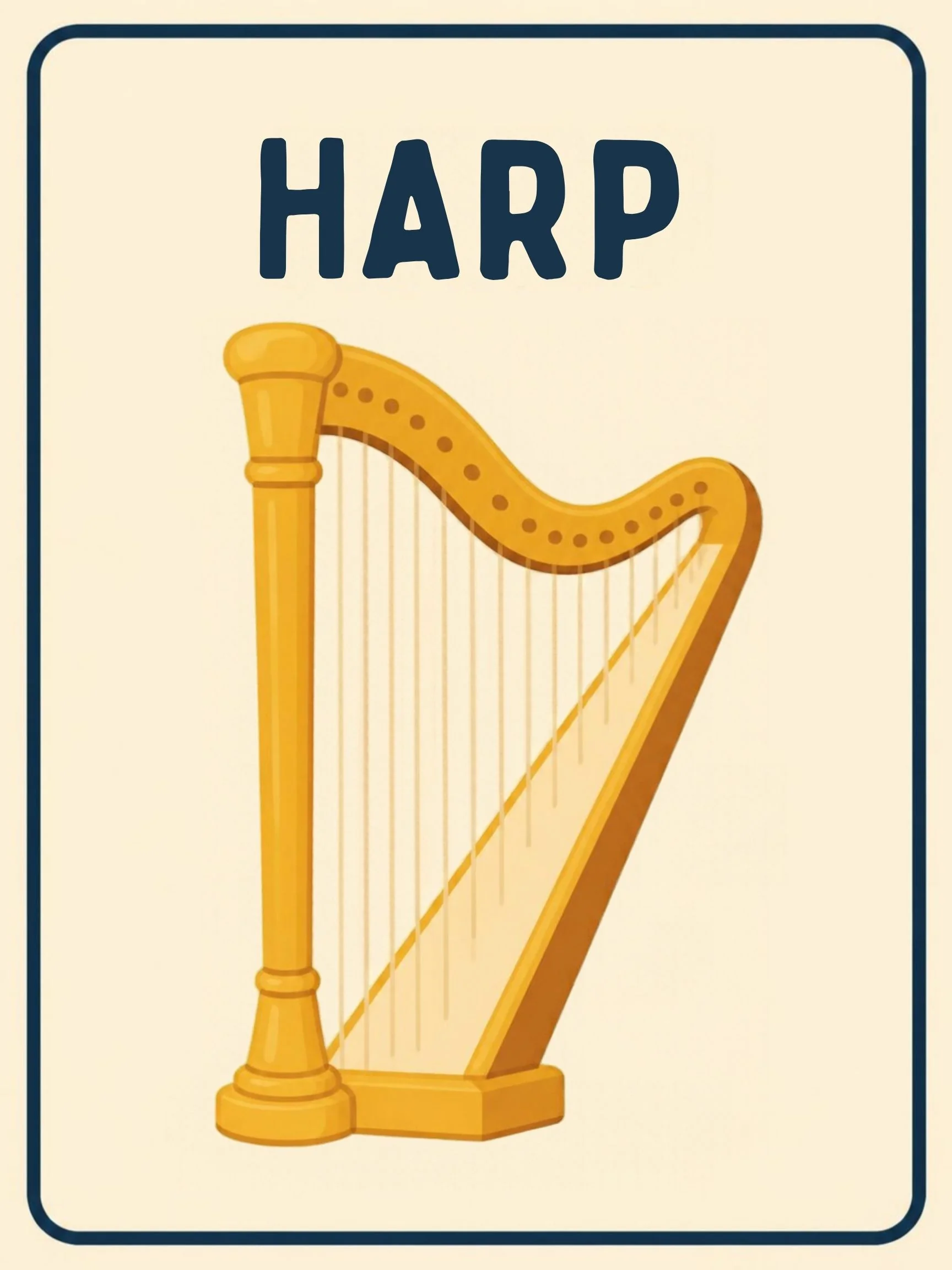
What is this?
A harp is a frame of strings standing upright: nearly fifty of them, arranged long to short. Pluck a string and it sings one soft note; drag a finger across all of them — the glissando — and the whole sky ripples at once.
What does it mean?
The harp makes pitch VISIBLE in the most beautiful way: string length IS the ladder. Long-low at the bottom, short-high at the top — the whole scale standing upright in golden rows, pluckable by anyone.
What does the child need to know?
Your child needs three harp ideas: long string = low note, short string = high note — the ladder stands upright here; the pluck is gentle — pull-and-release like picking an apple, never a snap; and the glissando is one finger dragging across ALL the strings — the angel run.
Why this matters
The glissando is the most beautiful one-finger sound in music — instant, enormous, achievable on day one. And the length-pitch ladder repeats later on every stringed instrument a child will meet.
What it teaches
Length-pitch mapping (upright this time), gentle pluck-release control, the sweeping glissando, and high-low ordering across nearly fifty choices.
Words to learn
harpstringsladderpluckglissandolongshort
Say this to your child
“"The harp is a ladder of strings standing up to the sky! Long strings at the bottom — low and sleepy. Short strings at the top — high and sparkly. Pluck one like picking an apple: pling. And drag one finger across ALL of them — fwwwish! — the glissando, the angel run, the most beautiful sweep in music."”
Step by step
- Show the card: "This is a harp — a ladder of strings standing up to the sky."
- The upright ladder: strings at the bottom are LONG — low, sleepy. Strings at the top are SHORT — high, sparkly. The scale is standing up!
- The apple pluck: pull the string gently and let go — like picking an apple, soft and round. Never a sharp snap.
- The glissando: one finger, dragging slowly across ALL the strings — fwwwwwish! The angel run. Practise slow, then slower.
- Play the ladder game below and close: "long is low, short is high."
Look closer at the picture
On this card the word "Harp" stands in big navy capitals inside the rounded frame, with a friendly illustration of the tall harp below — its strings exactly as the ladder looks.
Ask your child
"Which strings ring low — long or short? What is the gentle pluck like? What do we call dragging one finger across all the strings?"
What your child can say or do
Your child might say: "Long is low, short is high!" "The apple pluck!" or the angel run: "Fwwwish — I played the whole sky!"
Out in the real world
Harps stand in orchestras, Irish pubs and storybooks of angels — and their ladder lives on every rubber-band frame and garden fence: long band low, short band high. The angel run is one finger away.
Try it together
Rubber-Band Harp Ladder: stretch five bands of different lengths over an open box or chair back — long to short, bottom to top. Pluck the ladder: low… high. Name it, then sing it. Then the glissando: one finger, one slow sweep — the room fills. Finish with harp stories: every sparkle moment in a fairy film is this exact sweep. Now it lives at your house.
Understanding check
Ask: "Long string or short — which is low? What is the gentle pluck called here? What is the sweep?" Long-low, the apple pluck, the glissando — three answers and the ladder sings.
Parent tips
Different band lengths AND thicknesses both change pitch — let the child rebuild the ladder until the order sings true. And the apple pluck keeps fingers (and bands) safe from snapping.
This lesson pairs with the Harp flashcard in the library — print it, show it, keep it on the fridge. Back to Music Room (Class 23).