
Piano — a step-by-step lesson for grown-up and child
This lesson teaches the piano’s grand idea: eighty-eight keys laid out in one perfect ladder — low on the left, high on the right — and inside every key, a little hammer waiting to strike a string.
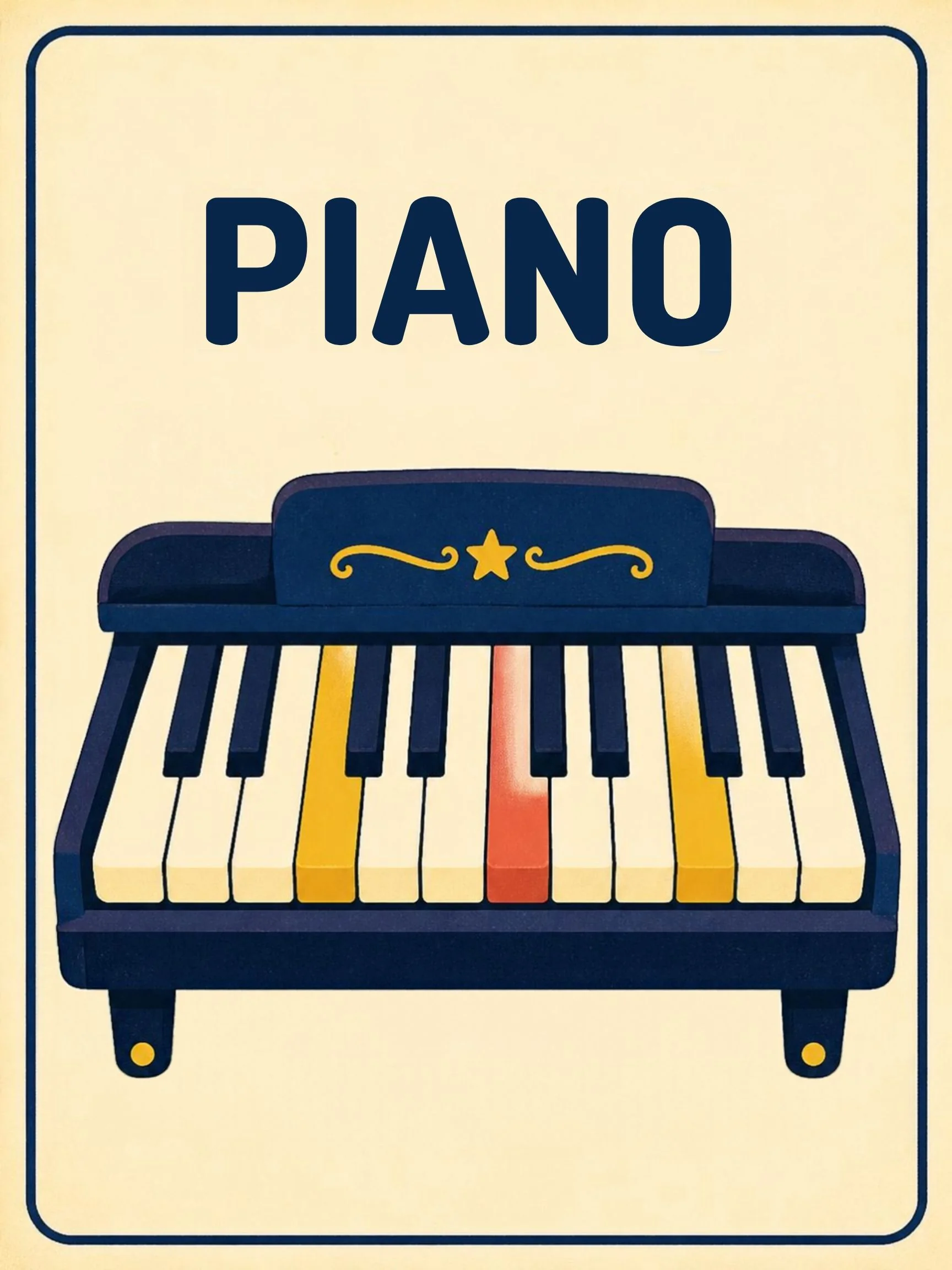
What is this?
A piano is a keyboard over hammers and strings: press a key, a felt hammer strikes a string inside, and the note rings. The keys run low (left) to high (right), with the black keys standing in twos and threes like landmarks.
What does it mean?
The piano is the pitch ladder made physical: every note has its own key, in order, waiting. No breath, no bow, no tuning — just reach, press, hear. It is the clearest map of music ever built, and children read it by walking it.
What does the child need to know?
Your child needs three piano ideas: left is LOW, right is HIGH — the ladder lies flat under your fingers; inside each key a hammer strikes a string — the piano is a drum shop for strings; and the black keys are landmarks — two-then-three, two-then-three — the map’s signposts.
Why this matters
Key-order thinking — one note per key, left-low right-high — is the foundation every keyboard, glockenspiel and scale climbs. And the hammer-inside story turns pressing into a small mechanical joy.
What it teaches
Pitch mapping across space (left-right ladder), one-finger pressing to five-finger walking, pattern spotting (the black-key groups), and the cause-press-effect-sound loop.
Words to learn
pianokeyshammerstringlowhighblack keys
Say this to your child
“"The piano is eighty-eight keys in one long ladder! Left side — big, sleepy, LOW notes. Right side — tiny, sparkly, HIGH notes. And here is the secret inside: press a key and a little hammer strikes a string — bonk! — the piano is a drum shop for strings. Find the black keys: two… three… two… three — the mountains that show you where you are."”
Step by step
- Show the card: "This is a piano — eighty-eight keys, one long ladder."
- The ladder law: slide a finger along the card’s keyboard left to right — the notes climb. Left: big sleepy notes. Right: tiny sparkly ones.
- The hammer story: press a key and inside, a little felt hammer strikes a string — bonk! The piano is a room full of tiny drummers with tiny drums.
- Black-key landmarks: find the groups — two… three… two… three. The black keys are the keyboard’s mountains: they never change their pattern.
- Play the ladder games below and close: "left is low, right is high."
Look closer at the picture
On this card the word "Piano" stands in big navy capitals inside the rounded frame, with a friendly toy-piano illustration below — its keys exactly as the ladder looks.
Ask your child
"Which side is low — left or right? What strikes the string inside? What pattern do the black keys make?"
What your child can say or do
Your child might say: "Left is low, right is high!" "A little hammer — bonk!" or the map-reader: "Two, three, two, three — the black mountains!"
Out in the real world
Pianos stand in every school hall and living room — and their ladder lives on every toy keyboard, tablet app and drawn-on-paper eight-key strip. The hammer story works on all of them: press, bonk, hear.
Try it together
Paper-Key Ladder: draw eight keys on paper — white row with black groups — and "play" the ladder with one finger, low to high, humming each step. Then the landmark hunt: caller says "find a two-group!" — finger lands on it. Finish with the high-low guessing game: player presses a mystery key (or hums a mystery note) — the other calls LOW or HIGH. Eighty-eight keys, one flat ladder, fully walked.
Understanding check
Ask: "Left or right for the low notes? What is inside every key? What do the black keys mark?" Left, a hammer, the map’s groups — three answers and the ladder is walked.
Parent tips
Paper keys first: the left-right law is spatial, and drawing it cements it. And always touch-name the black-key groups before playing melodies — landmarks first, roads after.
This lesson pairs with the Piano flashcard in the library — print it, show it, keep it on the fridge. Back to Music Room (Class 23).