
Pitch — a step-by-step lesson for grown-up and child
This lesson teaches pitch — the highness or lowness of a sound: the ladder every note stands on, which your voice has been climbing since your first squeak and roar.
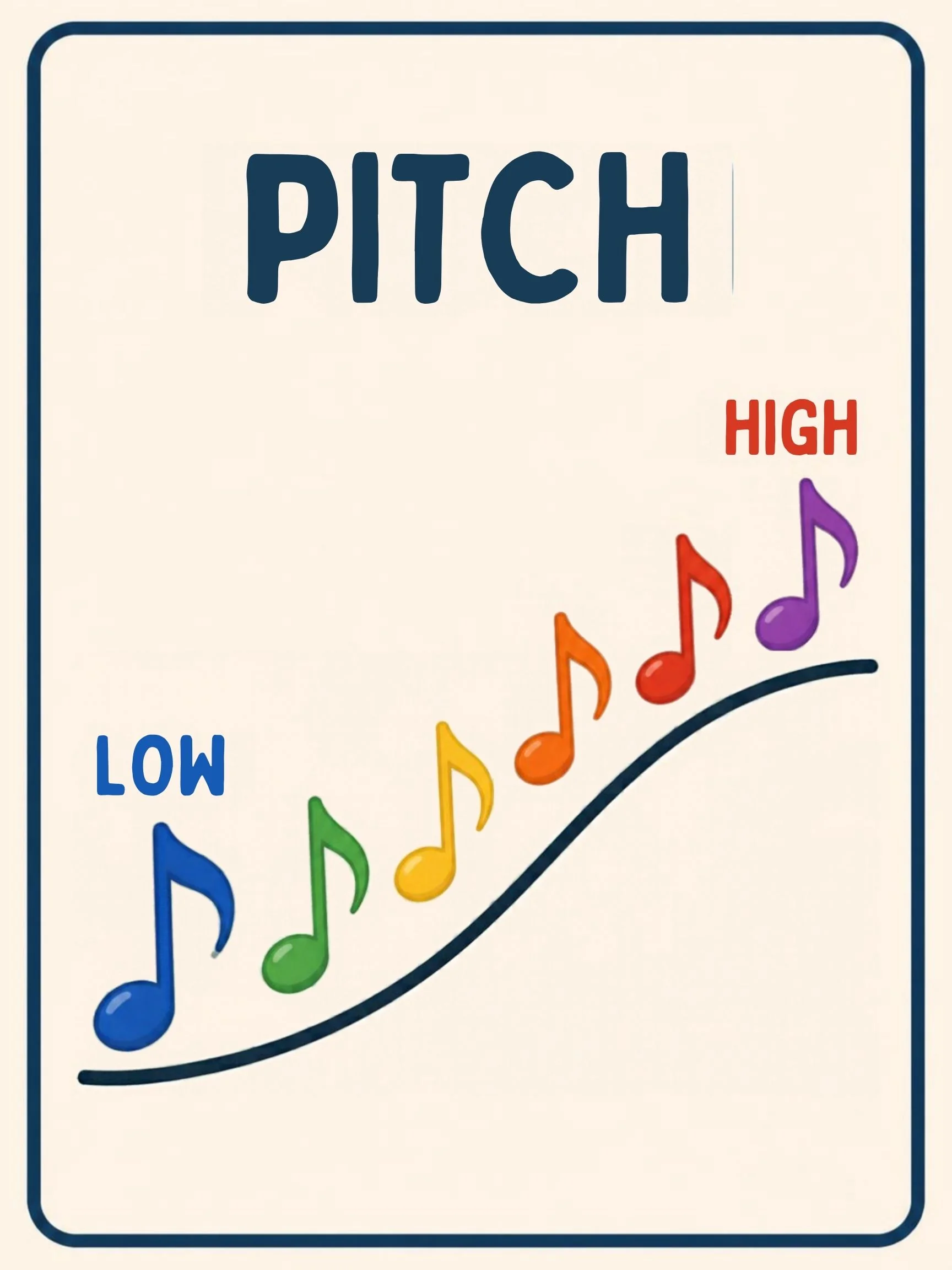
What is this?
Pitch is how high or low a sound is: a mouse squeaks HIGH, a giant stomps LOW, and every note lives somewhere on that ladder. Small, fast things make high pitches; big, slow things make low ones.
What does it mean?
Pitch is the most physical of musical ideas: size IS sound. Big drum, low boom; tiny bell, high ting. And the voice can climb the whole ladder — sliding from mouse to giant — which makes pitch the easiest musical knob to feel and the hardest to explain, unless you slide it.
What does the child need to know?
Your child needs three pitch ideas: pitch is HIGH or LOW — not loud or soft (that is volume!); big-slow things hum low, small-fast things squeak high; and the voice slides the whole ladder — siren slides teach pitch faster than any explanation.
Why this matters
Pitch separates music’s two most-confused ideas at once: high-low is NOT loud-soft — and the siren slide, plus the whisper-shout test, untangles both in one game.
What it teaches
Pitch discrimination (high-low), the size-pitch law, voice-slide control, and the pitch-versus-volume distinction — two knobs, finally separate.
Words to learn
pitchhighlowladdersqueakstompslide
Say this to your child
“"Pitch is the high-and-low of sound! The mouse squeaks HIGH, the giant stomps LOW — big slow things hum low, small fast things squeak high. And your voice can climb the whole ladder: siiiiren — slide up, slide down! But careful: high-low is NOT loud-soft — you can whisper HIGH and shout LOW. Two different knobs!"”
Step by step
- Show the card: "This is pitch — how high or low a sound is."
- The size law: big slow giant — LOW stomp-hum. Small fast mouse — HIGH squeak-hum. Big is low, small is high: the whole ladder in two animals.
- The siren slide: hum from your lowest to your highest — siiiiren! Slide up, slide down, land on a high, land on a low. The voice just climbed the ladder.
- The mix-up test: whisper a HIGH squeak — quiet but high! Shout a LOW stomp — loud but low! Pitch and loudness are two different knobs.
- Play the ladder games below and close: "big is low, small is high."
Look closer at the picture
On this card the word "Pitch" stands in big navy capitals inside the rounded frame, with a friendly high-low illustration below — exactly as the ladder looks on the wall.
Ask your child
"Who hums lower — the giant or the mouse? What does the siren slide climb? Are high-low and loud-soft the same knob?"
What your child can say or do
Your child might say: "Big is low, small is high!" "Siiiiren — my voice slid the ladder!" or the knob-sorter: "Whisper-high, shout-low — different knobs!"
Out in the real world
Pitch runs the whole sound world: big dogs bark low, small dogs yip high; big cars rumble, mosquitoes whine. And every keyboard, bell row and guitar string is the ladder laid out to touch.
Try it together
Mouse-and-Giant: the leader calls an animal — MOUSE! ELEPHANT! BEE! BEAR! — and everyone moves AND hums at that animal’s pitch: tiny squeaks, floor-scraping lows. Then the siren ladder: slide up for "climbing the stairs," down for "sliding down the hill," freeze on a mystery pitch for "who am I — high or low?" Pitch, felt in the throat, named by the ear.
Understanding check
Ask: "What is pitch? What is the size law? Are high-low and loud-soft the same?" High or low, big-low and small-high, no — three answers and the ladder is climbed.
Parent tips
The whisper-high and shout-low test is the lesson’s crown — pitch and volume separate in one laugh. And pitch-by-animal beats pitch-by-number for small children every time.
This lesson pairs with the Pitch flashcard in the library — print it, show it, keep it on the fridge. Back to Music Room (Class 23).