
Tuba — a step-by-step lesson for grown-up and child
This lesson teaches the tuba — the brass family’s giant: metres of tube coiled into a bear-hug shape, huffing the deep floor notes that every other instrument stands on.
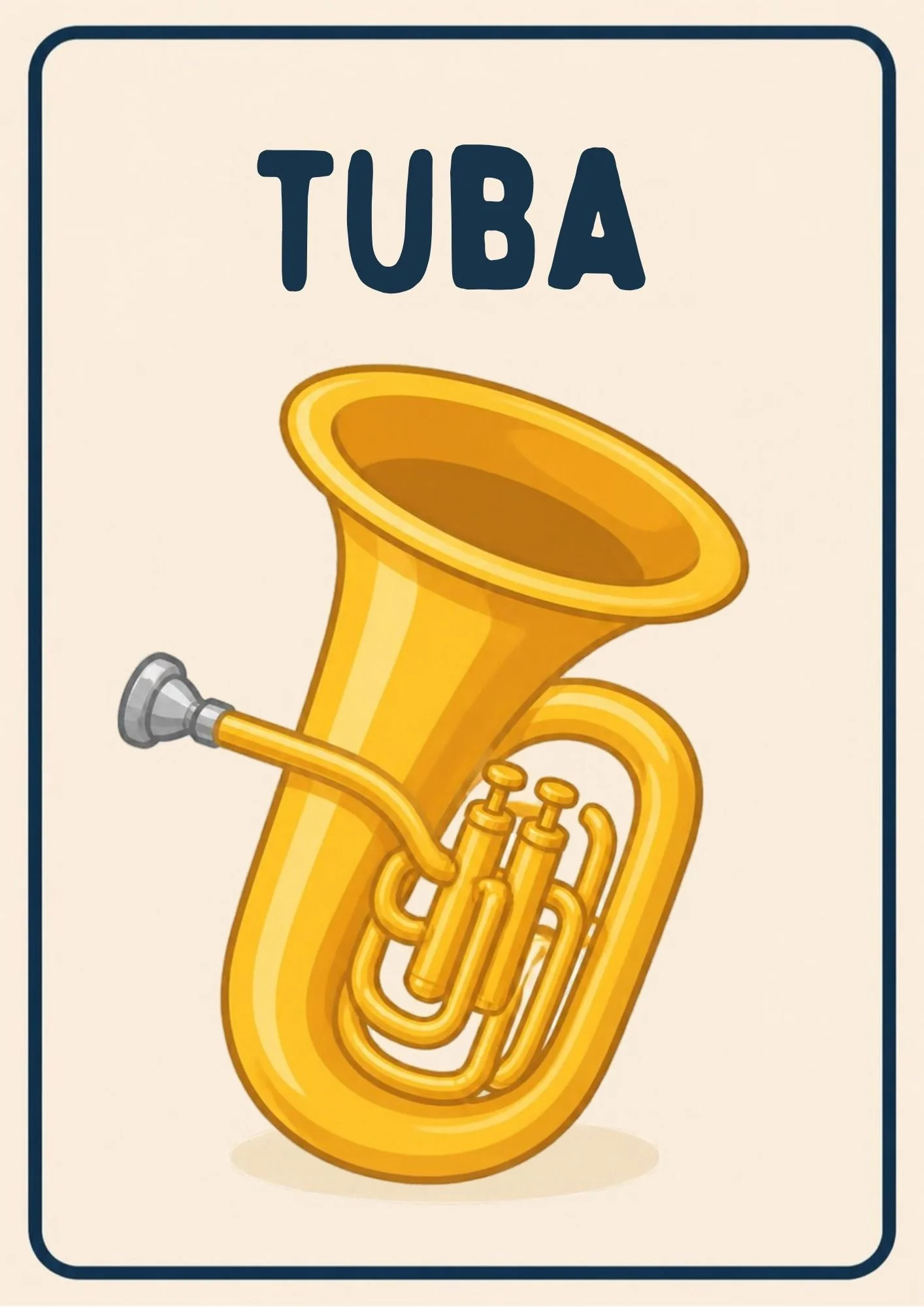
What is this?
A tuba is the largest brass instrument: a huge coil of wide tubing ending in a great bell, played sitting down with the whole body wrapped around it. Its notes are the lowest in the band — the musical floor.
What does it mean?
The tuba completes the length law: the longest tube, the lowest notes. And its role is the foundation — oom-pah’s oom, the bass that makes every melody above feel grounded. Deep notes are carrying notes: you feel the tuba before you find it.
What does the child need to know?
Your child needs three tuba ideas: it is the BIGGEST and LOWEST of the brass — the family’s giant; the tube is metres long, coiled so a person can carry it; and its notes are the FLOOR of the music — everything else dances on top.
Why this matters
The tuba rounds out the brass size-spectrum — trumpet small-bright to tuba huge-deep — completing the family map, and its floor-note job is the child’s first lesson in musical foundations.
What it teaches
Size-pitch completion across the brass family, low-note humming, the oom-pah floor pattern, and the carrying-power of deep sounds.
Words to learn
tubagiantcoillowflooroom-pahdeep
Say this to your child
“"The tuba is the brass family’s giant! Metres and metres of tube — coiled round and round so you can carry it — and the deepest notes in the whole band. The tuba is the music’s FLOOR: hum low, oom… oom — and every song above stands on it. Oom-pah, oom-pah: that is the giant dancing under everything!"”
Step by step
- Show the card: "This is the tuba — the giant of the brass family."
- The giant’s tube: the biggest instrument needs the longest tube — metres of it! — coiled round and round so a player can carry it. Biggest coil, lowest notes.
- The floor: hum your lowest note — that is tuba country. Every melody above stands ON the tuba’s floor.
- Oom-pah: hum OOM (low), clap PAH (higher) — the tuba’s famous dance pattern from every brass band.
- Play the floor game below and close: "big coil, deep floor."
Look closer at the picture
On this card the word "Tuba" stands in big navy capitals inside the rounded frame, with a friendly illustration of the big tuba below — exactly as the giant coil looks.
Ask your child
"Which brass instrument is biggest and lowest? Why is the tube coiled? What is the tuba’s job — the ceiling or the floor?"
What your child can say or do
Your child might say: "The giant of the brass!" "Metres of tube, coiled up!" or the floor-keeper: "Oom-pah — I hold the floor!"
Out in the real world
Tubas oom-pah through brass bands, polkas and New Orleans streets — and the floor-note idea lives under every song: listen for the low voice holding still while the melody dances. Find the floor in any tune today.
Try it together
Find-the-Floor: hum a simple melody while one player holds a steady LOW hum underneath — the song suddenly feels grounded, like furniture arrived. Swap roles. Then oom-pah band: half the family hums the low oom-oom, half claps the pah-pah — a whole brass-band floor, built of people. Big coil, deep floor.
Understanding check
Ask: "Who is the brass giant? Why coil the tube? What does the tuba build under the music?" The tuba, so it is carryable, the floor — three answers and the oom-pah is on.
Parent tips
Low humming is a full-body feeling — hands on the chest make it visible. And honour the floor role: children who love holding the bottom note are bass players in the making.
This lesson pairs with the Tuba flashcard in the library — print it, show it, keep it on the fridge. Back to Music Room (Class 23).