

Concentric circles — a step-by-step lesson for grown-up and child
This lesson uses the ring card two ways — still, for inward gaze practice, and moving, for the near-far rhythm babies find quietly amazing.
What is this?
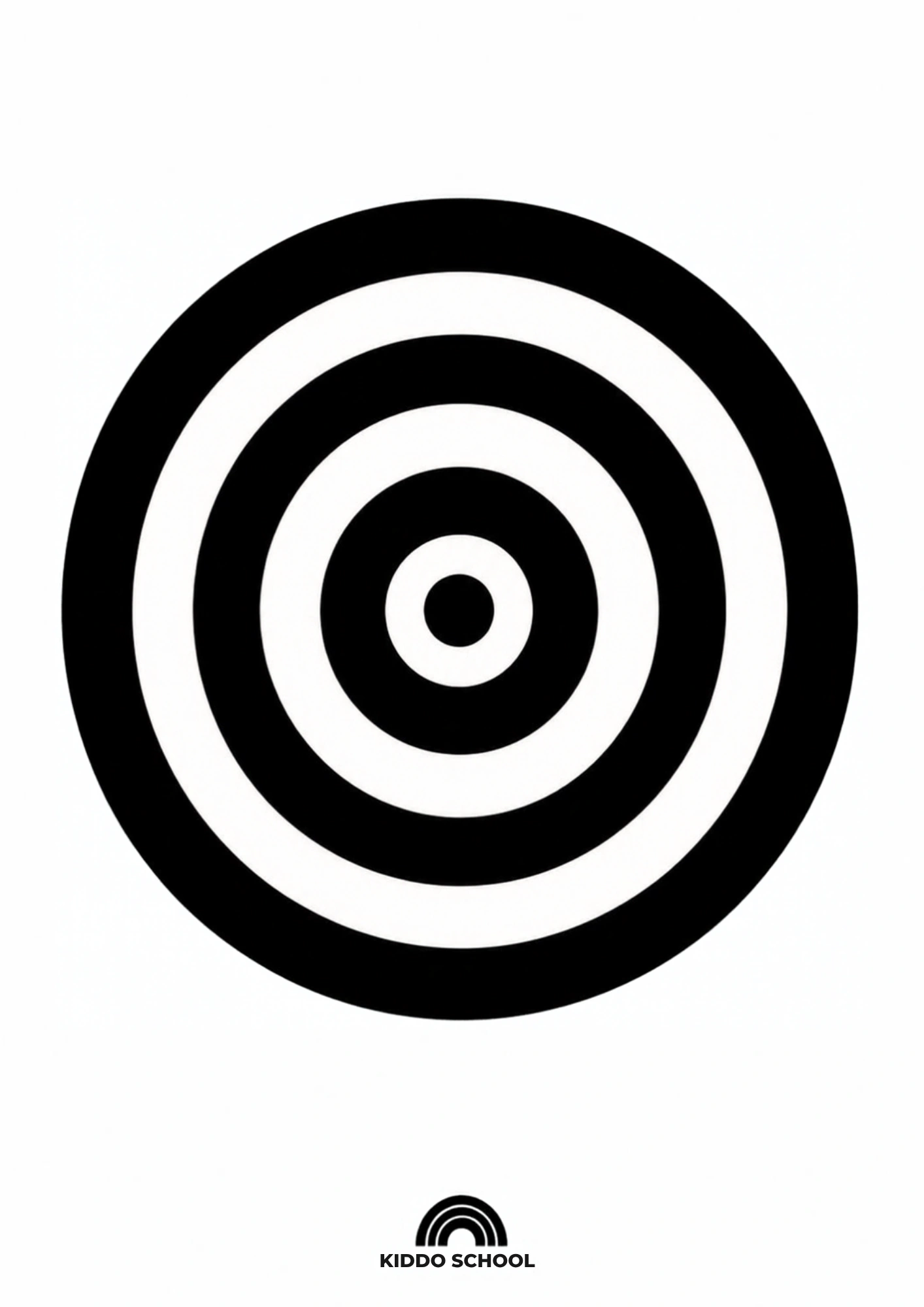
Concentric circles are circles nested inside circles, like ripples from a dropped stone. Drawn in bold black and white they give a young baby one clear centre to aim at and a set of rings to travel inward through.
What does it mean?
Two visual jobs live in this card. The centre gives fixation a bullseye; the rings give the eye a path. Moving the whole card closer and further adds a third: focusing — the lens-work your baby’s eyes are only just learning to do.
What does the child need to know?
Stillness in a watching baby is not boredom — it is concentration at full volume. Some babies go completely quiet on this card. Give the stillness room, keep your voice low, and resist filling the silence with words.
Why this matters
Tracking and focusing are the twin skills under everything visual your baby will ever do. Rings offer both in the gentlest form: no corners to trip over, no story to follow, just in, in, in — and out again.
What it teaches
Fixation on a target, inward tracking, distance focusing, and self-regulation — the quiet alertness that lets looking become studying.
Words to learn
circlesroundinoutrippleslook
Say this to your child
“"Circles, inside circles, all the way in. Here is the middle — a tiny circle hiding inside the big ones. The circle comes closer... and further away. Round and round the rings go."”
Step by step
- Show the card still and centred at focusing distance, and let the bullseye do its work — say its name once: "Circles. Round and round."
- Move the card slowly closer, then slowly further, about the length of your hand each way. The rings will seem to breathe.
- Watch the eyes adjust; some babies lean in, some go very still, some blink in a slow rhythm of their own.
- Trace one ring from outside in with your fingertip, one slow lap, and stop at the centre without a word.
- Finish on a look-away or a yawn, whichever comes first — this card is calm work, and calm work ends early.
Look closer at the picture
The artwork is verified simple: bold black and white rings, one inside another, nothing else on the card. Say that plainly, then watch the better show — your baby going still, which at this age is effort, not absence.
Ask your child
Watch for the lean: does your baby’s head tilt forward as the card comes closer? Does a blink or a sigh arrive when it pulls back? Wonder aloud: "I wonder if the stillness is looking or resting — after a nap I will find out."
What your child can say or do
Total stillness with wide eyes, a slow lean towards the card, soft cooing that matches your calm voice, or a heavy-lidded drift towards sleep — rings settle some babies so well they end their own session.
Out in the real world
Nested circles are rarer than you would think in a house — plates stacked on plates, the rings of a bath toy, lampshade circles one above the other. Wherever circles nest, one quiet "round and round" keeps the card’s idea alive.
Try it together
Ripple voice: hum one long low note while tracing ring after ring inward, letting the note fade as your finger reaches the centre. Sound winding down plus eyes travelling in makes a wind-down ritual worth keeping.
Understanding check
Parent check-in: did you manage one slow near-far move without hurrying, and did your baby give you ten quiet seconds of looking? That combination is the whole lesson; nothing else is owed today.
Parent tips
Move slower than feels natural — at this age, quick movement vanishes. If the stillness worries you, wave gently once; a response means an awake, working baby. Save this card for the wind-down end of a session, not the opener.
Staying safe
Near-far movement stays in your hand, never on a string or propped above the cot — an object swinging over a baby’s face is a grown-up job with eyes on it the whole time. Keep sessions to a few minutes; calm is the goal, mileage is not.
This lesson pairs with the Concentric circles flashcard in the library — print it, show it, keep it on the fridge. Back to Faces & Visual Tracking (Newborn 2).