

Wavy lines — a step-by-step lesson for grown-up and child
Waves are the friendly gatekeeper of tracking: smooth, corner-free and endlessly re-traceable. This lesson walks one wave at a time.
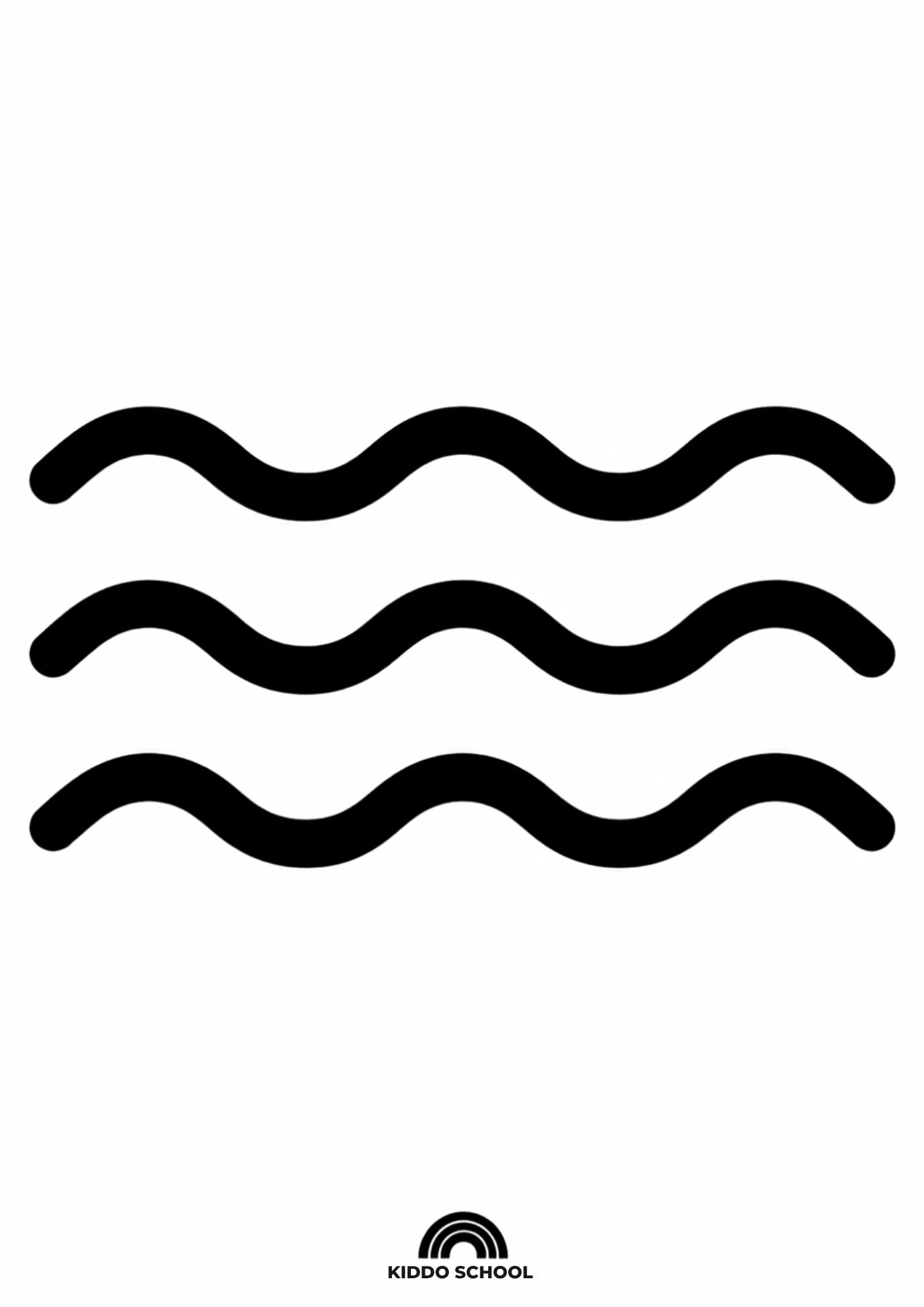
What is this?
Wavy lines are curves that rise and fall across the card, drawn thick and bold. For a baby whose eyes are learning to move on purpose, a wave is a road: it goes somewhere, and it never turns sharply.
What does it mean?
Smooth pursuit — the eye’s ability to follow a moving path — is assembled in these months from practice. Curves suit beginners because the direction change is gradual; the eye succeeds often, and success keeps the game alive.
What does the child need to know?
Take a single wave each lap, left to right, at a walking-in-honey pace. Your finger leads and the gaze follows; if the eyes drop off the line, pause and let them re-find it alone. Left-to-right order is a quiet gift to a future reader, not a rule to enforce.
Why this matters
Every look your baby will ever take — at a rolling ball, a passing bus, a line of text — runs on the eye control this card exercises. Waves make the practice feel like nothing, which is exactly why it works.
What it teaches
Smooth visual tracking, left-to-right scanning, hand-eye coordination when tracing, and shared rhythm — sway, trace, watch, repeat.
Words to learn
wavesupdownsideslowboat
Say this to your child
“"Waves! Up and down and up and down, slow as a boat on sleepy water. My finger rides the wave — here it goes, all the way across. And back again. One little wave at a time."”
Step by step
- Show the card at focusing distance and name it with a rising-falling voice: "Wavy lines. Up... and down."
- Lay your fingertip at the start of one wave and travel it left to right, slower than slow, while your baby watches.
- At the end, rest, breathe once, and trace the same wave back — repetition is the interest here, not variety.
- Then sway the whole card gently side to side like a slow boat and let the whole image move as one.
- Trade jobs: still card plus moving finger, then moving card plus still voice. Whichever holds your baby longer wins tomorrow.
Look closer at the picture
The artwork shows bold wavy lines rolling across a plain card — that is all it claims, so say exactly that much. The tracing and the swaying are yours to add; the richness to notice is whether the eyes ride the line or hop off it.
Ask your child
Watch the ride: does the gaze stay with the finger to the end of the wave, or slip off mid-way? Does the boat-sway pull the eyes when the finger does not? Wonder aloud, softly: "Slower, or even slower — I wonder which you like."
What your child can say or do
Eyes gliding along with the finger, a whole-body wiggle when the card sways, a gummy attempt to bat at the moving line, or watching that ends in a yawn — a yawn on this card is a job well done, not a dropout.
Out in the real world
Waves live in daily life: the scalloped edge of a doily, the curved handle of a mug, water in the bath moving as your hand sweeps it. Trace any real curve you pass and the card keeps rehearsing itself.
Try it together
Boat lap: hold your baby supported against your shoulder and sway side to side in the same up-down rhythm as your tracing voice. Eyes, ears and body get one wave together — the fullest version of this lesson there is.
Understanding check
Two-question self-check: did one wave get traced all the way across at least once, and did the eyes follow for most of the trip? If yes on both, the tracking practice happened — done for today.
Parent tips
Trace with the hand your baby sees best from their current position, and swap sides across the week so both eyes get equal work. If interest fades fast, do a single wave and stop; short and perfect beats long and sloppy.
Staying safe
Sway small and slow — a young baby’s neck does most of the holding at this age, so big movements belong to the card, not the baby. Keep the card a hand’s width from the face during swaying so it never taps or covers them.
This lesson pairs with the Wavy lines flashcard in the library — print it, show it, keep it on the fridge. Back to Faces & Visual Tracking (Newborn 2).