

Red circle — a step-by-step lesson for grown-up and child
Everything so far has been black and white. This card changes one thing — the colour — and this lesson shows you how to make that change visible without making it a lesson.
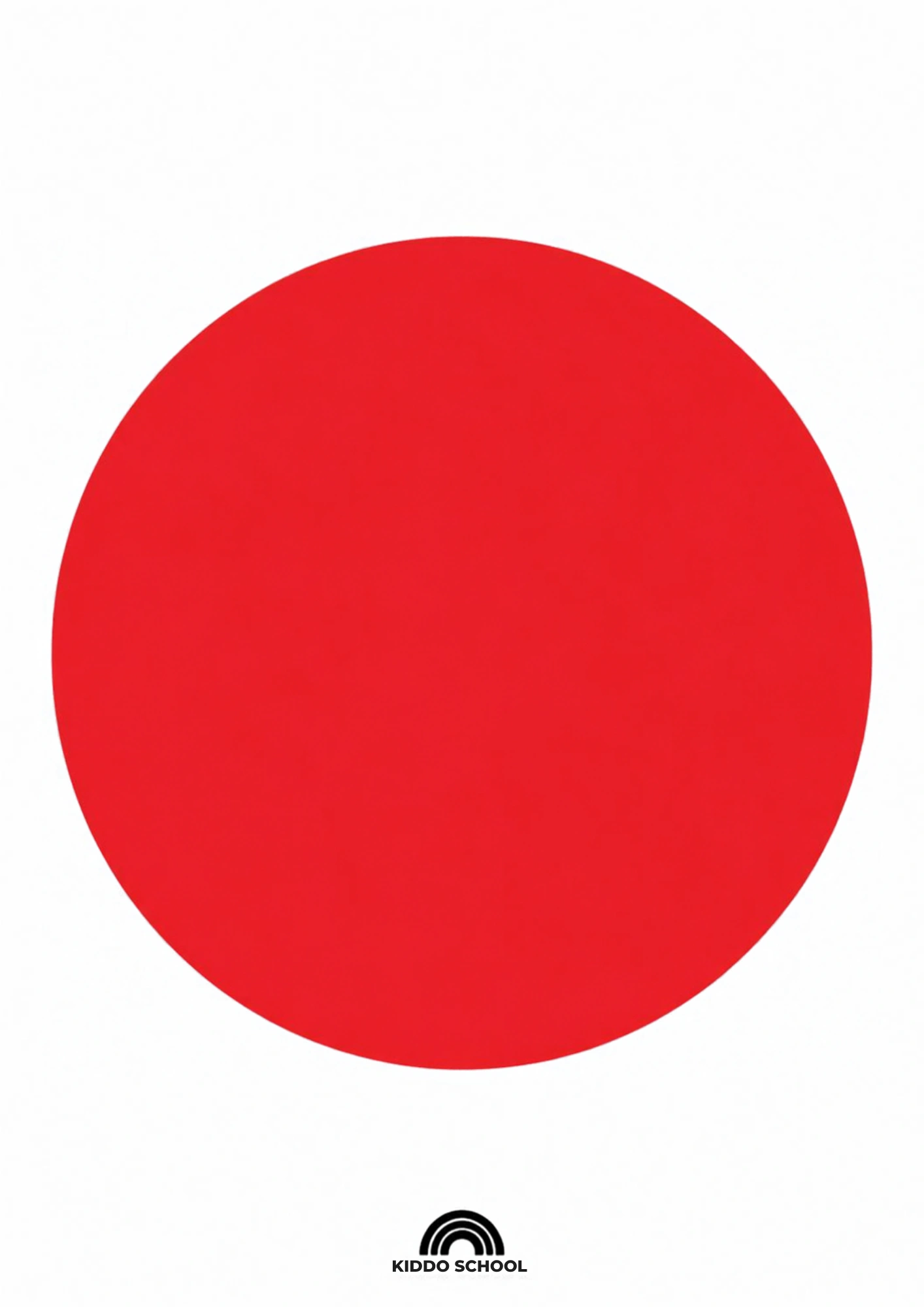
What is this?
Red opens the colour half of the set: one large, bold red circle on plain ground. Red happens to be the colour young eyes notice earliest, which makes this the classic first step out of the black-and-white world.
What does it mean?
Colour vision arrives in stages, and long-wavelength red registers before most of the spectrum. That is why generations of baby cards start here: the colour is new, but the odds of it landing are better than any other colour’s.
What does the child need to know?
The honest test: hold this card beside a black-and-white one and see whether the gaze travels to the red. Many babies go; some do not yet, and both are on schedule. The strong shape alone earns its keep while colour catches up.
Why this matters
A first colour is a first property: the same "circle-ness" wearing different clothes. Meeting that idea now, gently and repeatedly, prepares the ground for every colour word your child will one day sort the world into.
What it teaches
Colour noticing, comparison (colour against no-colour), choice behaviour when two cards compete, and the vocabulary seed of "red" said warmly and often.
Words to learn
redcircleroundcolourlookthere
Say this to your child
“"Red! Here is a big round circle, red as a berry. Look — next to it, a black and white one. Red... and not-red. Where will your eyes go? There they go. Red is a lovely thing to meet."”
Step by step
- Show the red circle alone at focusing distance and name it with warmth: "Red. A big round circle in red."
- Say it a second time, slower, and let the card sit in view for a long moment before anything else happens.
- Now the experiment: bring a black-and-white card alongside and hold the pair steadily — equal heights, equal distances.
- Watch where the eyes settle or return. Whichever card wins, say so out loud — "you looked at the red!" — without scorekeeping.
- Repeat the pairing across a few days; colour noticing tends to arrive quietly between one session and the next.
Look closer at the picture
The artwork is one large red circle — say that plainly. The comparison is where the noticing lives: does the red pull the gaze across, or does the familiar black-and-white hold it? Either outcome tells you something true about this week.
Ask your child
Watch the crossing: does the gaze visit the red card first, return to it, or stay put on the black and white? Wonder aloud: "I wonder if red looks loud or quiet to you this month."
What your child can say or do
A direct gaze-lock on the red, back-and-forth comparing between the two cards, a fresh burst of interest after days of black-and-white familiarity, or total indifference — the last one is schedule, not failure.
Out in the real world
Red shows up for babies more than you would guess: a red mug, the cover of a board book, a red jumper folded in the pushchair basket. Tap each real red once and say the word — the card travels with you.
Try it together
Red hunt, parent edition: before the session, find two or three red things and lay them near the card. Name the card, then each real red in turn, one tap each. The world, briefly, is organised around one colour — and your baby gets to watch you enjoy it.
Understanding check
Self-check: did the red-versus-black-and-white comparison actually happen this week, and did you say "red" warmly at least a handful of times? Both are cheap to do, and the pairing is the lesson’s engine.
Parent tips
If red earns nothing, keep the card in rotation anyway — the shape is doing quiet work while colour waits its turn. Offer one colour at a time across the set; three colours at once is three chances to teach nothing.
Staying safe
Colour talk invites pointing at the world — fine, because your finger does the pointing. Keep the card itself out of the grab-and-gum zone unless you are holding it; wet cards fray, and frayed cards go in the bin, not the mouth.
This lesson pairs with the Red circle flashcard in the library — print it, show it, keep it on the fridge. Back to Faces & Visual Tracking (Newborn 2).