
Dog — a step-by-step lesson for grown-up and child
This lesson marches: your child taps the d sound with their tongue, drums it on their knees, joins a barking dog parade, and traces the letter with the big round belly.
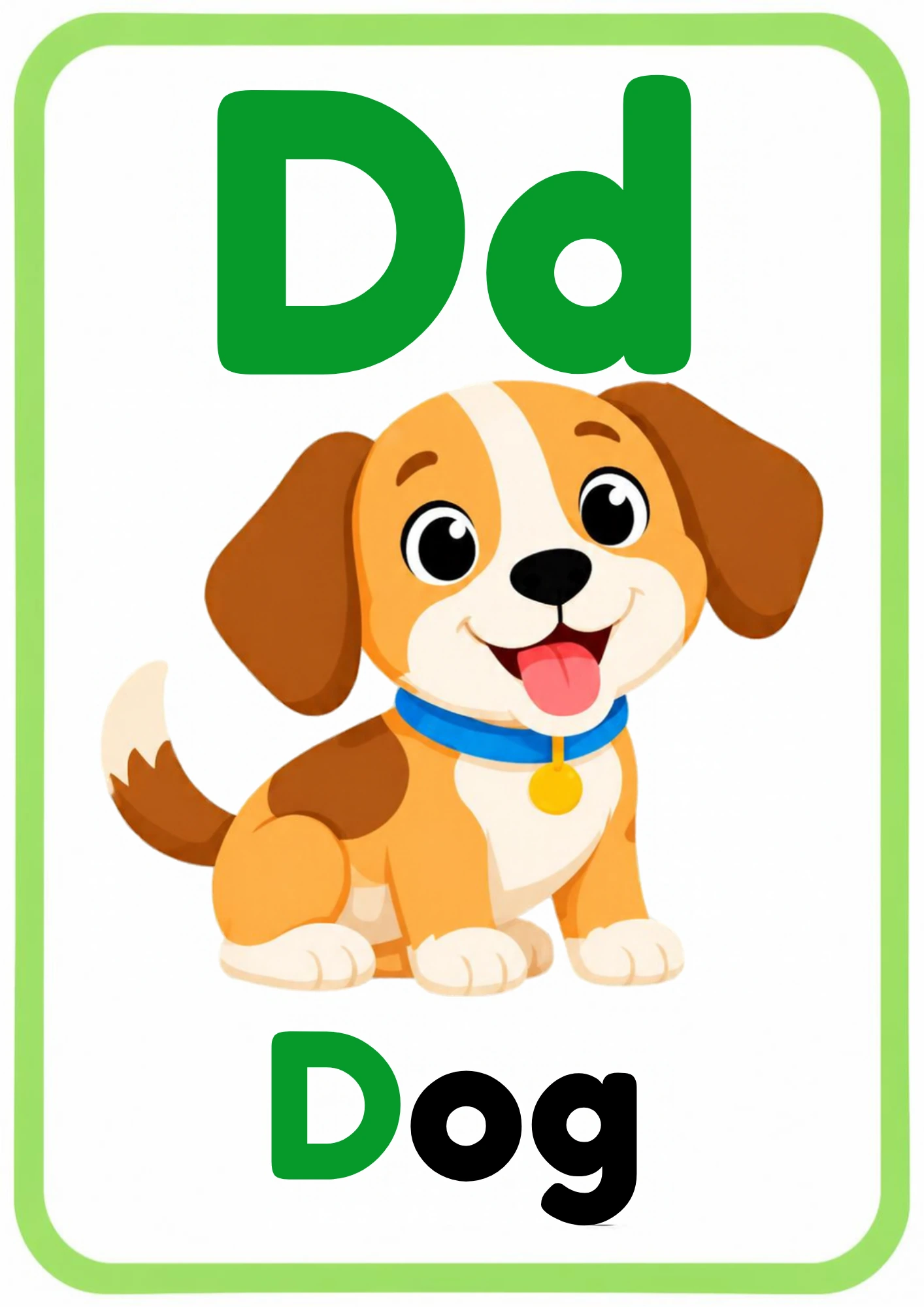
What is this?
D is the fourth letter of the alphabet. Big D and little d make the d sound — the tongue taps behind the top teeth once and the word is off: d-d-dog.
What does it mean?
D comes with its own sound effect — most children bark long before they read. The lesson builds on that enthusiasm and adds the two things a letter lesson needs: the clean sound and the traced shape.
What does the child need to know?
The letter is called D; the sound is a quick tongue-tap: d. Say it short and neat, without an uuu trailing behind. B is the lip-pop, D is the tongue-tap — same family, different tools.
Why this matters
A letter that arrives with marching, drumming and woofing turns practice into a parade. And feeling the difference between the lip sound and the tongue sound is real phonemic awareness, earned through play.
What it teaches
Tongue placement awareness, sound-and-action pairing, rhythm and marching, letter recognition in two cases, and pretend play that doubles as rehearsal — every woof is a d-word in costume.
Words to learn
Ddogtaptonguedrumwoof
Say this to your child
“"This is the letter D — hello, D! D says d: your tongue taps behind your teeth, quick like this — d! Feel it tap? Now trace big D with me — tall stick, big belly — and little d. Then we march: d, d, d, and WOOF at the corners. Dogs spell their own letter, honestly."”
Step by step
- Show the card and greet both: this is the letter D, and this is a dog — say dog and let the d tap at the front of it.
- Make the sound: tongue taps behind the top teeth — d! Quick and clean. Now drum it: d-d-d on your knees like a tiny drumroll.
- Trace big D — tall stick first, then the big round belly — and little d: a tall stick with a round belly at the bottom.
- Start the dog parade: march around the room, one d for every step — d, d, d — with a woof at every corner.
- End with the d-hunt: find three things that start with the d sound — a door, a doll, a duck if you have one — and tap each one with the sound.
Look closer at the picture
Find the big uppercase D and the little lowercase d on the card, then the dog and the word Dog. Ask which letter has the round belly and which way it faces — D wears its belly on the right.
Ask your child
"What is this letter called?" "What sound does D make?" "Where does your tongue tap?" "What d-words can we find on our parade?" — answered with a name, a clean d, a tongue-point and three collected treasures.
What your child can say or do
"D! D-d-dog!" Expect knee-drumming at dinner, d-sounds attached to doors and dads, and parades organised at short notice. Woofs may punctuate the alphabet song from now on — accept them as authentic.
Out in the real world
D is everywhere a child is: dog, daddy, door, duck, down. Each d-word is a tap rehearsal, and every real dog met on a lead is the card walking past on four legs.
Try it together
Drum the sound: tap d-d-d slowly on your knees, then faster, then loud, then whisper-quiet — the sound gets a whole volume range. End with three d-taps on three d-objects you collected.
Understanding check
Ask what D says: a quick tongue-tap d means the sound is clean and in place. A big-bellied D traced in the air finishes the lesson.
Parent tips
If d slides into buh-land, model the short tap — "d!" — and let your child copy the length, not hear a lecture. B and d mix-ups coming soon are normal; more marching, less testing.
Staying safe
Parades need clear floor and walking feet — marching is not sprinting. If a real dog joins the family day, greetings happen with a grown-up close: hand out flat, let the dog come to you, and never bother one that is eating or sleeping.
This lesson pairs with the Dog flashcard in the library — print it, show it, keep it on the fridge. Back to Alphabet A–Z (Preschool).