
Cat — a step-by-step lesson for grown-up and child
This lesson prowls: your child makes the k click at the back of their mouth, creeps around the room like a cat saying it softly, and traces the letter that is basically a smile.
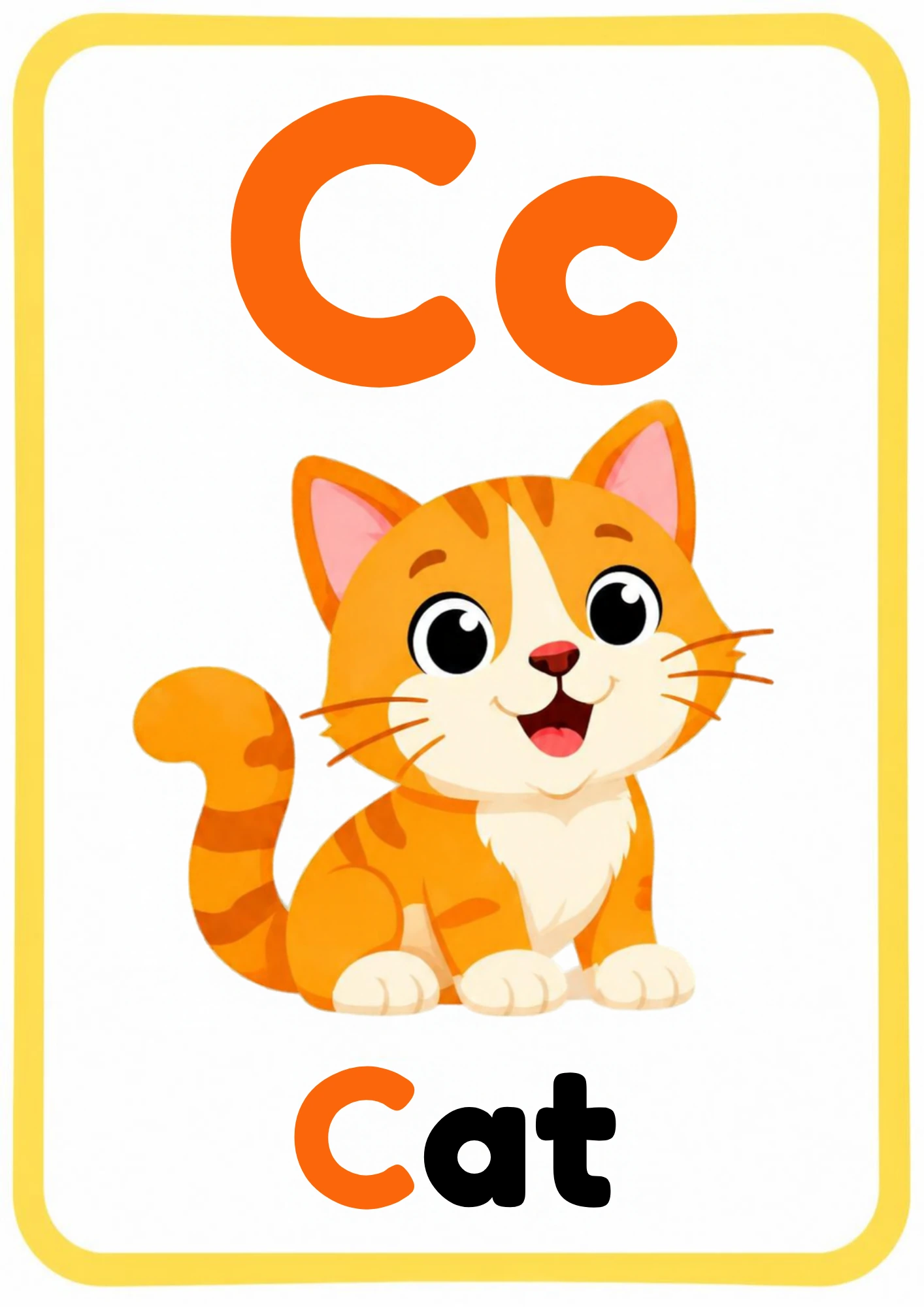
What is this?
C is the third letter of the alphabet. In cat, it makes the k sound — a quick click at the back of the mouth. C is a letter of two talents: it can also borrow the s sound, but cat keeps it simple.
What does it mean?
C teaches children that letters share — the same sound as k, wearing a different costume. Accepting that calmly at three makes phonics feel like a game of twins rather than a list of exceptions.
What does the child need to know?
The letter is called C; in cat it says k — a clean click, no uuu attached. K and C make the same sound and that is simply true; a shrug and "letters share sounds" is the whole explanation needed at this age.
Why this matters
Cat is a word most three-year-olds already say with feeling. Clipping the k sound onto a beloved animal gives C a friendly face — and the prowl game gives the sound a whole body to live in.
What it teaches
Back-of-mouth sound production, letter recognition in two cases, soft-versus-loud voice control, crawling coordination, and the sharing-sounds idea that prepares later letters.
Words to learn
Ccatclicksoundprowlwhisper
Say this to your child
“"This is the letter C — hello, C! In cat, C says k: a little click at the back of your mouth. Say it with me — k! Now be a cat with me: creep along the floor, soft and quiet... k, k, cat! And when we stand up, we trace the big C and the little c. Round and open, like a smile."”
Step by step
- Show the card and name both: this is the letter C, and this is a cat. Say cat slowly and let the k sound be heard at the front.
- Make the k click: the tongue taps the back of the mouth — k! Try k-k-k, like a tick-tock with a cough. Keep it short and clean.
- Trace big C — one open curve, like a half-moon — and little c, the same curve smaller. It is the easiest letter to draw in the air.
- Prowl: creep around the room on hands and knees, whispering k, k, cat! Whispers make prowling official and keep the game gentle.
- End with a k-hunt: find two things that start with the k sound — a toy cat counts, so does a key, a cuddly koala, a kettle.
Look closer at the picture
Find the big uppercase C and the little lowercase c, then the cat and the word Cat. Ask which letter looks like it is opening its mouth — C curves open like a cat about to meow.
Ask your child
"What is this letter called?" "What does C say in cat?" "Can you make the k click?" "What k-words are hiding in this room?" — answered with a name, a click, a tongue-tap and two finds at least.
What your child can say or do
"K! K-k-cat!" Expect clicking sounds in the supermarket, cat-prowling at bathtime, and C spotted on mugs and coats. The whisper-prowl may become the household’s official way to cross a room at night.
Out in the real world
C opens cat, cup, car, cake, cold — most of a day’s vocabulary. Every k-sound word is a chance for the click, and every real cat met is the card coming to life at arm’s length.
Try it together
Cat prowl and freeze: prowl and whisper k sounds until you call "nap time!" — then every cat curls up still. Reverse roles so your child calls the nap; being the caller is the vocabulary reward.
Understanding check
Ask what C says in cat: a clean k click means the sound landed true. A traced C curve in the air completes the lesson.
Parent tips
Do not chase the why-does-C-sound-like-K question — "letters like to share sounds" said cheerfully settles it for this year. Keep the prowl to clear floors; knees and table legs negotiate poorly.
Staying safe
Prowling happens on open floor, away from stairs and furniture corners. If a real cat joins the game, gentle-hands rules apply: one soft stroke, no tail-pulling, and walking away when the cat says so.
This lesson pairs with the Cat flashcard in the library — print it, show it, keep it on the fridge. Back to Alphabet A–Z (Preschool).