
Queen — a step-by-step lesson for grown-up and child
This lesson parades: your child learns that q never appears without u at its side, blends their two sounds into one kwuh, and rules a kitchen kingdom from a paper crown.
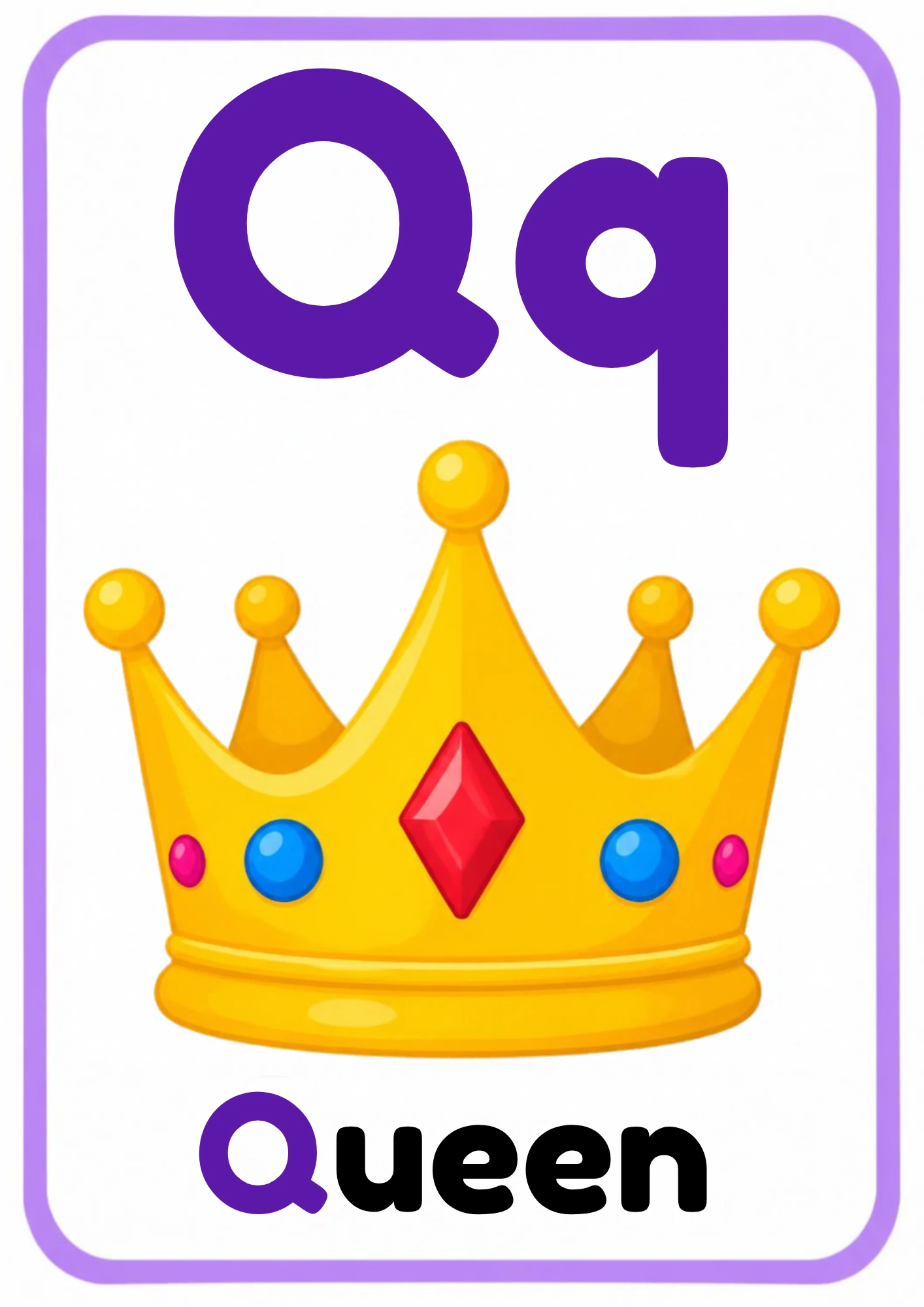
What is this?
Q is the seventeenth letter of the alphabet. It nearly always arrives with its friend u, and the two together say kwuh — the start of queen, quick and quack. One sound, two letters, a team.
What does it mean?
Q is the alphabet’s first famous friendship: q and u holding hands on almost every page. Framing that as a best-friends story turns a spelling fact into something a three-year-old finds charming.
What does the child need to know?
The letter is called Q; the sound is kwuh, said by q and u together. Q standing alone is rare and can wait years — on this card the friends travel as a pair and the crown does the rest.
Why this matters
A letter with a built-in story and a built-in costume is a gift: crowns get made, parades get held, and kwuh gets rehearsed from the throne. The friendship idea also quietly explains why qu-words never split.
What it teaches
Two-letter sound blending (qu said as one), letter recognition in two cases, craft skills with paper and stickers, royal-wave motor planning, and the social idea that some letters work as teams.
Words to learn
Qqueenqukwuhcrownwave
Say this to your child
“"This is the letter Q — hello, Q! And look: u comes too, because q and u are best friends. Together they say kwuh — like the start of quick! Try it: kwuh, kwuh, queen! Now crown yourself, wave like royalty, and let the parade begin. Long live the queen!"”
Step by step
- Show the card and tell the friendship first: this is the letter Q, and this is a queen — and wherever q goes, u goes too. They are a team.
- Make the team sound: kwuh — q and u said together, like the start of quick. Try kwuh three times, then kwuh-queen.
- Trace big Q — a round circle with a small tail at the bottom — and little q: a circle with a tail that dangles low, like a wand.
- Make paper crowns: decorate, then tape them on. Everyone wears one; royalty must practise the royal wave before parading.
- Hold the parade: march through the kitchen saying kwuh, kwuh, queen! and salute your loyal subjects — the chairs, the teddies, the dog if one agrees.
Look closer at the picture
Find the big uppercase Q and the little lowercase q on the card, then the queen and the word Queen. Ask which letter has grown a tail — big Q wears a small one at its bottom, little q lets its tail hang low.
Ask your child
"What is this letter called?" "What sound do q and u make together?" "Which letter is q’s best friend?" "Shall we parade past the chairs again?" — answered with a name, a blended kwuh, a proud u and a royal wave.
What your child can say or do
"Kwuh! Kwuh-queen!" Expect crowns worn to breakfast, kwuh-sounds offered to quilts and questions, and parades organised at royal short notice. Q and u may be declared best friends in drawings too. The friendship has been internalised.
Out in the real world
Q arrives quietly in daily life: quick, quiet, quack at the duck pond, quilt on the bed. Every kwuh is the team sound — and every picture-book queen is the card waving from the page.
Try it together
Royal parade: crowns on, one leader, everyone else as subjects. The parade only advances on kwuh — call the sound, take three royal steps. Change leaders at each chair so the smallest subject also gets to rule.
Understanding check
Ask what Q says: a kwuh with both letters mentioned together means the team idea landed. A little q traced in the air — circle, then tail — completes the coronation.
Parent tips
Q alone can wait for school years — never quiz it now. If u gets forgotten, draw the two letters holding hands on paper once; the story does the memory work better than repeating the fact.
Staying safe
Crown-making means grown-up scissors for cutting and tape instead of staples near small heads. Parades need clear floor and no sprinting in socks, and royal waving stays indoors-safe, away from lamps and shelves.
This lesson pairs with the Queen flashcard in the library — print it, show it, keep it on the fridge. Back to Alphabet A–Z (Preschool).