
Pig — a step-by-step lesson for grown-up and child
This lesson puffs: your child releases a tiny explosion of air strong enough to move a tissue, trots around the room with an oink in reserve, and traces a letter shaped like B’s cousin.
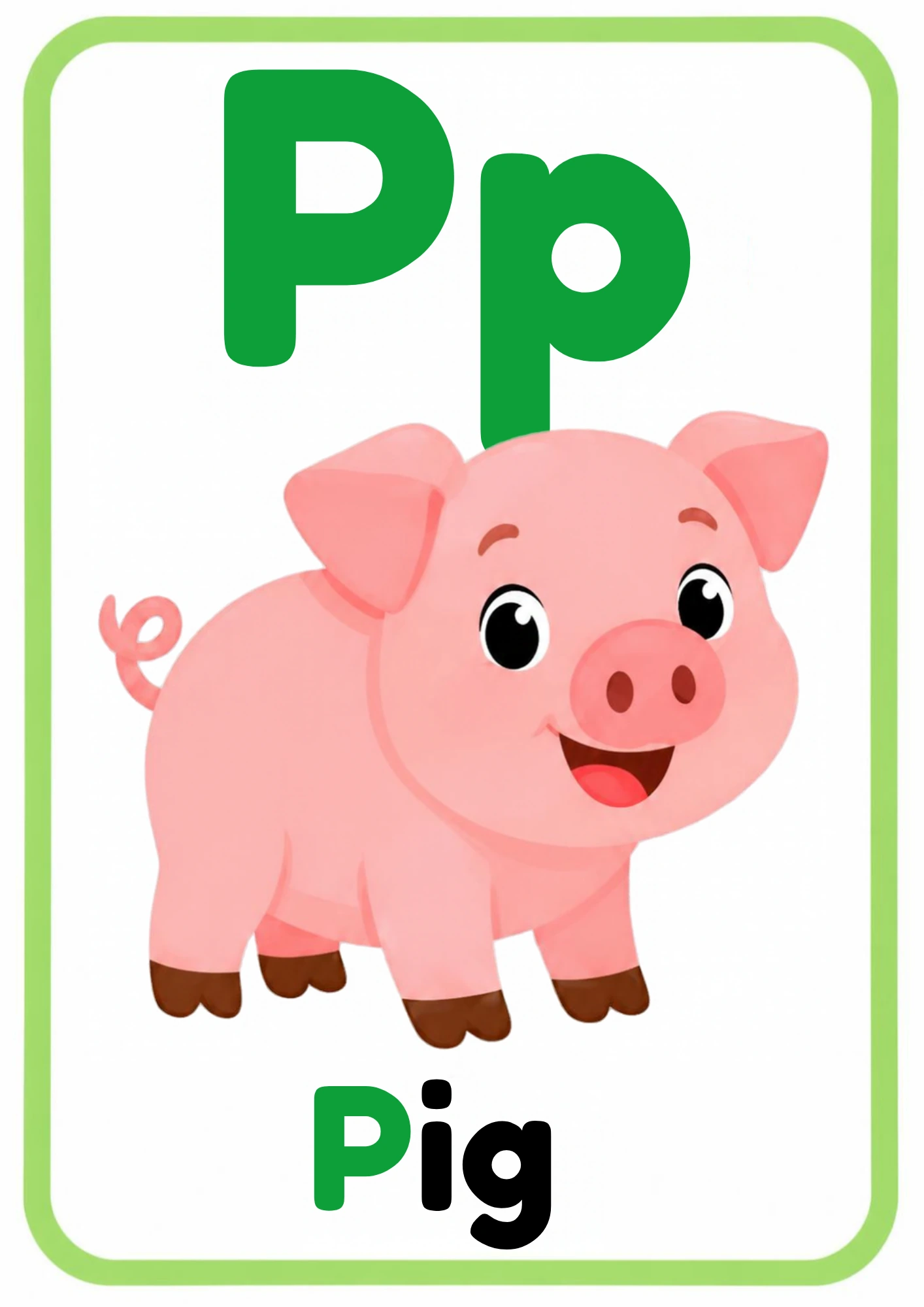
What is this?
P is the sixteenth letter of the alphabet. Big P and little p make the p sound — puh, a tiny puff of air that pops out from closed lips. No buzz, just the little gust.
What does it mean?
P is B’s twin: same lips, but B buzzes and P only breathes. Children mix the two freely and it costs nothing — the tissue test makes the difference visible whenever anyone is curious.
What does the child need to know?
The letter is called P; the sound is puh, a short puff. Say it with a tissue in front of your mouth and the tissue jumps — that little gust is the entire sound, and oinks are optional garnish.
Why this matters
A sound your child can see working in a jumping tissue turns correction into observation: it either moved or it did not. And the pig supplies the giggle track that keeps everyone coming back.
What it teaches
Lip-burst airflow control, voice-off versus voice-on discrimination against B, letter recognition in two cases, trotting gross-motor play, and pretend feeding games that grow vocabulary on the side.
Words to learn
Ppigpuhpufftissueoink
Say this to your child
“"This is the letter P — hello, P! P says puh — a tiny puff of air, like this. Lips together... pop! See the tissue jump? That is the whole sound. Now trot with me: puh, puh, pig! Oink optional but encouraged. Then we trace the big P — tall stick, round belly."”
Step by step
- Show the card and make the introduction: this is the letter P, and this is a pig — the noisiest dinner guest in the barnyard.
- Make the puff: lips together, then let a tiny gust pop out — puh. Hold a tissue in front of your mouth and watch it jump each time.
- Trace big P — a tall stick with a belly attached at the top — and little p: the same shape with its belly hanging below the line.
- Play the trot: hands and knees or trotting feet, moving through the room saying puh, puh, pig — with an oink at every corner.
- End with a p-hunt: find three things that start with the puff sound — a pot, a pencil, a pet picture — and puff the sound at each.
Look closer at the picture
Find the big uppercase P and the little lowercase p on the card, then the pig and the word Pig. Ask which letter hung its belly low — big P wears its belly up on the stick, little p lets it dangle below.
Ask your child
"What is this letter called?" "What sound does P make?" "Can you make my tissue jump?" "What p-words are trotting around this room?" — answered with a name, a clean puff, a gust of air and a happy hunt.
What your child can say or do
"Puh! Puh-pig!" Expect tissue-jumping demonstrations for every visitor, p-sounds offered to pets and puddles, and trots around the kitchen at suppertime. Oinks may punctuate conversations indefinitely. Consider it fluency.
Out in the real world
P puffs through the day: potty, park, pasta, please, the p of a puddle being jumped. Every tiny gust is the card again — and every real pig met at a farm is the sound effect arriving in person.
Try it together
Tissue tester: everyone holds a tissue at lip height, and the challenge is to make it jump with the smallest possible puh — then the biggest. Small puffs, giant puffs, whisper puffs: the sound gets a whole gust range before snack.
Understanding check
Ask what P says: a short puff that moves a tissue means the sound landed with its gust intact. A little p traced in the air — stick first, dangling belly second — completes the barnyard.
Parent tips
If puffs keep turning into buzzes, it is the P-B twin thing and it is fine: hold your throat and let your child discover which one purrs. The trotting game teaches more than any correction ever will.
Staying safe
Trotting needs cleared floor and watchful knees — hands-and-knees pigs must steer around table legs. Tissues stay out of mouths, and the game ends while the giggles are still the friendly kind.
This lesson pairs with the Pig flashcard in the library — print it, show it, keep it on the fridge. Back to Alphabet A–Z (Preschool).