
Cat — a step-by-step lesson for grown-up and child
This lesson brings the softest voice in the collection indoors. Meow is our copy of a cat’s call — long, stretchy, a little demanding — and the kitten on the card is sitting up, ready to demonstrate it in your child’s best voice.
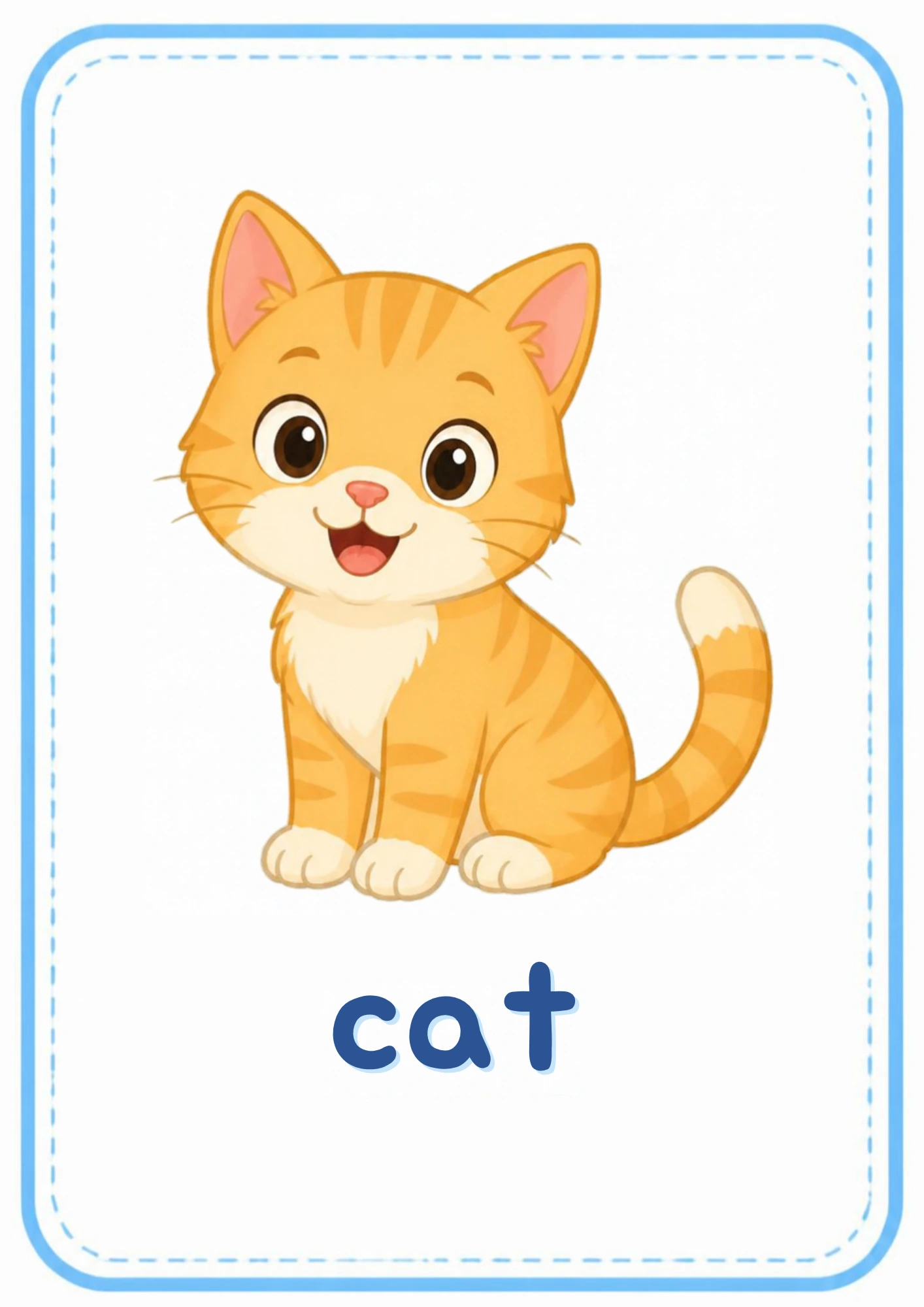
What is this?
A cat is a small, soft pet with quick feet, sharp ears and a quiet way of walking. When a cat lifts its head and calls, people copy the sound as meow: a long, stretchy word for a long, stretchy voice.
What does it mean?
The meow on the card is a people-word, not the cat’s own name for its call. And here is a fact worth sharing: grown-up cats save meow mostly for humans — with each other they sniff, rub and purr far more than they meow. The call is how a cat talks to us, which makes your child the exact audience for it.
What does the child need to know?
Your child needs to know: a cat’s sound is written meow in English, cats purr when they are content — a rumbly second voice — and they move on quiet feet. Cats we do not know are looked at, not grabbed; the asking rule from the dog works here too.
Why this matters
Meow is the perfect first stretchy sound: it slides, it holds, it can be loud or tiny. Copying it exercises the voice muscles that speech needs, and the quiet-cat games build the body control that circle time will one day call sitting nicely.
What it teaches
Voice modulation (stretching, whispering, squeaking a single word), imitation and listening, animal vocabulary, gentle-hands practice, and the self-control of moving slowly and softly on purpose.
Words to learn
catmeowkittenpurrsoftquiet
Say this to your child
“"The cat says meow! Meee-ow — stretch it out long, like a ribbon. Meow is our word for the cat’s call, and cats mostly say it to people — to you! Can you purr too? Rrrrr. Two cat sounds in one lesson: the loud one and the rumbly one."”
Step by step
- Show the card and ask what the kitten is saying. Collect every guess, then model it: meee-ow, long and slow.
- Say the pair together — the cat says meow — and stretch the word across the whole breath. Long meow, short meow, squeaky meow: the word is a toy.
- Look at the picture: an orange kitten sitting up. Ask what a sitting kitten might be asking for — dinner? a door opened? a lap?
- Try the purr next: a low rrrrumble in the throat. It is the cat’s second sound, and children are surprisingly good at it.
- Set the rule for real cats: ask the person nearby first, then let the cat come to you. A cat that walks away has answered too.
Look closer at the picture
Look at the picture together: what color is the kitten? Is it sitting or moving? Where are its ears pointing? What word sits under the kitten?
Ask your child
"What does the cat say?" "Why do you think cats walk so quietly?" "What sound does a happy cat make instead?" "What do we do before touching a cat we do not know?"
What your child can say or do
Your child may meow at every cat picture for a week, purr on request with alarming realism, or creep across the floor on silent feet announcing "quiet cat coming through!" — the sound and the walk arriving as a set.
Out in the real world
Cats appear on fences, in windows, in storybooks and in the neighbour’s garden. Every one is a chance to whisper-meow together and ask the big question — what is that cat saying? — with the whole street as the practice field.
Try it together
Quiet-cat creep: music on, everyone struts like lions — then the music stops and the cats take over: slow steps, soft feet, meows in whispers only. The moment somebody stomps, the dogs win. It is volume control wearing a costume.
Understanding check
Ask: "What does the cat say? What is the rumbly sound? How do we move like a cat?" The stretched meow, the purr and the silent creep — that is the lesson landed.
Parent tips
Accept every meow volume — the point is the stretch, not the loudness. And if your child meows instead of answering you for a day, play along: asking the cat questions back keeps the game alive and the talking going, which is the whole point of talking at all.
Staying safe
Cats we do not know are watched, not grabbed — ask the person nearby first, and let the cat choose to come close. Never touch a cat that hisses, flattens its ears or backs away; those are the cat’s words for not-yet.
This lesson pairs with the Cat flashcard in the library — print it, show it, keep it on the fridge. Back to Animals & Their Sounds.