
Dog — a step-by-step lesson for grown-up and child
This lesson starts the animal-sound collection with the voice your child already knows best. Woof is more than a fun noise — it is our word for a dog’s bark, and learning it means learning how people copy the sounds animals make.
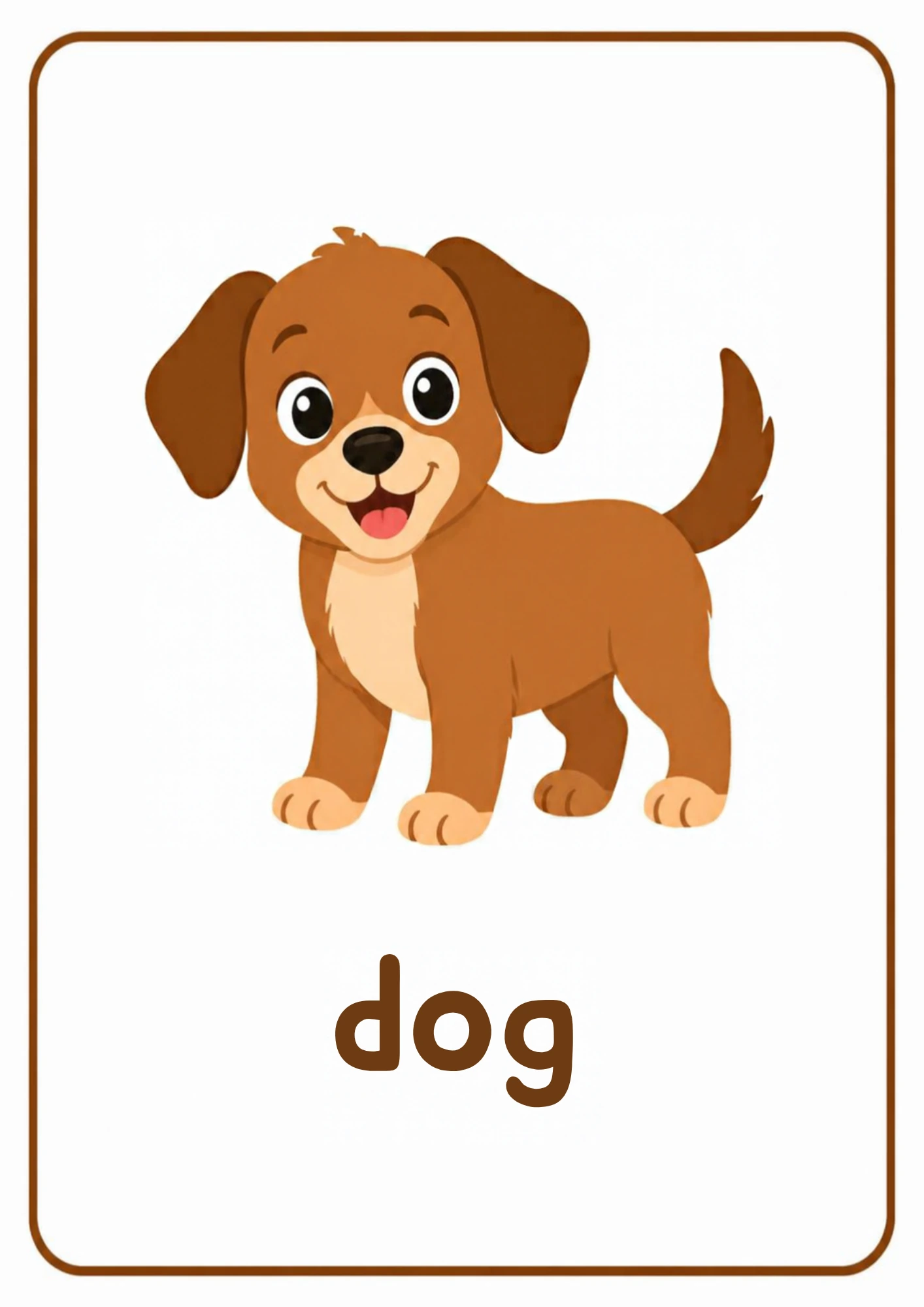
What is this?
A dog is a four-legged friend who lives with people — a pet that eats, plays, naps and greets the whole family at the door. When a dog makes its loud voice, we write it as woof: that is our word for the bark, our copy of the real thing.
What does it mean?
Here is the honest part: a dog does not know the word woof. Barking is the dog’s true voice — short, loud, repeated — and people listened and made a word that sounds like it. In English that word is woof. Every language built its own copy, but the bark they are all imitating is the same one.
What does the child need to know?
Your child needs three things: a dog’s sound is called woof in English, real dogs bark for reasons — hello, warning, excitement — and a dog we meet belongs to somebody, so we ask the person before we stroke the dog.
Why this matters
Animal sounds are a child’s first matching game: sound to animal, animal to word. Getting woof right trains listening and memory, hands over a proud piece of knowledge, and unlocks every dog story on the shelf — because now your child can supply the voice.
What it teaches
Listening and matching, sound imitation — real practice for strong consonants — animal vocabulary, empathy for living creatures, and the social rule of asking before touching someone else’s pet.
Words to learn
dogwoofbarkpuppypetgentle
Say this to your child
“"The dog says woof! Woof woof! A bark is the dog’s big voice, and woof is our word for it — the sound people hear when a dog talks. Can you say woof? Loud woof, soft woof, fast woof, slow woof — you speak dog!"”
Step by step
- Show the card and ask the big question first: what does the dog say? Let the woof come from your child if it can — owning the answer beats hearing it.
- Say the pair in one breath — the dog says woof — then answer each other: you woof, your child woofs back, a whole conversation with a single word.
- Look at the picture together: a happy brown puppy. Ask what the puppy might be woofing about — dinner? a walk? a ball under the sofa?
- Play sound match: line up three or four animal cards, make one sound, and let your child grab the animal that owns it.
- Set the real-world rule gently: when we meet a dog on its lead, we ask its person first, then stroke softly on the back. Rule and sound, learned in one lesson.
Look closer at the picture
Look at the picture together: what color is the puppy? Is it sitting or standing? Does its face look happy or cross? Where is the word dog written?
Ask your child
"What does the dog say?" "Why do you think the puppy looks happy?" "What do we do before we stroke a real dog?" "Can you woof softly, like a puppy falling asleep?"
What your child can say or do
Your child may answer every dog story with a full-volume woof, match the sound to the card in one grab, or rehearse the asking rule aloud — "may I stroke your dog?" — ready for the next walk.
Out in the real world
Dogs bark all over town: behind garden fences, in the park, on television, at the door when friends arrive. Each bark you hear is a round of the matching game — "whose voice was that?" — and your child already knows the answer.
Try it together
Sound match backwards: spread three or four animal cards face up. You make a sound — woof! — and your child grabs the right card. Then swap: your child makes the sound, you point, and get one wrong on purpose. Being corrected by a three-year-old is the best reward this game has.
Understanding check
Ask: "What does the dog say? What do we ask before stroking a dog? Show me a soft woof." The bark, the rule and the whisper — that is the lesson landed.
Parent tips
The sound is the easy half and the name is the other half — keep both in every round: dog, woof; woof, dog. If your child answers everything with woof for a few days, that is normal: fresh words get used like hammers. Let the woof run its course.
Staying safe
Real dogs are stroked only with their person’s permission — ask first, let the dog sniff a hand, then touch gently on the back, away from the face, the tail and the food bowl. A dog that is eating or sleeping gets left alone.
This lesson pairs with the Dog flashcard in the library — print it, show it, keep it on the fridge. Back to Animals & Their Sounds.