
Fingers — a step-by-step lesson for grown-up and child
This lesson counts what your child already carries everywhere. Fingers are the counting set that came free at birth — five per hand, ten in total — and the finest tools the body owns, already at work on buttons, crayons and page corners.
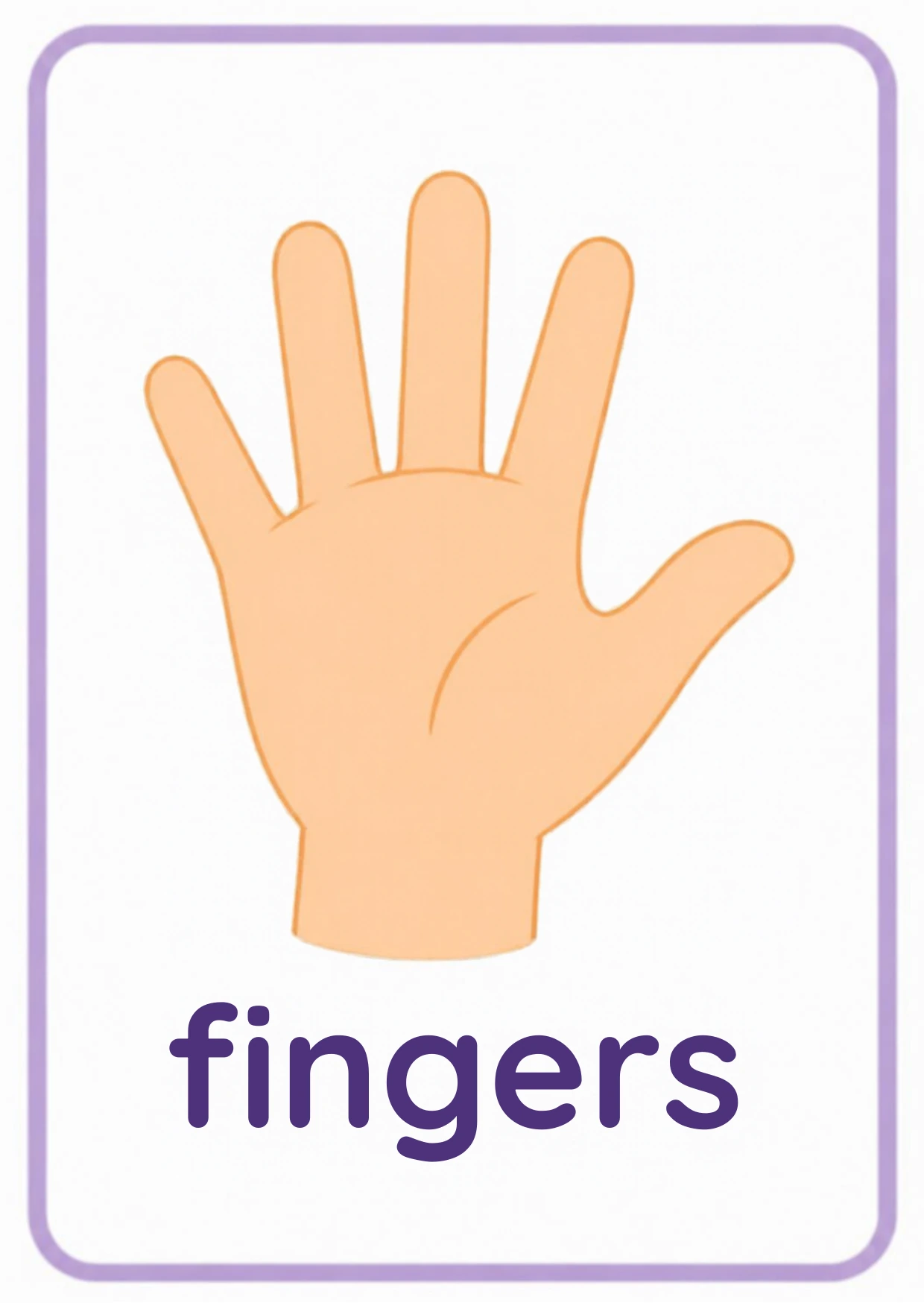
What is this?
Fingers are the five long parts at the end of each hand — a thumb and four fingers. They wiggle, point, grab, pinch and count, and they do the fine work: buttons, zips, page turns, puzzle pieces, pencil grips. Every hand comes with the full set, five per hand.
What does it mean?
Fingers are the body’s precision team: the arms reach, the hands hold, and the fingers do the detail. Each one has a speciality — the thumb can touch every other finger, which is why holding anything works; the pointing finger leads the eye; the smallest one sneaks into the tiniest spaces.
What does the child need to know?
Your child needs to know: each hand has five fingers, ten on both hands together, they can be counted — which makes them the friendliest maths lesson there is — and each has a job: thumb for grabbing, one for pointing, all of them for wiggling on request.
Why this matters
Finger naming is counting’s natural on-ramp: most children count their fingers before they count anything else, and the counting sticks because the objects are always attached. Fine-finger control is also the school-readiness skill underneath every crayon, zip and scissors job to come.
What it teaches
Counting and one-to-one correspondence, fine-motor isolation (moving one finger at a time is genuinely hard), hand preference, pointing as communication, and the finger-play tradition — rhymes and games that train every finger in order.
Words to learn
fingersthumbfivecountwigglepoint
Say this to your child
“"These are your fingers — five on every hand, ten altogether! They wiggle, they point, they grab, they count. The thumb can touch every single fingertip — try it! And they are the counting set you were born with: one, two, three, four, five. Show me one finger wiggling all by itself!"”
Step by step
- Show the card and count the fingers on the open hand: one, two, three, four, five. Then count your child’s real hand to check the set is complete.
- Wiggle test: can your child wiggle just one finger, then two, then all five like a piano? Moving one finger alone is a real skill — celebrate every success.
- Name the special jobs: the thumb that touches every fingertip, the pointer that shows the way, the little one that fits the small spaces. Try each job out.
- Play hide-and-seek fingers: hide all five in a fist, then let one peek out — can your child name which one? Thumb? Pointer? Guessing is half the game.
- Give the fingers real work: a button, a zipper, a page to turn, a puzzle piece to place. Fingers learn by doing — and the doing is the lesson.
Look closer at the picture
Look at the picture together: how many fingers does the open hand show? Is the thumb among them? What word sits with the hand? Are the fingers spread out or curled?
Ask your child
"How many fingers on one hand? On both hands?" "Can you wiggle just your thumb — now just your pointing finger?" "What is your pointing finger for?" "What did your fingers learn to do this week?"
What your child can say or do
Your child may count to ten on fingers at every opportunity, show off a one-finger wiggle like a party trick, or use the pointing finger to lead the whole family to what matters — the counting set, fully operational.
Out in the real world
Fingers work everywhere: turning book pages, fastening shoes, picking berries, counting out apple slices, pressing doorbells. Name the finger-work as it happens — your fingers buttoned it, your fingers counted it — and the fine team gets its reviews.
Try it together
Finger football: fingers lined up as teams on the table edge, one ball (a soft pom-pom), and flicking only — which finger can shoot the pom-pom across the table? Each finger gets a turn. Precision flicking is finger isolation training in World Cup packaging.
Understanding check
Ask: "How many fingers on each hand? Which one touches all the others? Show me a single-finger wiggle." The count, the thumb and the wiggle — that is the lesson landed.
Parent tips
Fingerplays — rhymes with finger actions — are the tradition for good reason: they train isolation, counting and rhythm in one sitting. Learn two or three by heart and keep them for queues and car seats. And never rush pencil grip: fingers that wiggle freely now will hold pencils properly later.
Staying safe
Fingers and doors do not mix — keep them clear of hinges and edges, and fingers and small objects need the choking rule around babies. Fingernails get trimmed by a grown-up; the picking and poking jobs belong to the fingers, not the fingernails.
This lesson pairs with the Fingers flashcard in the library — print it, show it, keep it on the fridge. Back to Body Parts & Five Senses Flashcards.