
Five Ladybugs — a step-by-step lesson for grown-up and child
This lesson lands on the number your child carries on the end of each arm: five. Five ladybugs to touch, five fingers to wiggle, and the perfect place for a first proper counting session to finish.
What is this?
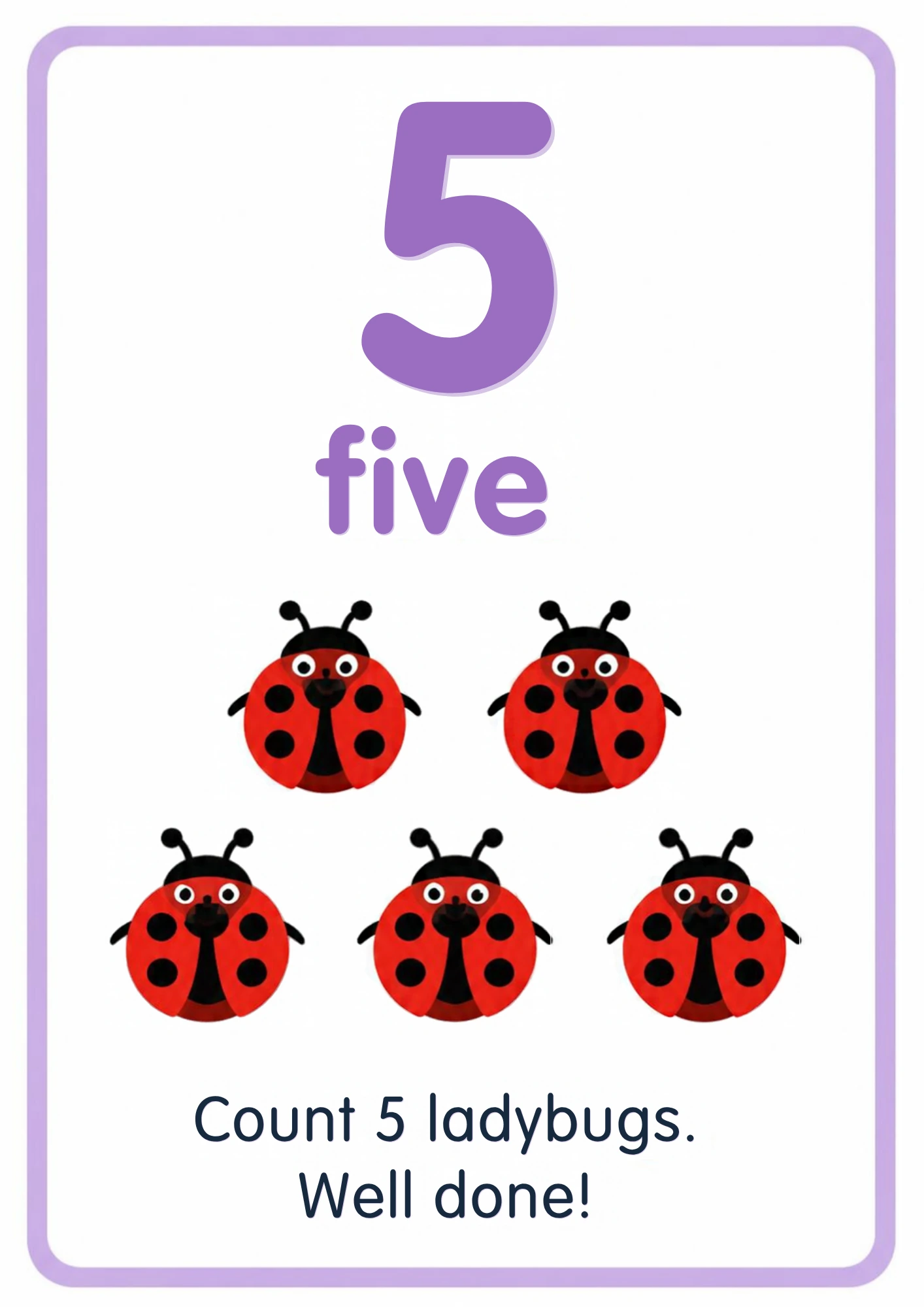
Five is four and one more — a whole hand. On the card: five red ladybugs, the word five and a big numeral 5 — little counting stations waiting for their taps.
What does it mean?
Five is the first number with a body part of its own: the hand. Children can check a five against their own fingers, which makes it the first number that verifies itself — count the bugs, then count the hand, same answer.
What does the child need to know?
Your child needs: five comes after four, each ladybug gets one touch, and five matches one whole hand. Reaching five in order — wobbles allowed — is a proud, complete day’s work, not a warm-up.
Why this matters
Finger-counting is the training wheels of arithmetic: it makes numbers touchable, portable and always available. Five is the anchor point — once a child trusts five, six-to-ten become five-and-some-more, and the number line folds in half.
What it teaches
Finger counting, touch accuracy at five objects, counting a group that arrives in rows (a quiet prelude to adding), and the satisfaction of a finish line reached by pointing.
Words to learn
fiveladybugshandfingersrowsfinish
Say this to your child
“"Five ladybugs! Let’s count them — one touch each: one, two, three, four, five. Now count your fingers — the same number! Five ladybugs, five fingers. High-five! Five is a whole hand, and today you counted all the way there."”
Step by step
- Show the card and ask how many ladybugs landed on it — then count together, one gentle touch per ladybug.
- Hold up one hand and count the fingers — one to five, thumb first — then match each finger to a ladybug on the card, one for one.
- Seal the count with a high-five: five! The slap makes the number arrive in the palm as well as the ears.
- Set the table for five: five pegs in a row, five blocks, five pom-poms — touched and counted into place, one per tap.
- Finish with five jumps, five claps and one enormous high-five — the hand number deserves the full-body send-off.
Look closer at the picture
Look at the card together: how many red ladybugs are visiting it? Touch each one as you count to five. Find the big numeral 5 and the word five — then hold up your hand and count its five fingers too.
Ask your child
"How many ladybugs are on the card?" "Can you touch every one of them?" "How many fingers on one hand?" "Is five more than four — how could we check?" "Can you give me a high-five?" — every answer ends in a slap.
What your child can say or do
Your child may hold up a hand and declare five at random moments — fingers out, very certain — and count stairs, snacks and fingers with fresh ambition. Watch for the double-tap: it is the next skill queueing up, not a flaw to fix.
Out in the real world
Fives frame the day: five toes on each foot at sock time, five candles to blow, five little pumpkins in the song, five minutes more at the park. Each five named is the anchor rehearsed.
Try it together
Finger-and-bug match: press your child’s hand on paper, trace it, and draw five ladybugs above the five fingertips — then let them draw a line from each bug to its finger. One-to-one counting as art, and the matching is the maths.
Understanding check
Ask tomorrow how many fingers one hand has — hands down first, then up for the count: a five that arrives before the wiggling starts means the number is carried in the head now, not just the hand.
Parent tips
End sessions at five without apology — a complete, happy five beats a frazzled ten every time. If the count drifts, park the ladybugs in a line first: straight rows keep counts honest and children calm.
Staying safe
Ladybug crafts keep glue and googly eyes above tasting height — small craft pieces wait for the no-mouths years. Real ladybugs stay admired on leaves, not in fists; five is for counting, never for keeping.
This lesson pairs with the Five Ladybugs flashcard in the library — print it, show it, keep it on the fridge. Back to Numbers 1–10.