
Hexagon — a step-by-step lesson for grown-up and child
The hexagon arrives with the best story in the class: it is the shape bees build with. Six sides, six corners, and a fitting-together trick that honeycombs use to hold honey without wasting any space. This lesson counts the six, tells the bee story and builds a real hexagon from coins and pencils.
What is this?
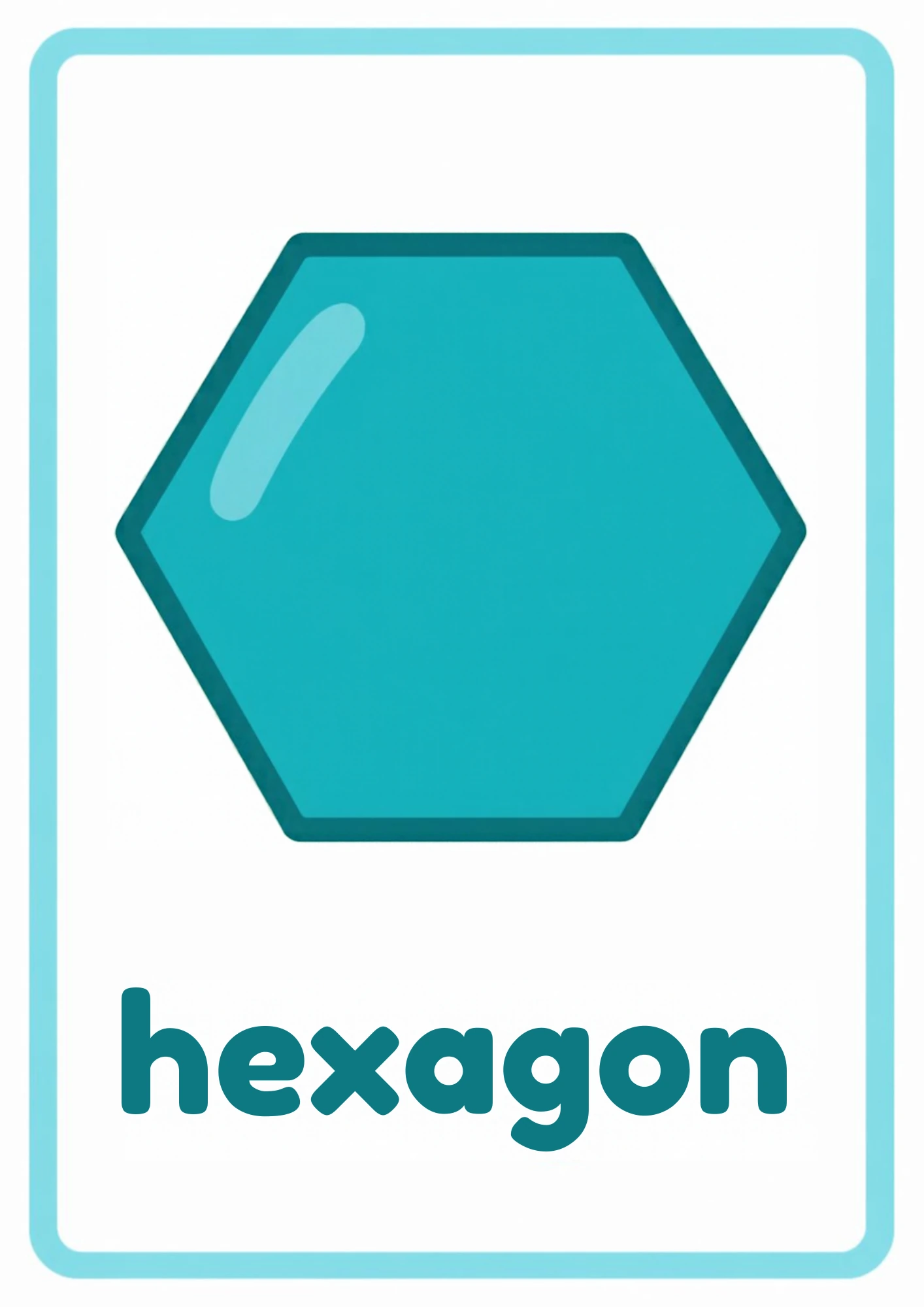
A hexagon has six straight sides and six corners. On the card it is one big teal hexagon with six straight sides and the word hexagon underneath. Its famous talent is fitting: hexagons sit side by side with no gaps, which is why honeycombs — and some fences and floor tiles — are built from them.
What does it mean?
Fitting is the hexagon’s superpower: some shapes tile a surface snugly and others leave gaps, and the hexagon is the champion of snug. A child who pushes six-sided rooms together and finds no spaces has discovered tessellation — the reason the bee story is true — with their own hands.
What does the child need to know?
Your child needs the count — six sides, traced slowly — and the bee story, retold at will: bees build with hexagons because the rooms fit together perfectly. The coin game below builds a hexagon-shaped gap out of round coins, which is the kind of magic children retell for weeks.
Why this matters
Tessellation is deep spatial maths met through insects: shapes that fit define how tilers, bees and package designers think. And a shape attached to a story sticks — the child who retells “bees build with hexagons” at every opportunity is doing exactly what memory wants.
What it teaches
Counting to six on edges, fit-and-tile spatial reasoning, the bee-biology connection, fine motor work in coin placing and tracing, and narrative memory — a shape attached to a story sticks harder than a shape attached to a drill.
Words to learn
hexagonsixsidesbeehoneycombfit
Say this to your child
““Hexagon! Six straight sides — one, two, three, four, five, six. And do you know who loves hexagons most? BEES! Bees build with hexagons because the rooms fit together perfectly, no gaps, like a puzzle. Let us do the coin trick and find a hidden hexagon... there it is!””
Step by step
- Show the card and trace all six sides slowly, counting together: one to six.
- Tell the bee story: bees build their honey houses from hexagons, because six-sided rooms fit together with no gaps.
- The coin trick: trace around one coin, then tuck five more coins tightly around it and trace them — the space left in the middle is a hexagon.
- Look at honey: if there is a honey jar in the kitchen, check the label or a honeycomb picture together and find the six-sided rooms.
- Build it again from craft sticks or straws — six sides, closed, no gaps — and admire it the way a bee would.
Look closer at the picture
On the card: one big teal hexagon with six straight sides and the word hexagon underneath. Can your child trace all six sides without stopping? Which side is on top? Do the sides all look the same length, or is one stretching longer?
Ask your child
“How many sides does a hexagon have? Who builds with hexagons, and why?” “What happens when hexagons sit next to each other?” “Can we build a hexagon from sticks?”
What your child can say or do
Your child might retell the bee fact to every visitor, count sixes on tiles and fences, or build hexagons from anything straight at hand — a shape with a resident story gets narrated, and the narration is the revision.
Out in the real world
Hexagons hide in plain sight: honeycomb patterns on jars and boxes, some floor tiles, the hex heads of nuts and bolts, the patches on a football. Once the bee story is told, every sighting becomes evidence — the child starts finding the shape the insects built their world from.
Try it together
The hexagon hive: draw or tape a big honeycomb of touching hexagons on paper or the floor, and let your child fill each room with a toy bee, a pom-pom or a piece of snack cereal — one per room, counted aloud. Fitting things into hexagon rooms is the game the bees invented first.
Understanding check
Ask: “How many sides? Who builds with them? What happens when they sit together?” Six, bees and a no-gaps answer — that is the lesson landed.
Parent tips
If the coin trick flops — small hands and pencils have off days — skip ahead to the stick build: six craft sticks on the table close into a hexagon just as honestly. The bee story carries the lesson even on days when the building refuses.
This lesson pairs with the Hexagon flashcard in the library — print it, show it, keep it on the fridge. Back to Shapes & Patterns (Preschool).