
Pentagon — a step-by-step lesson for grown-up and child
The pentagon raises the stakes: five sides, five corners, and a word long enough to be an achievement all by itself. Children who say pentagon out loud own something rare — and this lesson earns it with a slow count, a drawing job and a house fit for a very lucky toy.
What is this?
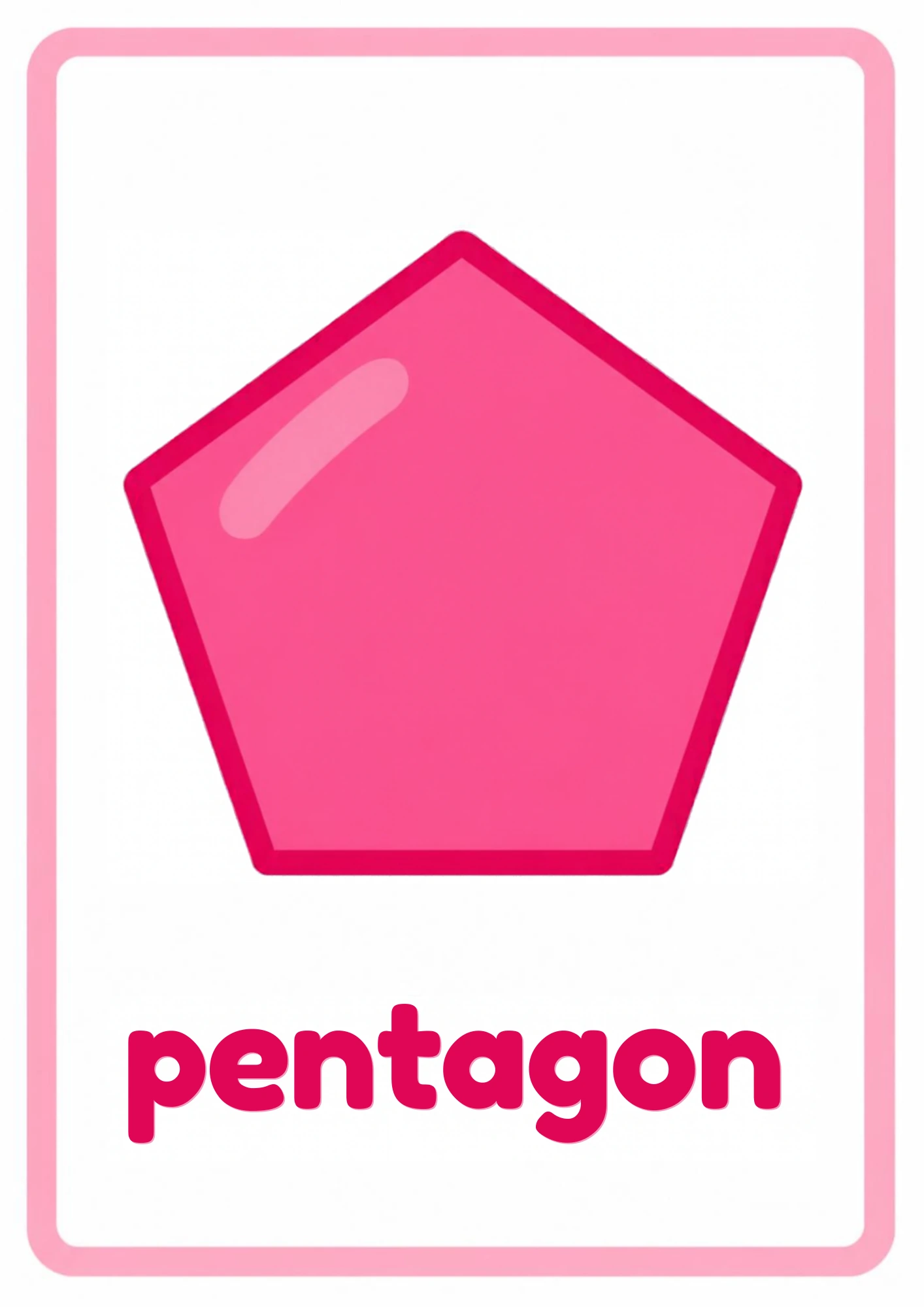
A pentagon has five straight sides and five corners — count them and you have the whole rule. On the card it is one big pink pentagon with five straight sides and the word pentagon underneath. It is not a shape your child meets every day, which is exactly what makes saying it feel powerful.
What does it mean?
The count jumps to five, and the word is a trophy. Pentagon is a three-syllable mouthful that most adults rarely say, so a three-year-old who says it owns a rare thing — and rare things get repeated. The pride is the pedagogy: a child showing off a long shape word is rehearsing it for free.
What does the child need to know?
Your child needs the count — five sides, five corners, one slow finger trip around the edge — and the courage of the long word: pen-ta-gon, three claps. The five-sided house drawing turns the count into a gift, and the gift needs a tenant.
Why this matters
Counting sides generalizes: shapes can be named by their numbers, which is the whole system — three, four, five, six, eight — hiding behind the names. Meeting the pattern now, with the word as a prize, teaches that new shapes are new counts, not new mysteries.
What it teaches
Counting to five on edges, slow-trace finger control, syllable clapping on a three-part word, drawing closed shapes with a target number of sides, and the vocabulary pride of a word most adults rarely say out loud.
Words to learn
pentagonfivesidescornershousecount
Say this to your child
““Pentagon! Pen-ta-gon — three claps for this word! Five straight sides: one, two, three, four, five. And five corners, one at every stop. Let us draw a house with five sides... a pentagon house! Who should live in it? Choose your luckiest toy.””
Step by step
- Show the card and take one slow finger trip around all five sides, counting aloud: one, two, three, four, five.
- Clap the word: pen-ta-gon — three claps for three parts. Say it like a cheer.
- Draw a five-sided house together — pentagon body first, then a door and windows your child adds.
- Count the corners the same way as the sides — five again? Let your child check and report.
- Move in a toy: which lucky teddy gets the pentagon house? The drawing is the lesson; the tenant is the reward.
Look closer at the picture
Look at the card together: one big pink pentagon with five straight sides and the word pentagon underneath. Can your child count the sides with one finger? Which side sits at the very top? Are the corners pointy — and how many are there?
Ask your child
“How many sides does a pentagon have? Clap the word — how many parts?” “What did we draw with five sides?” “Is a pentagon round anywhere, or all straight?”
What your child can say or do
Your child might announce pentagon at random moments for the pleasure of the sound, clap the word at the dinner table, or assign a beloved toy to the drawn house with full paperwork — a rare word used proudly is a word fully owned.
Out in the real world
Pentagons are rare guests in daily life — some street signs, the famous five-sided building, the home-plate shape in baseball pictures — and their rarity is the lesson’s charm. The count and the claps travel; the sightings, when they come, feel like spotting a celebrity.
Try it together
Five-side builders: lay five straws or craft sticks on the table and challenge your child to make them into a closed shape with no gaps. Five sides, five corners — when it closes, it is a pentagon, and it deserves a toy inside. Building the count beats counting the build.
Understanding check
Ask: “How many sides? Clap the word. What lives in your pentagon house?” Five, three claps and a name — that is the lesson landed.
Parent tips
Five is a big count and wobbles are normal — keep the finger moving and the counting calm; the trip around the shape matters more than perfect pointing. And let the long word be fun: a child who says pentagon at breakfast has already won the morning.
This lesson pairs with the Pentagon flashcard in the library — print it, show it, keep it on the fridge. Back to Shapes & Patterns (Preschool).