
Oval — a step-by-step lesson for grown-up and child
The oval arrives holding hands with the circle, because it is the circle with a story: something stretched it. Eggs, balloons, spoons — the shape of a gentle pull. This lesson lets your child do the stretching, in playdough first and in words second, until the difference between round and almost-round is something their hands already know.
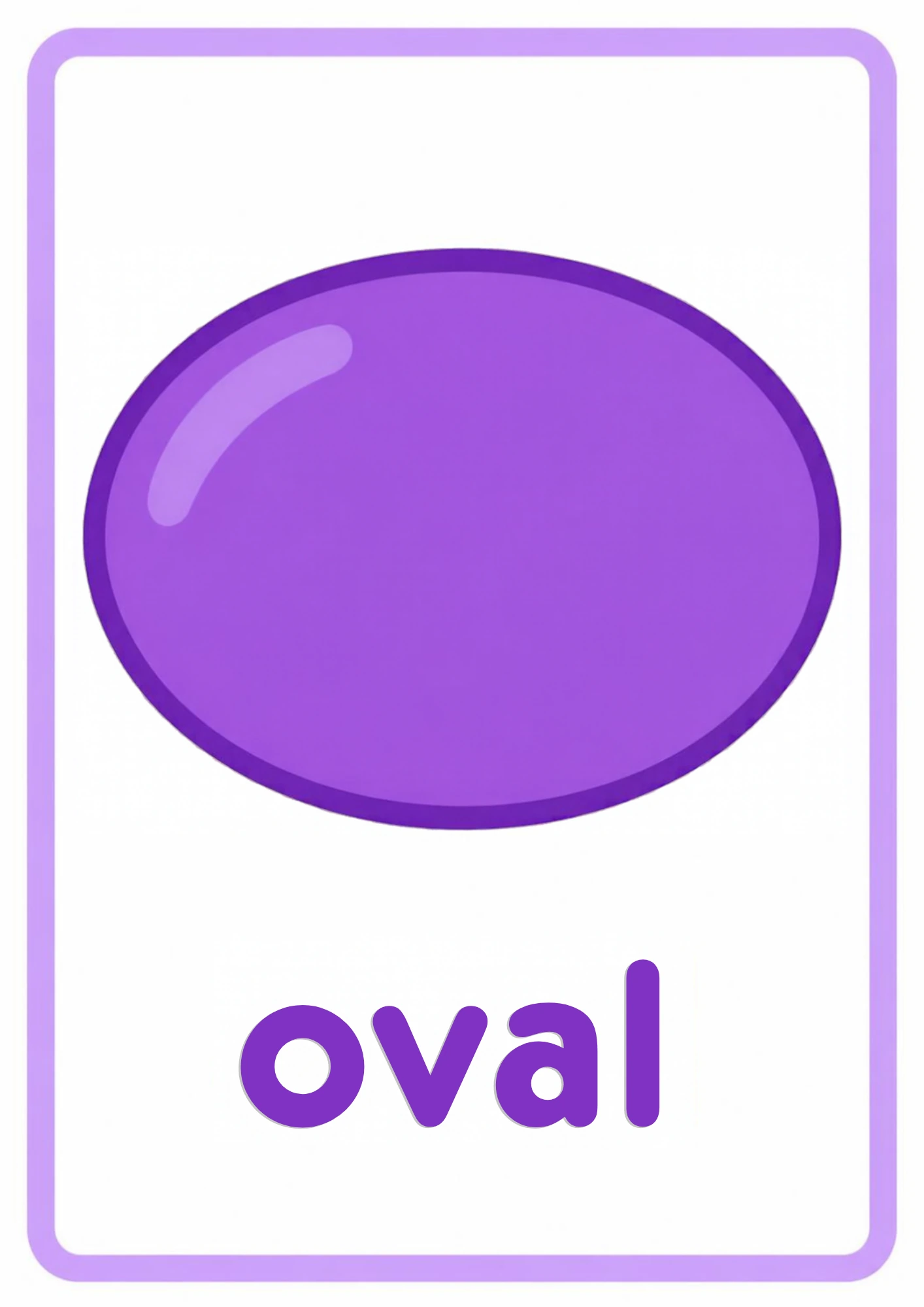
What is this?
An oval is like a circle that has been stretched — longer one way, still smooth and corner-free, with no straight sides anywhere. On the card it is one big purple oval, stretched like a balloon, with the word oval underneath. Eggs are ovals. So are balloons, plums and the bowl of a spoon.
What does it mean?
Near-twins teach precision. Circle and oval are so close that telling them apart is a genuine act of looking — round the whole way, or pulled? A child who holds both ideas at once, without collapsing them into one, is doing fine visual work: the same careful seeing that later tells b from d and p from q.
What does the child need to know?
Your child needs the stretch story — round became long — and a feel for the in-between: an oval is not a circle and not a rectangle; it is its own shape. The playdough game makes the whole journey physical: ball, then pull, then oval, then roll it back.
Why this matters
Shape transformation is big mathematical weather: one thing becoming another by stretching is the idea behind triangles into parallelograms and squares into boxes, years from now. Meeting it at three, with playdough and an egg, plants the idea where the hands can reach it again.
What it teaches
Shape-transformation thinking, comparison language (round, stretched, longer), fine motor work in pinching and rolling playdough, observation of natural ovals (eggs, plums, leaves), and the flexibility to hold two near-twin shapes apart without merging them.
Words to learn
ovaleggstretchroundsmoothballoon
Say this to your child
““Oval! A circle that got stretched — see? Long this way, smooth all the way round, no corners at all. Roll the playdough... now stretch it gently... it became an oval! Just like an egg. Can you make your hands into a big oval? Round... and stretch!””
Step by step
- Show the card and trace the outline — smooth, no corners, but longer one way.
- Tell the story: a circle got stretched — pull your hands gently apart as you say it.
- The playdough proof: roll a ball, then stretch it slowly — round... round... oval! Let your child do the pulling.
- The egg check: hold a real egg — which way does it curve? Turn it slowly: longer one way, smooth all round.
- The balloon connection: a grown-up blows up a balloon part-way and holds it out — an oval in the hand. Let more air in and watch it grow longer still.
Look closer at the picture
The card holds one big purple oval, stretched like a balloon, with the word oval underneath. Which way does it stretch — up, down or sideways? Trace the edge with your child: any corners anywhere, or smooth the whole way round? Does it look more like an egg or a balloon?
Ask your child
“What did we do to the circle to make an oval?” “Is an egg a circle or an oval?” “Can you stretch your playdough ball into an oval?” “What else is oval in the kitchen?”
What your child can say or do
Your child might stretch their hands into ovals at every egg, inspect balloons like a quality inspector, or roll-and-stretch playdough on a loop — ball, oval, ball, oval — until the two words live in their fingers instead of their ears.
Out in the real world
Ovals in the fridge and the toy box: eggs, plums, grapes, balloons, spoon bowls, some bathroom mirrors, the footprint in the sand. Each one is a stretched-circle sighting, and sightings at breakfast count double because the egg is there and so is the appetite.
Try it together
The playdough shape machine: roll a ball and call circle — then call oval, and your child stretches it; call circle again, and they roll it back round. Switch the calls faster and faster until their hands know both words by heart. Shape rules are easiest to learn when the hands do the editing.
Understanding check
Ask: “How do you make an oval from a circle? Is an egg round or oval? Show me oval with your hands.” Stretch, oval and the pull-apart gesture — that is the lesson landed.
Parent tips
Circle-versus-oval confusion is completely normal — they are near-twins, and near-twins take time. Compare side by side rather than correcting: the circle card and the oval card together, one finger on each edge. The day your child says “this one got stretched” is the day the lesson landed for good.
This lesson pairs with the Oval flashcard in the library — print it, show it, keep it on the fridge. Back to Shapes & Patterns (Preschool).