
Star — a step-by-step lesson for grown-up and child
The star is usually the shape a child already owns — stickers, reward charts, drawings on the fridge — which makes this the class’s confidence card. This lesson turns fame into precision: a star is five points, here is how to count them, and tonight the sky might just hand over the real thing.
What is this?
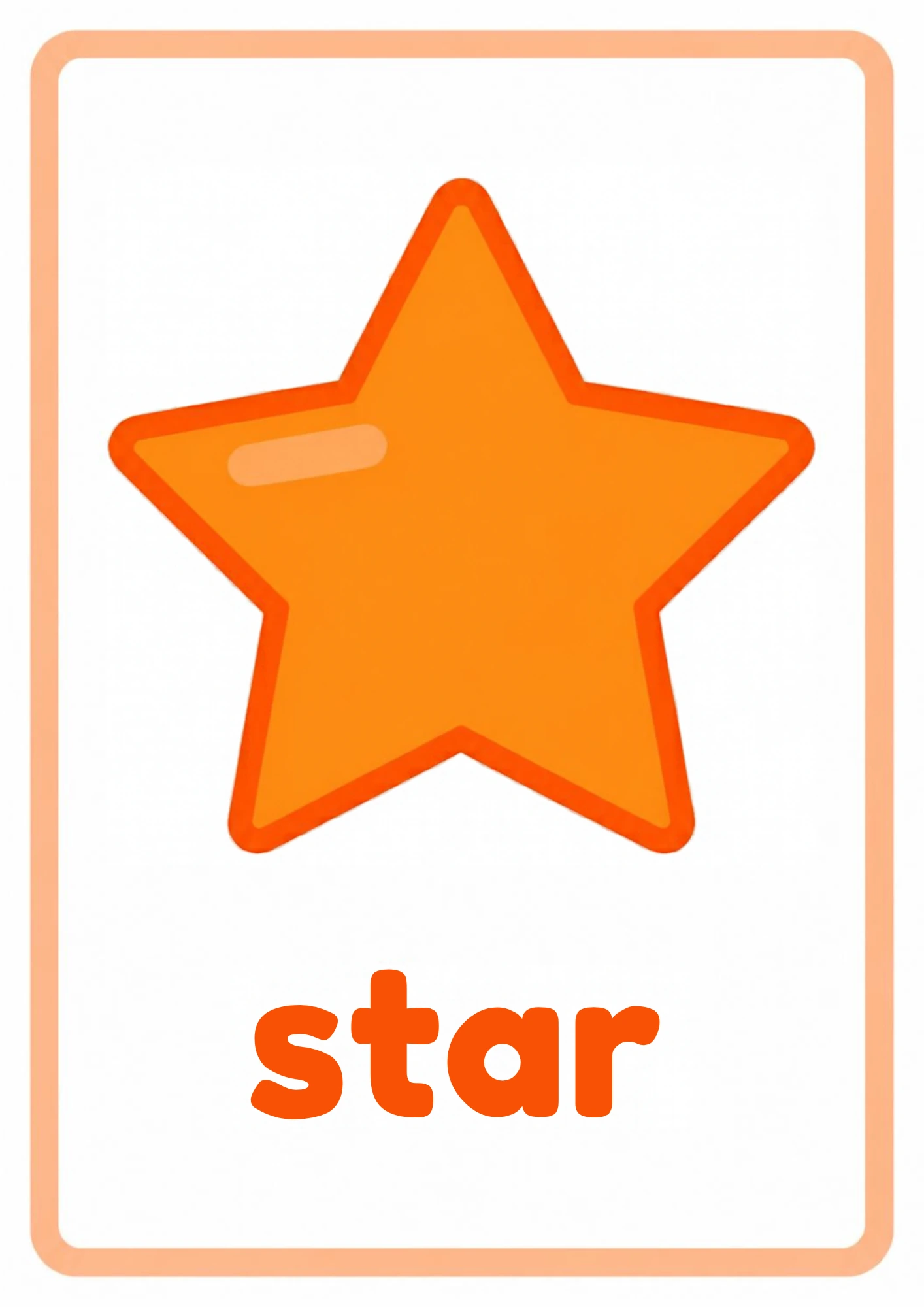
A star has five points shooting out from a middle — a shape that refuses to sit still the way circles and squares do; it sparkles. On the card it is one big yellow star with five points and the word star underneath. In life, stars live on drawings, decorations and, after dark, much higher up.
What does it mean?
The points are the whole identity: count them and you hold the shape. That makes the star a counting shape — five is not decoration, it is the definition — and counting five narrow tips takes more finger control than counting four fat sides. The word arrives already famous; the count is what turns fame into ownership.
What does the child need to know?
Your child needs the count — one to five, one point per finger — and the drawing bug: stars get drawn everywhere once learned, on every paper and in every margin. The night-sky visit gives the word its most magical rehearsal, and it is free every clear evening.
Why this matters
Pointing at five skinny targets is sneaky fine-motor and one-to-one counting practice — the pointer must land precisely, stop and move on. And the star carries a bonus no other shape has: it exists overhead, real and enormous, which turns bedtime into a vocabulary event.
What it teaches
One-to-one counting to five, pointing accuracy on narrow targets, air-drawing coordination, shape confidence from a familiar favourite, and the bedtime ritual that attaches vocabulary to wonder — the strongest glue early learning has.
Words to learn
starfivepointssparkleskycount
Say this to your child
““Star! Count the points with me — one, two, three, four, five! Five sparkly points. Now look at your hand — five fingers! A hand and a star are the same number. Draw one in the air... up, down, across, zig-zag! And tonight, we will look out of the window for a real one, far away in the sky.””
Step by step
- Show the card and count the points together, slowly: one, two, three, four, five.
- Five fingers, five points: hold up a hand and match finger to point — a hand and a star are the same count.
- Draw stars in the air with one big zig-zag arm movement, then on paper with a crayon — wobbly stars count double.
- Sticker round: any star stickers in the house? Hand them out and count the points on each one.
- Tonight, look out of the window for the first star. If the sky cooperates, your child meets the original.
Look closer at the picture
On the card: one big yellow star with five points, and the word star underneath. Can your child touch each point in turn? Is there one point at the very top? Are all five the same size, or does one shoot out longer than the rest?
Ask your child
“How many points does a star have? How many fingers do you have — the same number?” “Can you draw a star in the air?” “Where will the first star be tonight?”
What your child can say or do
Your child might draw stars on every available surface, hold up a five-finger star at dinner, or demand the window at dusk — a shape this famous gets produced, counted and celebrated, usually all before breakfast.
Out in the real world
Stars fill childhood: stickers, reward charts, wrapping paper, flags, and the actual night sky. Each drawing is a five-point rehearsal, and the sky adds the once-a-day magic round — the only vocabulary review that comes with a wish attached.
Try it together
Star jumps: five points, five jumps — jump and count one to five, then freeze into a star shape with arms and legs wide. Repeat until the giggles win. Counting and shape in one game, and the freeze at the end is a proper star, made of one delighted child.
Understanding check
Ask: “How many points? Show me five. Draw a star in the air.” Five, the hand and a zig-zag — that is the lesson landed.
Parent tips
Accept wobbly stars — the count matters more than the symmetry, and symmetry arrives with practice. If bedtime star-spotting becomes a ritual, protect it: the reward for a shape lesson should occasionally be the actual night sky, and children who look up once tend to keep looking.
This lesson pairs with the Star flashcard in the library — print it, show it, keep it on the fridge. Back to Shapes & Patterns (Preschool).