
Frog — a step-by-step lesson for grown-up and child
This lesson teaches what a pond is and why the frog is the animal that fits it best: a hunter that sits on the lily pads, swims when trouble comes, and raises its babies in the same quiet water.
What is this?
A pond is a small body of still water — smaller than a lake, big enough for lily pads, reeds, tadpoles and all the insects frogs eat. Ponds can be tiny: some fit in a garden.
What does it mean?
The frog is a two-home animal in one home: it breathes air and sits on the pads, but it swims like a champion and lays its eggs in the water. The pond feeds it flies, hides it underwater and raises its tadpoles. Every part of the frog’s day happens within one splash of the edge.
What does the child need to know?
Your child needs three pond ideas: ponds are small still waters with plants growing in and around them; frogs sit on lily pads by day and plop into the water when startled; and frog babies are tadpoles — little swimming dots that grow legs and turn into frogs right there in the pond.
Why this matters
The frog delivers the strangest, most memorable fact in the early habitat curriculum: it completely changes its body as it grows, from swimming tadpole to hopping frog — and it does it all inside one pond. Children who meet that transformation never forget that water is a living place.
What it teaches
Life-cycle sequencing (egg, tadpole, frog), the two-worlds idea of air and water, listening skills through croak-spotting, and gentle nerve — ponds are slimy, jumpy places and approaching them anyway is real confidence work.
Words to learn
pondlily padreedcroakploptadpoleswim
Say this to your child
“"The frog lives at the pond. It sits on the lily pad very, very still, and when anything comes close — plop! — into the water it goes. The pond is where it eats, swims and where it was a tadpole once, with no legs at all."”
Step by step
- Show the card: "This is a frog, and this is its home — a pond."
- Read the scene: the frog sits ON the water, not in it — that flat green pad is its chair. Ask what happens if a heron comes near. Plop! Straight into the water.
- Tell the baby story: frog eggs are laid in the pond, tiny tadpoles hatch and swim, and slowly they grow legs and hop out. The pond is the nursery.
- Practice the frog move: crouch small on an imaginary pad, sit very still, then leap and "plop" behind a cushion.
- Finish with the listening challenge — next pond visit, the game is to hear one croak.
Look closer at the picture
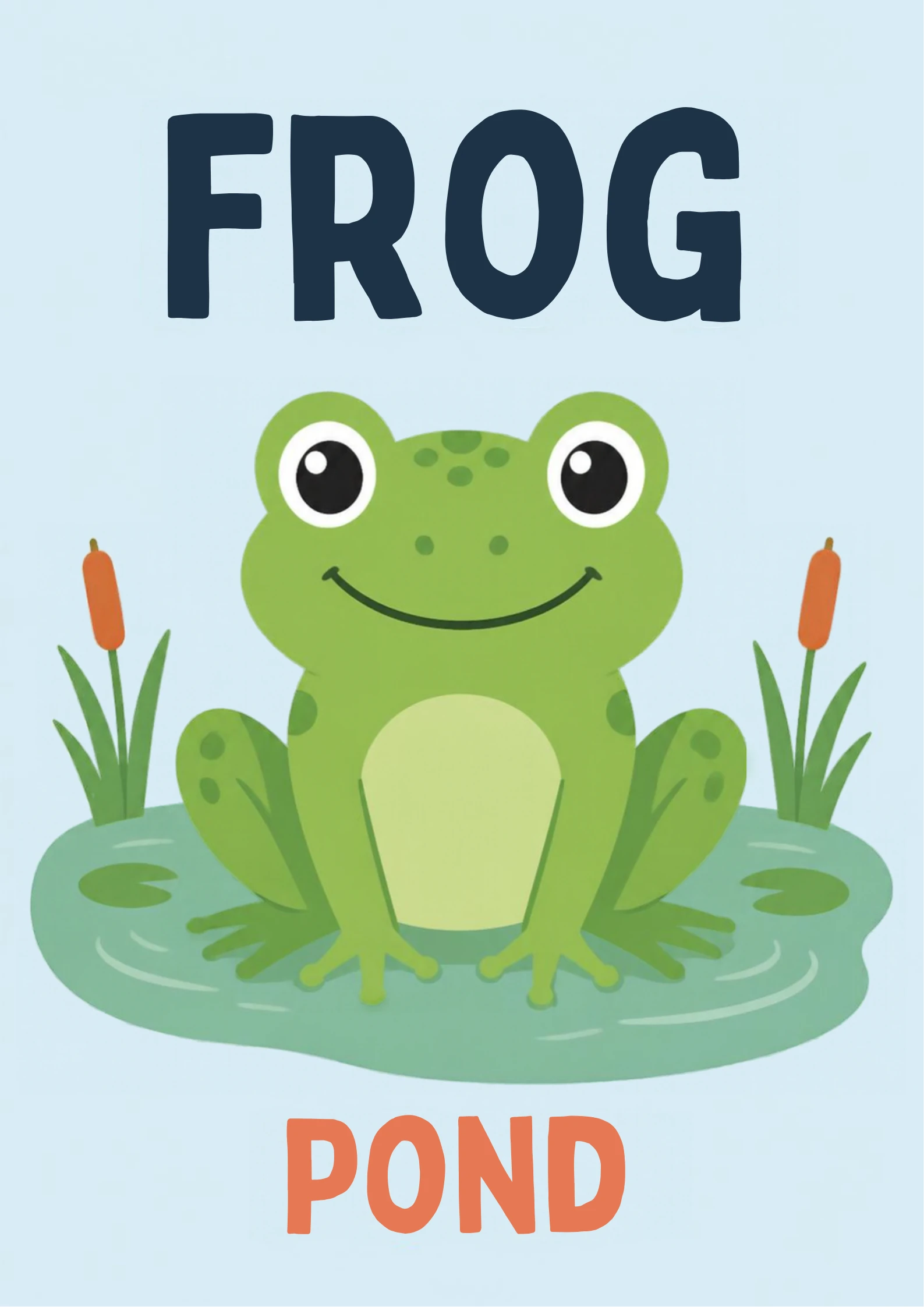
On this card a bright green frog with a wide smile and big dark eyes sits in the middle of a round lily pad. Two orange-tipped reeds stand at its sides and gentle green water spreads below. The word "pond" sits under the scene — everything the frog needs fits in this one still corner.
Ask your child
"Where does the frog sit?" "What does the frog do when someone comes close?" "What was the frog before it was a frog?" "Can we be that still?"
What your child can say or do
Your child might say: "It sits on the lily pad," "Plop! It jumps in the water," or the life-cycle line: "It was a tadpole first — it swims and then it hops!"
Out in the real world
Any pond, park puddle-pool or even a fountain edge works for frog-spotting: approach on tiptoe, listen for croaks, scan the pads. Most city ponds have frogs; the tiptoe approach is what makes it work. If a real plop happens as you arrive — that WAS the frog.
Try it together
Plop-and-freeze: everyone is a frog on a cushion pad. One player is the heron, walking slow circles. When the heron looks your way — freeze on the pad. When it looks away — you may bob and ribbit. Caught mid-bob means you hop to a new pad. Stillness is the skill; giggling is allowed after.
Understanding check
Ask: "Where does a frog live? Where does it sit? What do we call its swimming babies?" Pond, lily pad, tadpoles — three answers and the lesson has landed.
Parent tips
Do not rush the tadpole story — it is the single best transformation children this age own, and retelling it in three scenes (egg, swimmer, hopper) builds narrative muscle. And if your child asks whether frogs sleep in the water: yes, half-in, half-out — a frog never really leaves the pond far behind.
Staying safe
Pond edges are slip-prone: at real water, one grown-up holds one small hand, always. Never lean over a pond alone, and wash hands after any pond-side play — frogs are lovely, pond water is not for fingers.
This lesson pairs with the Frog flashcard in the library — print it, show it, keep it on the fridge. Back to Animals & Their Habitats (Class 36).