
Kangaroo — a step-by-step lesson for grown-up and child
This lesson teaches the grassland from the kangaroo’s side: open, treeless miles where walking is too slow — so the kangaroo hops, carries its baby in a pouch and owns the bounce.
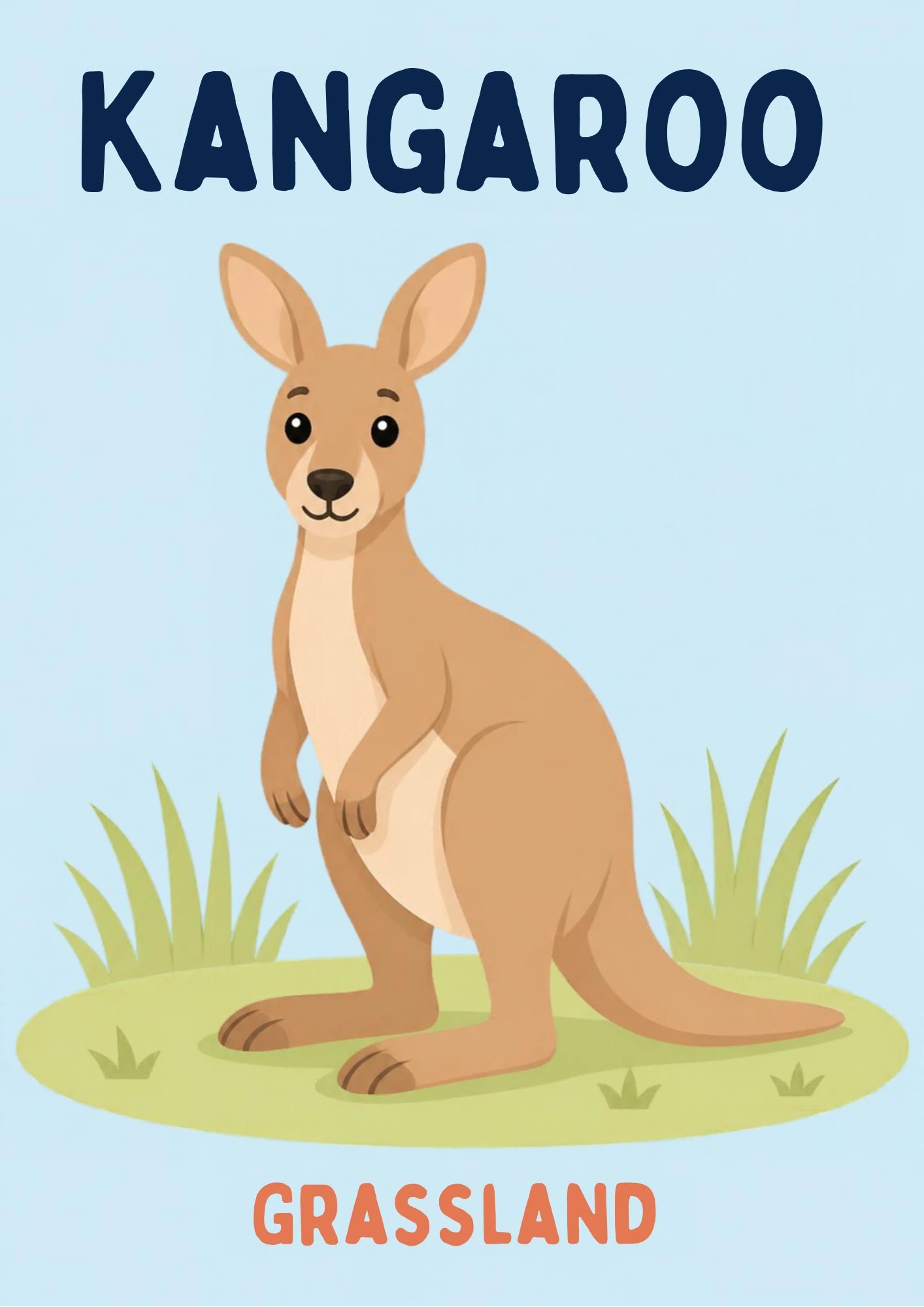
What is this?
The Australian grassland is wide open tussock country — clumps of coarse grass, scattered shrubs, endless sky. No forests to duck into, no corners to hide behind: a landscape of distance.
What does it mean?
In a home made of distance, slow feet go hungry. The kangaroo’s giant hind legs and springy tail make hopping cheaper the faster it goes — a living pogo that crosses the plains in great bounds. And the joey travels inside mum’s pouch: a moving bedroom on a bouncing mum, the safest seat on the grassland.
What does the child need to know?
Your child needs three kangaroo ideas: kangaroo country is open grass with far horizons; kangaroos hop — big feet and a balancing tail — and cannot walk backwards at all; and a joey baby rides in its mother’s pouch, drinking milk and peeking out.
Why this matters
The kangaroo answers a question every habitat asks — how do you move through THIS home? — with the funniest, bounciest answer in the set. It also sneaks in real physics: hopping is energy-saving at speed, backwards is impossible, and tails are balances, not extras.
What it teaches
Movement science (hop versus walk), energy ideas, body-part function (tail as prop and balance), and care concepts — the pouch as a first nursery, mother as transport, baby as passenger.
Words to learn
kangaroohoppouchjoeytailboundtussock
Say this to your child
“"The kangaroo lives on the open grassland. Its big feet are springs and its tail is a balance — it hops everywhere, faster and faster, and never walks backwards. Baby kangaroos ride along in the pouch, peeking out at the world."”
Step by step
- Show the card: "This is a kangaroo, and this is its home — the open grassland."
- Point at the legs: those feet are as long as the kangaroo’s arms — springs, built for bouncing across the miles.
- Reveal the two best facts in order: a kangaroo cannot walk backwards — try it yourself, the hop only goes forward — and the tail is a third leg for standing and steering.
- Tell the pouch story: a joey rides in mum’s pouch, popping its head out to watch the grass go by. A bedroom that hops.
- Hold the hop races (below) and close with the shape of the home: open country, long views, one bouncy specialist.
Look closer at the picture
On this card a tan kangaroo with tall ears, a cream belly and big long feet stands upright between clumps of spiky grass, tail resting behind it on the ground. The word "grassland" sits below — one kangaroo, standing tall in a home with nothing but grass and sky.
Ask your child
"How does a kangaroo move — walking or hopping?" "What are the big feet and the tail for?" "Can it walk backwards?" "Where does a joey ride?"
What your child can say or do
Your child might say: "It hops with its big springy feet," "Kangaroos can’t go backwards!" or the pouch line: "The baby rides in mum’s pouch and peeks out!"
Out in the real world
Two hops of kangaroo physics hide in daily life: a ball bounces higher the harder it is thrown (bigger hops cost less per metre), and stairs without a banister feel like open grassland — long views, no handrails, balance doing the work. Name both when you meet them.
Try it together
Hop-course: tape a start line and lay three "tussock" cushions across the room. Rules of the plains: hopping only, feet together, hands up as little paws — touch a cushion and it is a forward bound over it, never a step. Backwards is out of bounds — kangaroos cannot, and neither can the racers. Fastest joey to the far grass wins a peek-from-the-pouch rest.
Understanding check
Ask: "Where does a kangaroo live? How does it move and why? Where does the joey ride?" Grassland, hops on springy feet, in the pouch — three answers and the race is won.
Parent tips
The cannot-hop-backwards fact is the retell-forever fact — children verify it on their own bodies all week, and every failed backwards attempt re-teaches the lesson. If hopping indoors is too bouncy, ten slow-motion bounds with silent landings is the polite-kangaroo version.
This lesson pairs with the Kangaroo flashcard in the library — print it, show it, keep it on the fridge. Back to Animals & Their Habitats (Class 36).