
Zebra — a step-by-step lesson for grown-up and child
This lesson teaches what a grassland is and how the zebra survives one: no hiding places out in the open, so the zebra wears its hiding place — a moving crowd of stripes that melts every hunter’s aim.
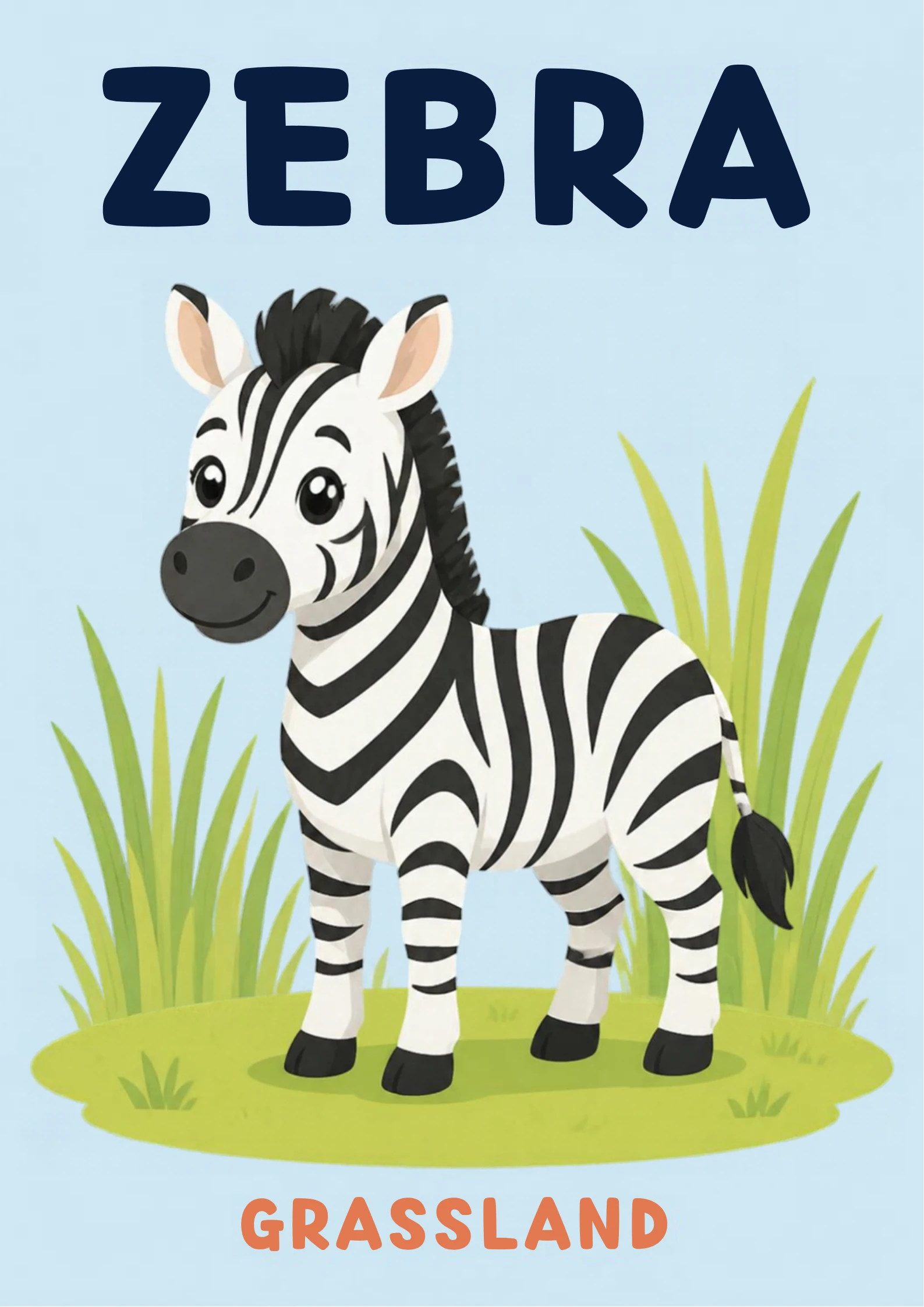
What is this?
A grassland is a huge stretch of grass with few trees and a sky that goes on forever — open, breezy country where grass grows taller than a toddler and herds can see trouble coming from far away.
What does it mean?
Out on the grassland there is nowhere to hide — so the zebras hide in each other. When a herd stands and moves together, the stripes run together into one flickering pattern, and a hunter’s eyes stop being able to say where one zebra ends and the next begins. The stripes also fit the light of tall grass: black, white and shadow-play.
What does the child need to know?
Your child needs three zebra ideas: grasslands are wide open grass countries with almost no trees; zebras live in herds and their stripes blur together when they move as one; and no two zebras share the same stripe pattern — each one is wearing its own name.
Why this matters
The zebra turns a weakness (nothing to hide behind) into the set’s most beautiful counter-trick, teaching children that safety can come from family togetherness as well as cover. It also plants the first "everyone is identifiable" idea: stripes like fingerprints.
What it teaches
Pattern and visual perception (what dazzles the eye), group behaviour (herd as shield), comparing open versus covered homes, and identity thinking — every zebra distinct, every pattern unique.
Words to learn
zebragrasslandherdstripesdazzletall grasshorizon
Say this to your child
“"The zebra lives on the grassland, where the grass grows tall and the sky goes on forever. There is nowhere to hide out here — so the zebras hide in each other! When they stand together, their stripes blur into one dazzle and nobody can tell where one zebra ends."”
Step by step
- Show the card: "This is a zebra, and this is its home — the grassland."
- Describe the openness: look how far the grass goes and how big the sky is. Out here there are no walls to hide behind — the zebra needs another trick.
- Do the dazzle demo (below): when many zebras stand together, their stripes run together like one wavy picture, and a hunter cannot tell where one zebra stops.
- Tell the name-secret: no two zebras wear the same stripes — a zebra knows its mummy in the herd by her pattern alone.
- Finish with herd stance: everyone huddles shoulder to shoulder, stripes together, faces out. That is the grassland trick: one pattern, many zebras.
Look closer at the picture
On this card a black-and-white striped zebra with a dark muzzle stands among tall green blades of grass that rise higher than its knees, under a soft pale sky. The word "grassland" sits below — one zebra, in grass, wearing a pattern as bold as its home is open.
Ask your child
"What does the grassland look like — full of trees or full of grass?" "Why do zebras stand together in a herd?" "How does a zebra know its mummy?" "What are the stripes doing when the herd runs?"
What your child can say or do
Your child might say: "It lives in the tall grass with the big sky," "The stripes dazzle the hunters!" or the identity line: "Every zebra has different stripes — like names!"
Out in the real world
Zebra-striped things are everywhere once you look: crossings, rugs, jerseys. At every one, ask the dazzle question — "could you count the zebras in that pattern?" — and watch the idea travel from card to street. A real-optical moment: hold a striped bag against other patterns and see which eye wins.
Try it together
Stripe wave: three or more players (or one child plus soft toys) each hold a striped thing — sock, ribbon, scarf — and shuffle side to side in a line. The counter, ten steps away, must say exactly how many stripes-owners there are. Moving stripes, miscounted. That is the herd, played.
Understanding check
Ask: "Where does the zebra live? What is its trick for staying safe? Do two zebras share stripes?" Grassland, herd dazzle, never — three answers and the lesson stands out plain as stripes.
Parent tips
If your child asks why lions do not just watch one zebra, give the honest version: sometimes they manage — but the dazzle makes every bite of watching harder, and out on the grassland, every extra second of confusion is a zebra saved. Nature’s tricks raise the odds; they do not promise miracles.
This lesson pairs with the Zebra flashcard in the library — print it, show it, keep it on the fridge. Back to Animals & Their Habitats (Class 36).