
Electrician — a step-by-step lesson for grown-up and child
This lesson names the person who tames electricity and installs the one rule that matters: children never touch plugs, wires or sockets.
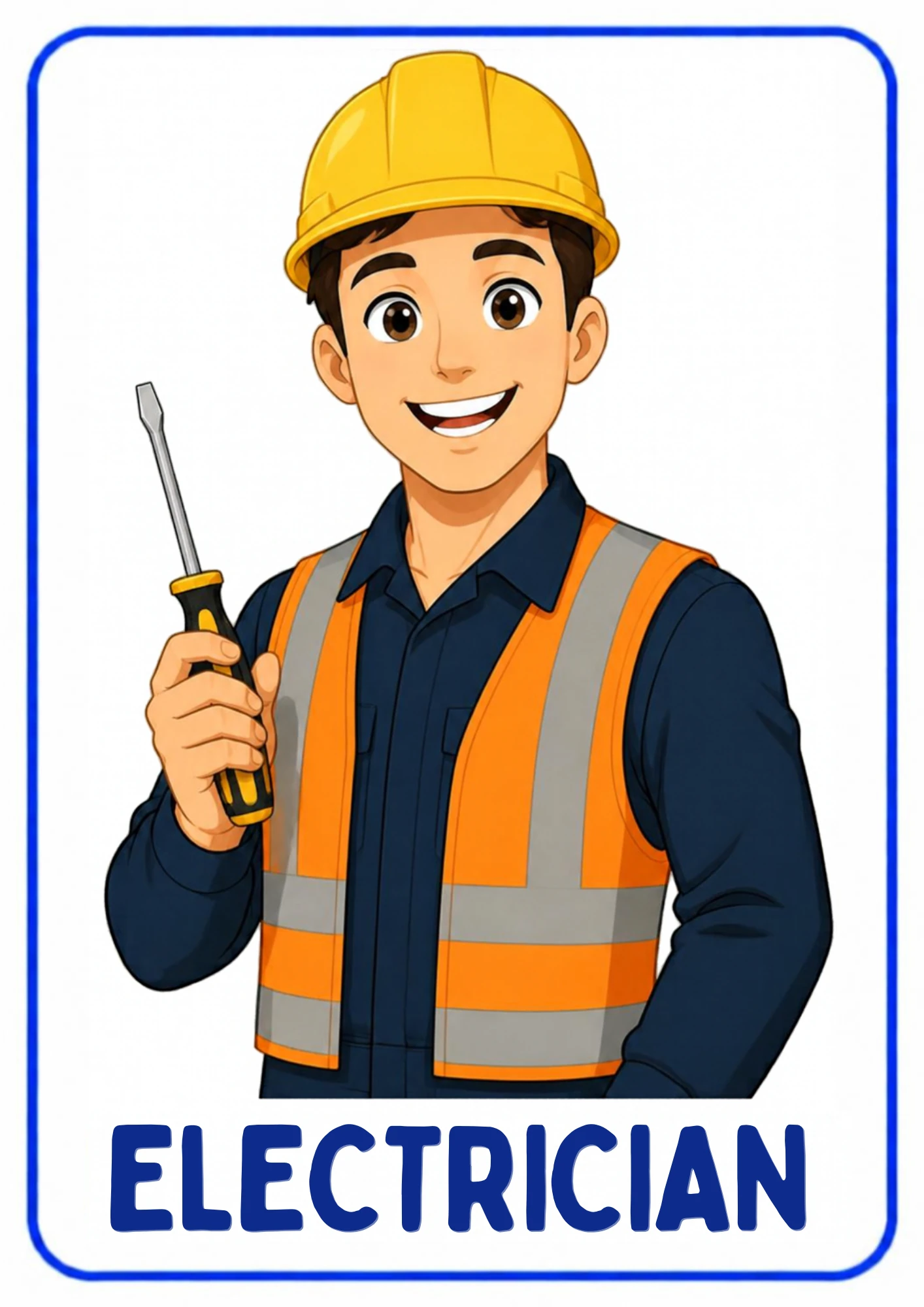
What is this?
An electrician is a power helper who works with wires and electricity — installing and fixing the power that lights our homes.
What does it mean?
Electricians run wires through walls, fit plugs, switches and lights, and test circuits with meters. They wear special gloves and follow strict safety rules, because electricity is powerful.
What does the child need to know?
Electricity rules for fours: sockets, wires and plugs are never touched or poked; water and electricity never mix; every spark, tingle or funny smell gets reported to a grown-up immediately.
Why this matters
"But WHY not?" deserves a real answer: electricity travels in wires like water in pipes, it is invisible, and it can hurt — so the electrician is the only one who opens those pipes.
What it teaches
Hazard recognition, rule-with-reasoning (which sticks!), report-reflex training, sorting skills (battery vs plug power), and respect for invisible forces.
Words to learn
electricianelectricitywireplugsocketsafety
Say this to your child
“"Electricians are the only ones who work with wires and plugs. We never touch sockets or cables — electricity is strong and invisible. If anything sparks or smells funny, we tell a grown-up straight away."”
Step by step
- Show the card: "This is an electrician. They work with electricity — the power that lights our lamps."
- Find the wires and tools. "Electricians wear special gloves and use testers — electricity is powerful, so they are careful."
- Explain it simply: electricity flows in wires like water in pipes. The electrician is the only person who may open those pipes.
- Install the rule with its reason: we never poke sockets or chew cables — not because we are in trouble, but because electricity BITES.
- Do the power hunt: what in this room runs on batteries, and what runs on plugs?
Look closer at the picture
Ask: what is the electrician holding? Can you find wires or a tester? What safety things is the electrician wearing? What might the electrician be fixing?
Ask your child
"Who may fix plugs and wires? Why do we never poke sockets? What runs on batteries in our home? What do we do if a cable looks broken?"
What your child can say or do
The rule, in full: "Sockets and wires are never for touching — I tell a grown-up instead." And the report line: "Come look — something is sparking/broken!"
Out in the real world
When an electrician visits, let your child watch the testing meter from a safe spot. Battery toys vs plug toys sorting happens naturally every playday.
Try it together
Power detective: tour one room and sort everything into "battery team" (torch, remote, toy) and "plug team" (lamp, TV, kettle). Draw both teams. The plug team gets a red paper "grown-ups only" sticker — drawn by your child.
Understanding check
Ask: "Who may touch wires and plugs? What do we do if a cable is broken? Can electricity and water play together?" Electrician-only + tell-a-grown-up + never = pass.
Parent tips
Answer "why?" with the water-in-pipes picture every time — reasoning survives better than prohibition. Never scare with horror stories; a calm, factual "electricity can hurt, so we have rules" is stronger.
Staying safe
Never poke sockets, chew cables or put anything into plugs. Water and electricity never mix — no bath toys near plugs. Report every spark, tingle or burnt smell immediately.
This lesson pairs with the Electrician flashcard in the library — print it, show it, keep it on the fridge. Back to Community Helpers & Our Neighborhood (Class 33).