
Plumber — a step-by-step lesson for grown-up and child
This lesson uncovers the hidden water roads under your home: who installs them, who fixes them, and why even a tiny drip gets reported.
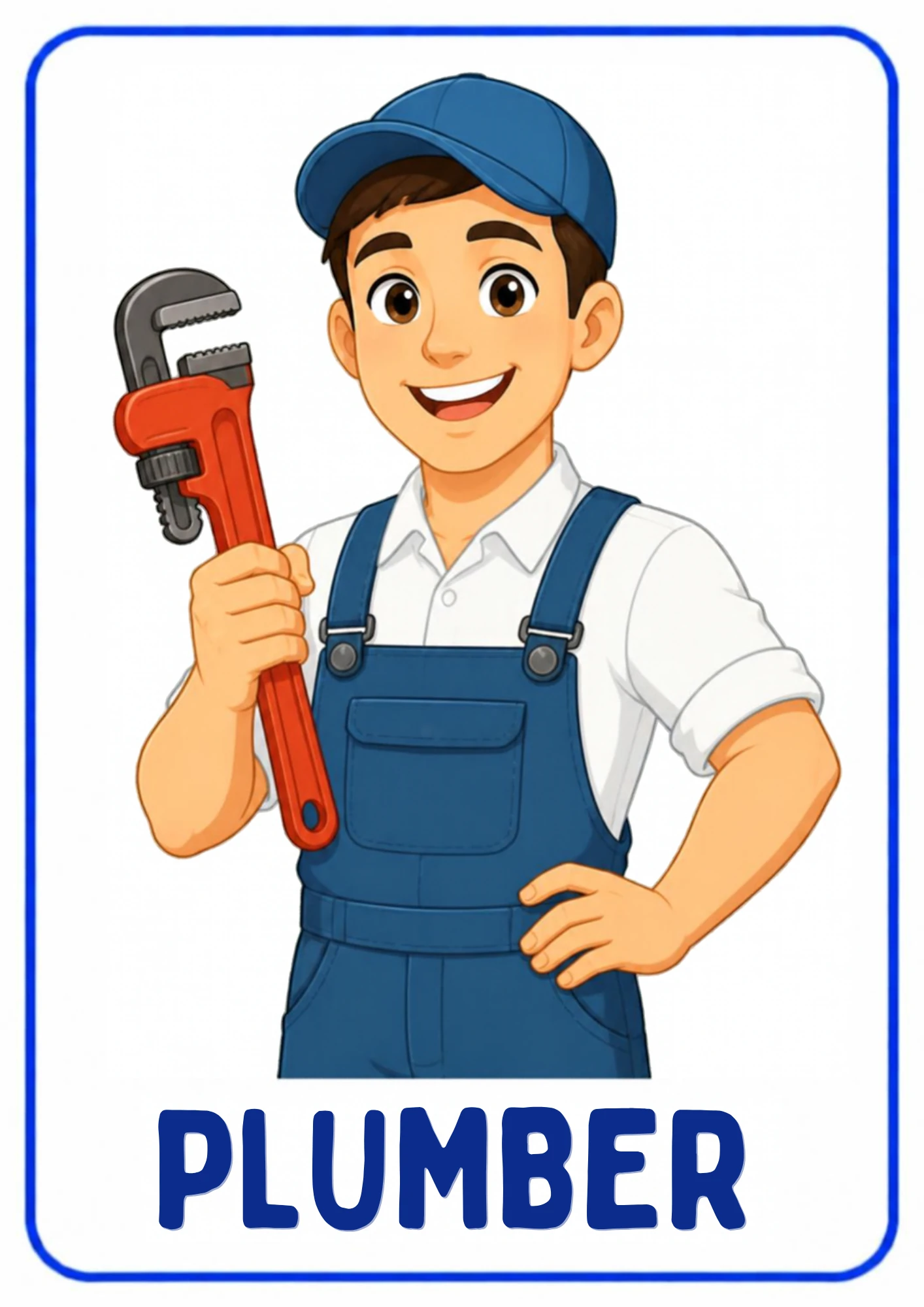
What is this?
A plumber is a water helper who works with pipes — installing sinks and taps, fixing leaks and keeping water flowing where it should.
What does it mean?
Plumbers crawl under sinks and along pipes with wrenches, tape, seals and a plunger. They fit pipes, fix blockages and test that water goes the right way — and only there.
What does the child need to know?
Water-system basics: clean water arrives through pipes, used water leaves through other pipes; drips and puddles get reported early; drains are not for poking things into.
Why this matters
Plumbing is invisible infrastructure your child uses ten times a day. Naming the system — and the person who fixes it — turns "where does the water GO?" into a story.
What it teaches
Systems thinking (in-pipes, out-pipes), cause-effect reasoning (drip today, puddle tomorrow), reporting responsibility, bath-time engineering play, and home-mapping.
Words to learn
plumberpipetapleakdrainwrench
Say this to your child
“"The plumber takes care of our water. Clean water arrives in pipes, used water leaves in pipes. If a tap drips or the floor is wet, we tell a grown-up so the plumber can fix it soon."”
Step by step
- Show the card: "This is a plumber. Plumbers take care of our water pipes."
- Find the pipes, the wrench, the tap. "The wrench turns big nuts that hold pipes together."
- Follow the water’s journey: pipe brings clean water to the tap → we use it → used water leaves through the drain → more pipes carry it away. Two directions, one system!
- Teach the drip rule: "A tiny drip is the pipe saying ‘fix me soon’ — we always tell a grown-up."
- Count the taps and pipes in your home; find the stop tap with a grown-up.
Look closer at the picture
Ask: what is the plumber fixing? Can you find a wrench or a pipe? Is the water running or dripping? What tools would a plumber carry?
Ask your child
"Who fixes our pipes? Where does water come from — and where does it go? What do we do about a drip? What should never go into a drain?"
What your child can say or do
The report line: "Drip drip — come look, the tap needs the plumber!" And the drain rule: "Only water goes down the drain."
Out in the real world
Under-sink safari (cabinet open, together): find the U-bend and the pipes. Every tap and toilet is plumbing your child already uses — name the system each time.
Try it together
Bath pipe-works: pool-noodle pipes cut in half, funnels, cups and jugs. Build routes from the tap-end to the bucket-end: which path carries the most water? Where does it leak? You are doing real plumbing.
Understanding check
Ask: "Who fixes pipes and leaks? What do we do when we see a drip? Do toys go down the drain?" Plumber + report + never = pass.
Parent tips
Report drips the same day and let your child hear you phone the plumber — early reporting is the actual lesson. Keep a small "fix-it list" on the fridge; your child can draw the dripping tap as item one.
Staying safe
Wet floors are slippery — report every puddle, do not splash-test it. Nothing poked into drains or taps, ever; that is the plumber’s job with real tools.
This lesson pairs with the Plumber flashcard in the library — print it, show it, keep it on the fridge. Back to Community Helpers & Our Neighborhood (Class 33).