
Sanitation Worker — a step-by-step lesson for grown-up and child
This lesson follows the bin truck’s route: who empties our bins, where "away" actually is, and how sorting recyclables becomes a daily family game.
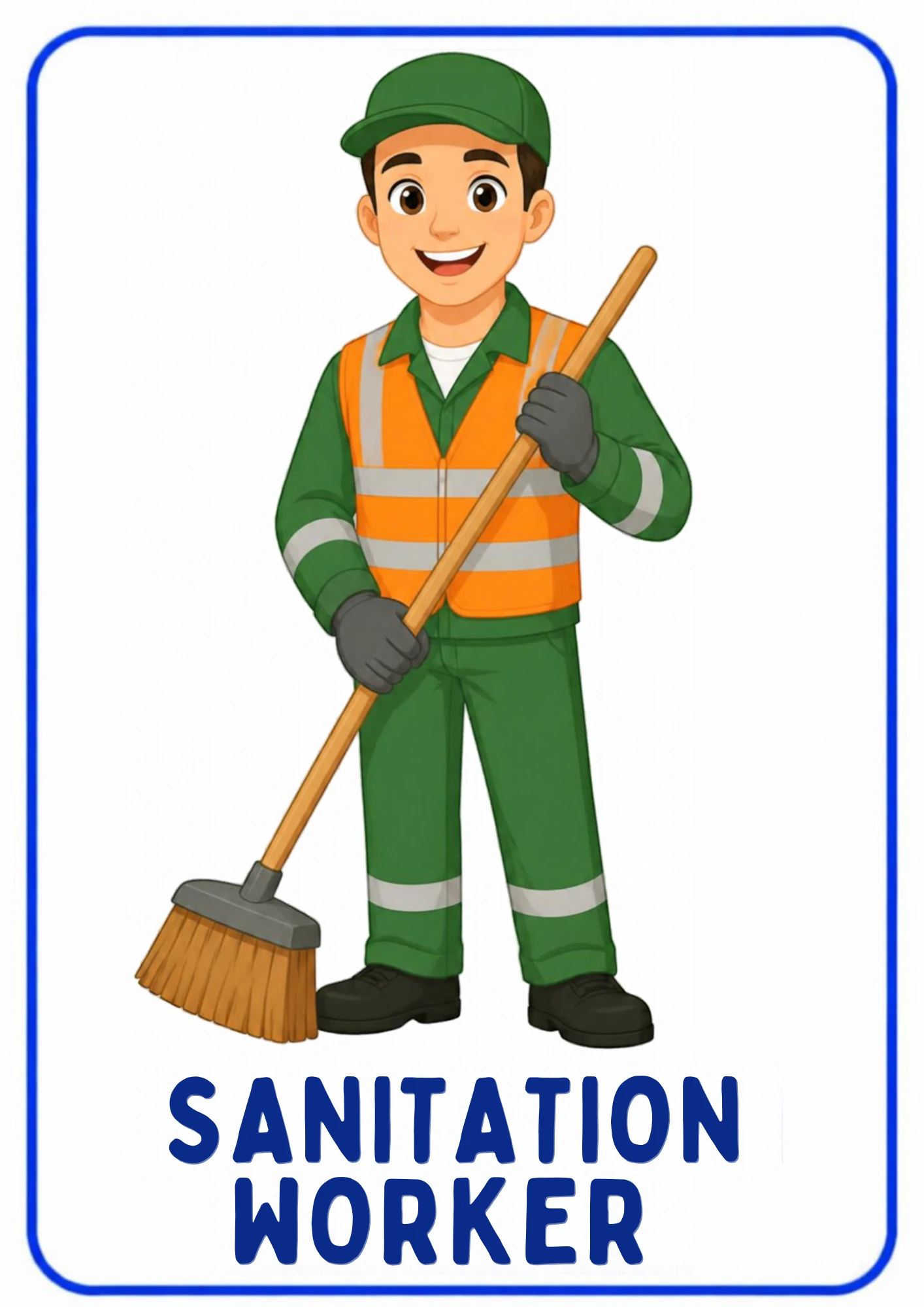
What is this?
A sanitation worker is a cleaning helper who collects our bins and waste so the neighborhood stays clean and healthy.
What does it mean?
Sanitation workers drive big collection trucks along a route, lifting and emptying bins — some trucks have robot arms! They collect recycling separately so it can be made into new things.
What does the child need to know?
Waste know-how for fours: rubbish does not vanish — helpers carry it away; recycling goes in its own bin; trucks are big, loud and cannot see small people.
Why this matters
Every child adores bin day. Naming the workers and the route turns adoration into gratitude and habits — and 'throw it away' becomes 'put it in the bin for the helpers'.
What it teaches
Sorting and classifying (the recycling game is real cognitive work), calendar sense (which day is bin day?), gratitude for invisible work, and truck-safety habits.
Words to learn
sanitation workerrubbishrecyclingbinroutecollect
Say this to your child
“"The sanitation worker keeps our street clean by taking the rubbish away. Recycling goes in its own bin so it can become something new — and on bin day we watch from far back and wave."”
Step by step
- Show the card: "This is a sanitation worker. They take our rubbish away and keep our street clean."
- Find the truck, the bins, the lifting arms. "The truck is strong enough to lift our whole bin — look!"
- Follow the journey: bin by our gate → truck lifts and tips → the rubbish rides away → recycling gets sorted and made NEW.
- Introduce the sorting idea: paper, plastic, everything else — three bins, three teams.
- Learn bin day: mark it on the calendar, put the bin out together the night before.
Look closer at the picture
Ask: what is the truck lifting? Can you find the driver and the helper? Which bin is for recycling? What colours do you see on the truck?
Ask your child
"Who empties our bins? Where does rubbish go after the truck? What goes in the recycling bin? What day is bin day?"
What your child can say or do
The sort call-out while playing: "Paper team! Plastic team!" And the bin-day line: "The truck is coming — let’s watch from the window."
Out in the real world
Bin day from the window (safely far back): lifting, tipping, crushing — theatre! Visit a recycling point and let your child post bottles into the bank; the clunk is deeply satisfying.
Try it together
Three-bin sorting game: clean "waste" from the recycling drawer (paper, card, plastic bottles). Three boxes, relay race, count each team’s score. Wrong bin? No scolding — "rescue it!" is part of the game.
Understanding check
Ask: "Who takes our rubbish away? Where does recycling go? What do we do when the truck comes — run to it or watch from far back?" Workers + recycling + far-back = pass.
Parent tips
Praise the invisible: "someone emptied six streets before breakfast — that is strong, kind work". Recycling confusion is normal; keep the rule simple and let your council’s guide settle the details.
Staying safe
Collection trucks are huge with blind spots — watch from the window or far back on the kerb, never near or behind the truck. Wash hands after touching bins.
This lesson pairs with the Sanitation Worker flashcard in the library — print it, show it, keep it on the fridge. Back to Community Helpers & Our Neighborhood (Class 33).