
Firefighter — solve it right on the sheet.
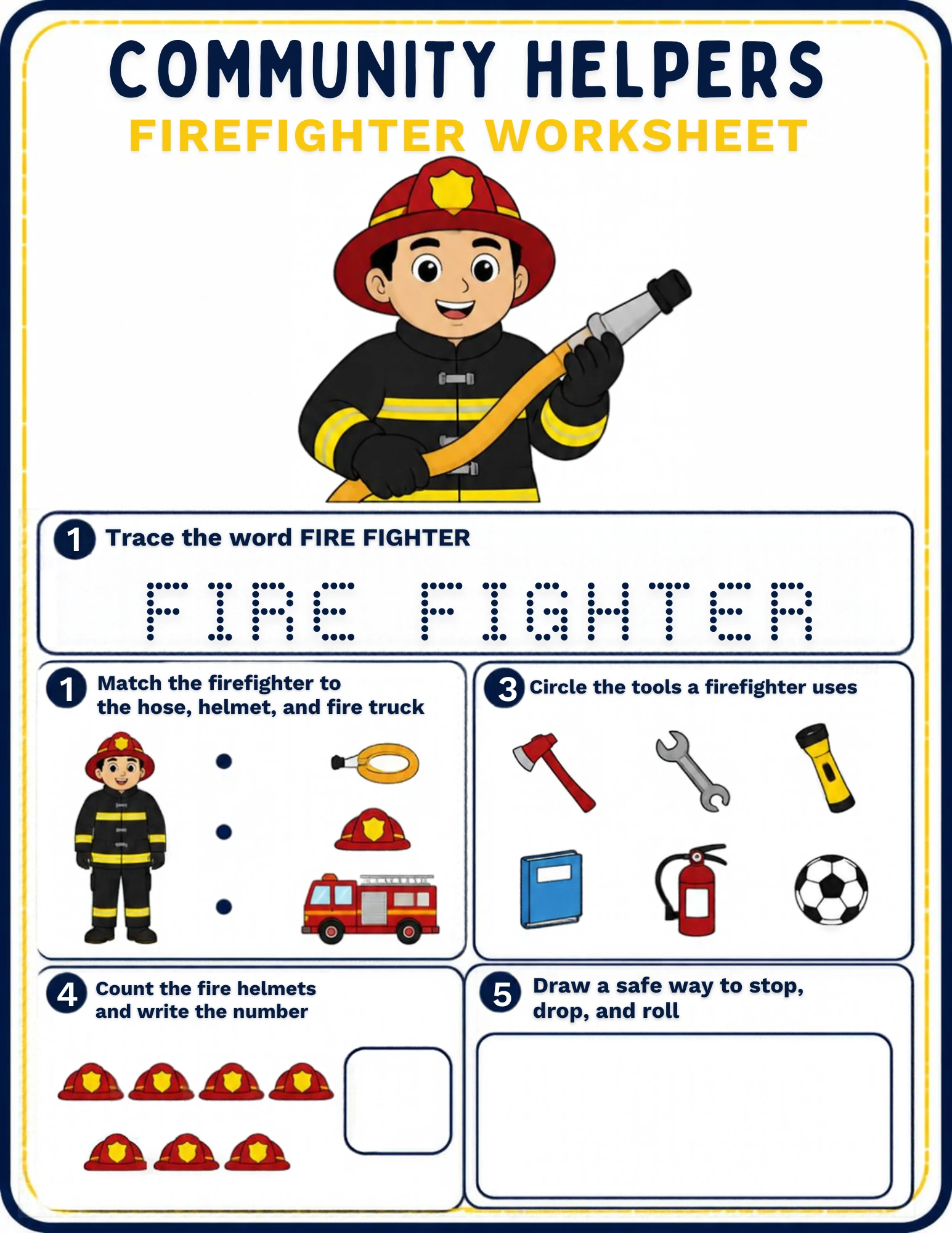
Trace FIRE FIGHTER, match the firefighter to the hose, helmet and fire truck, circle the tools a firefighter uses, count the fire helmets and draw stop-drop-and-roll.
Your sheet is ready.
Pick a color or the eraser, then trace, match, circle, count and draw straight on the sheet with your finger, a stylus or the mouse. Press Save my work when you are proud — that is what marks this activity cleared for your child.
What this worksheet teaches.
What the child is learning: What a firefighter wears and carries, which tools fight fires, and the emergency move every child should own: stop, drop and roll.
Knowledge to have ready: Before starting, name the gear together: the helmet protects the head, the hose carries water, the truck rushes everything to the fire. Explain stop-drop-and-roll in one sentence — if clothes ever catch fire, we stop, drop to the ground, and roll until the fire is out.
Why this activity matters: Fire safety is a skill with real stakes, and rehearsal is what makes it stick. The tool grid sharpens "who uses what" thinking, the helmet count is gentle number practice, and the draw box lets your child rehearse the emergency move with their own hands.
- Emergency vocabulary
- Tool matching
- Stop-drop-and-roll rehearsal
- Counting to 7
- Word tracing
- Safety drawing
What to say before you start: "This is a firefighter. Trace the two words, then connect him to his hose, his helmet and his truck. Now look at the six tools — a firefighter carries some of them, but a couple belong to a mechanic or a student. Count the helmets with your finger, and then draw the safety move: stop, drop, and roll."
What to look for on the sheet: Find the yellow stripes on the firefighter’s coat and the badge on the helmet — real gear details to spot. In the grid, ask which tool sprays water and which one would fix a car instead. In the count row, helmets point in different directions; touch each one so none is counted twice.
Questions to ask along the way: "What does the hose carry?" "Why does a firefighter wear a helmet?" "Which two tools in the grid are NOT for fighting fires?" "Show me stop, drop, and roll — can you do it on the carpet?"
Helpful hints without giving it away: If the grid stalls, sort out loud: "sprays water, chops, lights the dark, puts out small fires — what’s left?" For the count, group the helmets into the top row and the bottom row first, then add the groups.
Parent tips: Practise stop-drop-and-roll for real on a carpet after the sheet — the body remembers what the pencil rehearses. Never make fire scary-for-fun: firefighters are helpers, and practicing the move is what keeps children safe.
Understanding check: Ask: "What do firefighters spray from the hose? Show me stop-drop-and-roll. How many helmets?" Water, the move, the count = the sheet landed.
Real-life practice: Visit the drawing at bedtime: ask your child to SHOW the whole family how to stop, drop, and roll. Where is your family’s smoke alarm? Let your child find it — real maps of real safety.
This activity belongs to Class 33 — Community Helpers & Our Neighborhood on the Learning Path. Progress is saved on this device for the child chosen in My Classroom — and only a real save of finished work marks it cleared, never just opening the page.
How did it go?
One tap, no writing, no name. Pick the face that matches how it went — reactions are counted instantly and stay anonymous.
Parent reviews.
A different thing from the quick faces above: a star rating for the grown-ups, plus an optional line about how it went. Every review is read by the school office before it appears.
No parent reviews yet — yours could be the first.
Parent comments.
How did you use this page Share the game, the moment or the trick that worked in your house. Comments are read by the school office before they appear, and they are about your ideas — never about your child.
No parent comments yet — yours could be the first.