
Doctor — solve it right on the sheet.
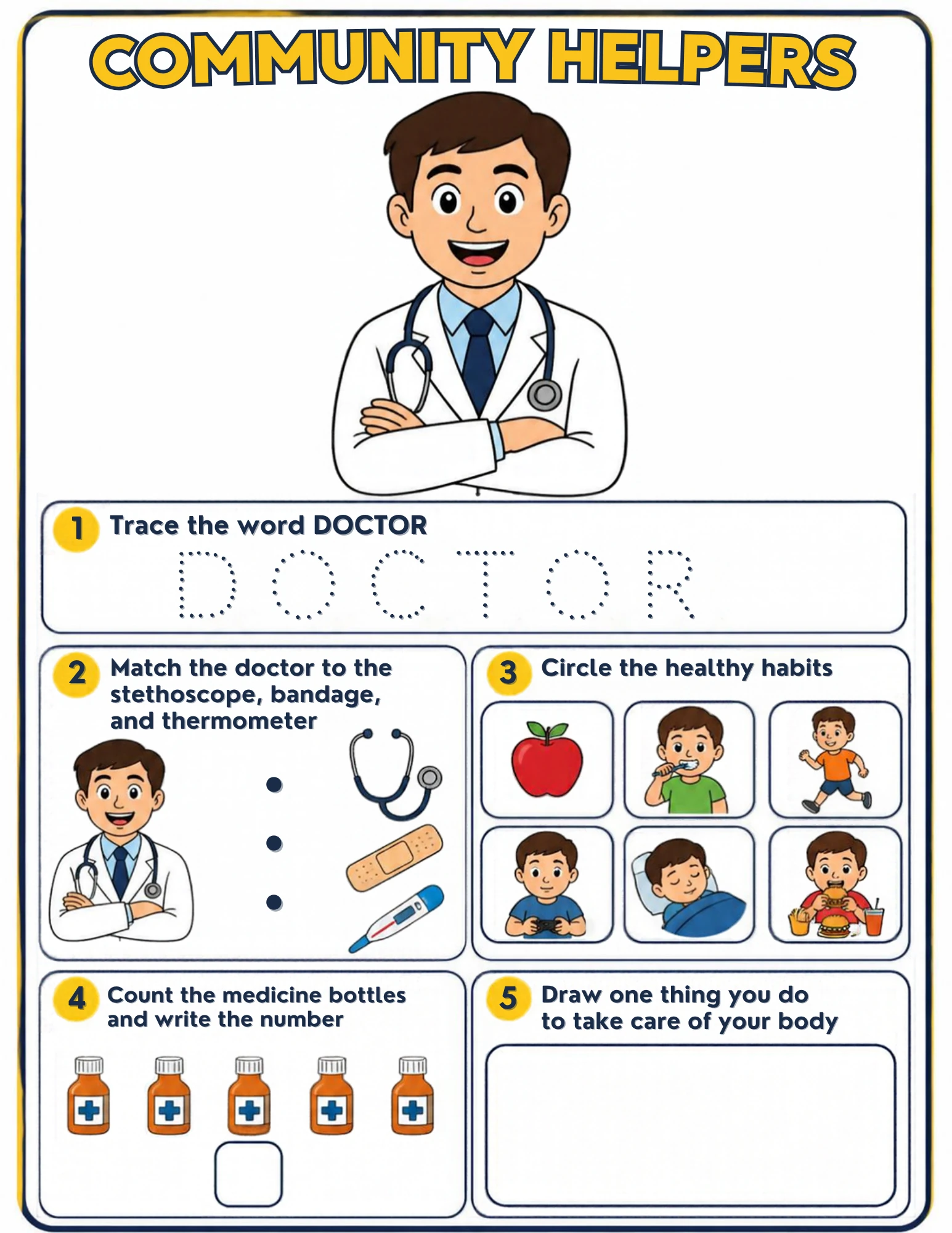
Trace DOCTOR, match the doctor to the stethoscope, bandage and thermometer, circle the healthy habits, count the medicine bottles and draw one way you care for your body.
Your sheet is ready.
Pick a color or the eraser, then trace, match, circle, count and draw straight on the sheet with your finger, a stylus or the mouse. Press Save my work when you are proud — that is what marks this activity cleared for your child.
What this worksheet teaches.
What the child is learning: What a doctor’s tools are for, which everyday habits keep bodies healthy, and how to read and write the word DOCTOR.
Knowledge to have ready: Your child needs a little vocabulary first: a doctor helps sick and hurt people, a stethoscope listens to heartbeats, a bandage protects a healing cut, and a thermometer checks temperature. Say each tool’s name before the pencil starts.
Why this activity matters: Doctors become familiar instead of frightening when children meet their tools on paper first. The healthy-habit grid also turns the worksheet into a gentle health talk, and the tracing row builds the same pre-writing muscles the alphabet class uses.
- Community helper vocabulary
- Tool matching
- Healthy-habit awareness
- Counting to 5
- Word tracing
- Drawing from life
What to say before you start: "This is a doctor — his tools help him take care of people. Trace his name, then find the three tools that belong with him. Now look at the six pictures: which ones show something healthy? Count the bottles slowly with your finger, and finish by drawing how YOU keep your body strong."
What to look for on the sheet: Point at the big picture together: the doctor wears a white coat and a blue tie and a stethoscope around his neck. In the match row, ask which tool would listen to a heartbeat. In the grid, ask your child to explain WHY a picture is or is not a healthy habit.
Questions to ask along the way: "Which doctor’s tool listens to your heart?" "Why do we wash hands before seeing the doctor?" "Which of the six habits do you do every day?" "What number did the medicine bottles count up to?"
Helpful hints without giving it away: If a match line is hard, name the tools first and ask what each one touches. In the circle row, the tricky tiles are the ones that look fun — ask "does this help your body or just feel fun right now?" Count the bottles with one touch per bottle so the count stays honest.
Parent tips: Keep doctor talk friendly and honest — doctors help, and saying how you feel to a doctor is always allowed. Let your child own the pencil: the tracing can be wobbly and the drawing messy; the thinking is the work.
Understanding check: Ask: "Which tool listens to the heart? Name one healthy habit from the grid. How many bottles?" Right tool, one habit, the right count = the sheet landed.
Real-life practice: Walk the healthy-habit grid at home today: the apple at snack time, the teeth brushing tonight, the running in the yard. Real repetition is what turns a circled picture into a habit.
This activity belongs to Class 33 — Community Helpers & Our Neighborhood on the Learning Path. Progress is saved on this device for the child chosen in My Classroom — and only a real save of finished work marks it cleared, never just opening the page.
How did it go?
One tap, no writing, no name. Pick the face that matches how it went — reactions are counted instantly and stay anonymous.
Parent reviews.
A different thing from the quick faces above: a star rating for the grown-ups, plus an optional line about how it went. Every review is read by the school office before it appears.
No parent reviews yet — yours could be the first.
Parent comments.
How did you use this page Share the game, the moment or the trick that worked in your house. Comments are read by the school office before they appear, and they are about your ideas — never about your child.
No parent comments yet — yours could be the first.