
Flight Attendant — solve it right on the sheet.
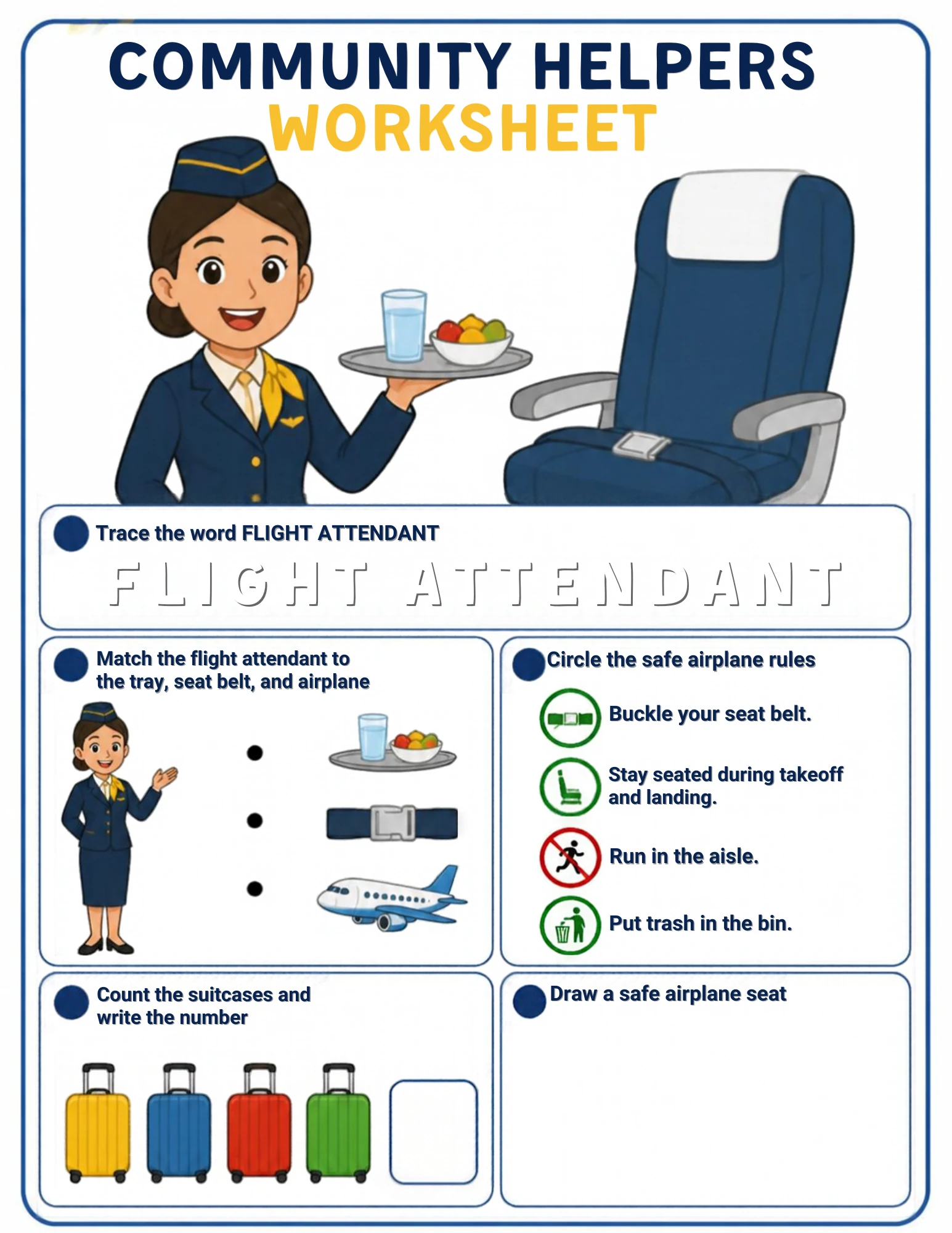
Trace FLIGHT ATTENDANT, match the flight attendant to the tray, the seat belt and the airplane, circle the safe airplane rules, count the suitcases and draw a safe airplane seat.
Your sheet is ready.
Pick a color or the eraser, then trace, match, circle, count and draw straight on the sheet with your finger, a stylus or the mouse. Press Save my work when you are proud — that is what marks this activity cleared for your child.
What this worksheet teaches.
What the child is learning: What a flight attendant does for passengers, the four rules of flying safely, and which rules are safe and which are not — plus how to write the words FLIGHT ATTENDANT.
Knowledge to have ready: The flight attendant takes care of everyone aboard: the tray carries meals and drinks down the aisle, the seat belt keeps every body snug for takeoff and landing, and the crew’s gentle voice is the one to listen to. Aisles are for walking only — and never during takeoff!
Why this activity matters: The cabin crew are the sky’s crossing guards: their rules keep a whole plane of wiggly travelers safe. Sorting the safe rules from the silly one lets your child rehearse the real flight before it happens — and giving the rules a face makes them easy to follow.
- Airport vocabulary
- Tool matching
- Flying-safety rules
- Safe-versus-unsafe sorting
- Word tracing
- Seat drawing
What to say before you start: "This is a flight attendant — she takes care of everyone on the airplane. Trace the two words, then connect the tray, the seat belt and the airplane. Now the four rules: which are safe? Count the suitcases slowly, and then draw you in a safe seat, belt clicked and ready to fly."
What to look for on the sheet: Find the tray and ask what travels on it — juice, meals, and sometimes a smile. In the grid, read each rule aloud and act the safe ones out: hands click an imaginary belt, bottoms sit tall. Let your child catch the aisle-run rule with a big NO.
Questions to ask along the way: "What does the flight attendant carry on the tray?" "Which three rules are safe?" "Why do we stay seated for takeoff and landing?" "What does the seat belt sound like when it clicks?"
Helpful hints without giving it away: Three rules keep every flyer snug and one rule would tumble a tray — the unsafe one happens in the aisle. Read all four out loud: safe rules sound steady, and the silly one sounds fast.
Parent tips: On your next flight, introduce your child to a crew member and let them show off the belt — the crew are the rules’ own grown-ups, and children follow a face better than a lecture. Trash in the bin, tray folded: the whole sheet, lived.
Understanding check: Ask: "Who takes care of passengers in the sky? Name two safe flying rules. Is running in the aisle safe or unsafe?" The crew, two rules, unsafe = the sheet landed.
Real-life practice: Rehearse with a kitchen chair: sit tall, click an imaginary belt, fold the tray, ask to move — grown-up style. Then fly it to the living room. The whole sheet, landed softly on the carpet.
This activity belongs to Class 33 — Community Helpers & Our Neighborhood on the Learning Path. Progress is saved on this device for the child chosen in My Classroom — and only a real save of finished work marks it cleared, never just opening the page.
How did it go?
One tap, no writing, no name. Pick the face that matches how it went — reactions are counted instantly and stay anonymous.
Parent reviews.
A different thing from the quick faces above: a star rating for the grown-ups, plus an optional line about how it went. Every review is read by the school office before it appears.
No parent reviews yet — yours could be the first.
Parent comments.
How did you use this page Share the game, the moment or the trick that worked in your house. Comments are read by the school office before they appear, and they are about your ideas — never about your child.
No parent comments yet — yours could be the first.